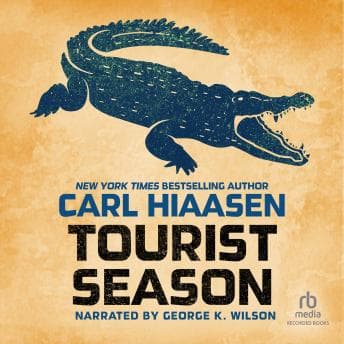

Everyone told me Hiaasen was the gold standard for Florida absurdism. The guy who makes you laugh while making you deeply uncomfortable about what capitalism does to swampland. So I came in expecting Skinny Dip-level chaos and... well. Let me explain.
I was halfway through prepping a chana masala — onions caramelizing, whole spices hitting hot oil, that perfect moment where the kitchen smells like my grandmother's house — when Skip Wiley started unraveling in my earbuds. And I found myself asking: why does Hiaasen's supposedly "deranged journalist" feel less like a psychological portrait and more like a cartoon with a megaphone?
Skip Wiley Is the Patient I'd Refer Out
Here's the thing about writing a character who's supposedly brilliant but unhinged: you have to make the brilliance credible before you earn the unhinged part. Skip Wiley, the rogue newspaper columnist who orchestrates a bizarre eco-terrorist campaign against Miami tourism, exhibits classic narcissistic grandiosity — the performative manifestos, the need for an audience, the belief that his violence is righteous because he's the one doing it. That tracks. Narcissists absolutely do build movements around their wounded egos and call it ideology.
But Hiaasen keeps Wiley at arm's length. We get the spectacle — feeding a tourist to a crocodile, mailing body parts, the escalating absurdity — without ever really sitting inside Wiley's fractured logic long enough for it to feel dangerous. Compare that to, say, Tom Ripley, where Highsmith makes you complicit in the rationalization. Wiley's terrorism reads more like a sketch comedy bit that occasionally remembers it involves murder. The research actually shows that radicalization follows recognizable psychological pathways — isolation, grievance narratives, incremental boundary violations. Hiaasen gestures at this but never commits.
And then there's Brian Keyes, our lovesick detective protagonist, who's supposed to be our moral center. Psychologically, this doesn't track. He's presented as competent but keeps making decisions that serve the plot rather than his established character. His obsession with his ex-girlfriend Jenna — who is involved with Wiley — should be the emotional engine of the story. Instead it feels like Hiaasen needed a reason for Keyes to stay connected to the villain and picked "ex-girlfriend" from a hat.
14 Hours Is a Lot of Hours for a Book That Doesn't End
Let's talk pacing. At 14 hours and 9 minutes, Tourist Season asks for a substantial time commitment. The first few hours? Genuinely fun. Hiaasen's satirical eye for Miami's grotesqueries is sharp — the real estate developers who'd pave the Everglades for a condo, the Chamber of Commerce types who treat human deaths as PR problems. This is a fascinating case study in how a place can become a character, and Hiaasen does that well.
But somewhere around the middle third, the momentum stalls. The terrorist plot, which starts as a darkly funny premise, becomes repetitive — another victim, another escalation, another scene of authorities being bumbling. I was jogging through Cambridge by this point (my therapist says exercise helps, and honestly the November cold was keeping me more alert than the plot was) and I caught myself zoning out during a stretch that should have been building tension toward the Orange Bowl Parade climax.
And that ending. Multiple listeners have flagged this, and they're right — it feels like Hiaasen just... stopped. Not in a deliberate, ambiguous literary way. More like a "my editor called and said it was due" way. The Orange Bowl sequence has energy, sure, but the resolution for Keyes is rushed and the fates of several characters feel arbitrary rather than earned.
George Wilson Warms Up Eventually (Emphasis on Eventually)
George Wilson's narration is a slow burn in the literal sense — it took me a solid two hours to stop being aware of the performance and just listen. His handling of the large cast is competent; you can distinguish between characters, which given Hiaasen's ensemble is no small feat. But "competent" is the ceiling here. There's no vocal performance that made me think "oh, that's who this person is." For a book this dependent on eccentric personalities — a Seminole elder, a retired football player turned revolutionary, various shady Miami operators — I wanted more texture. More weirdness in the delivery to match the weirdness on the page.
I'd recommend bumping the speed to 1.25x, honestly. It tightens Wilson's slightly languorous pacing and makes the saggy middle section more bearable.
Who Gets a Ticket to This Tourist Season
If you're already a Hiaasen devotee, you'll find the DNA of his better books here — the environmental rage dressed up as comedy, the Florida-specific absurdism. But if you're new to Hiaasen? Start with Skinny Dip or Sick Puppy instead. Tourist Season is a first novel that reads like a first novel: promising ideas, uneven execution, characters who are types rather than people.
If you need your fictional criminals to have psychologically coherent motivations — and I do, that's literally my whole thing — you'll spend chunks of this audiobook arguing with the author in your head. Which, fine, that's also my whole thing. But I'd rather argue with a book that's trying to be complex than one that's settled for being wacky.
My Therapist Would Say I'm Projecting My Dissertation Frustrations Onto This Book (She'd Be Half Right)
Hiaasen understands that Florida is inherently unhinged and that satire just requires accurate reporting. That's a genuine insight, and it carries Tourist Season further than its plotting deserves. But understanding a place isn't the same as understanding the people in it, and that's where this book — and this audiobook specifically, with Wilson's adequate-but-not-electric narration — left me wanting. Worth a listen if it's already in your library rotation. Worth a credit? I'd save it for something sharper.