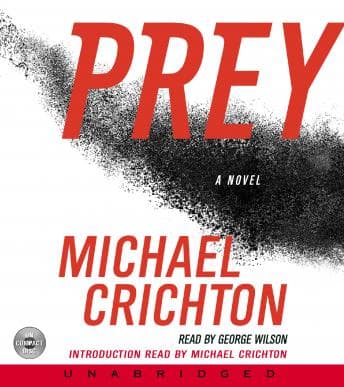

Look, I need to rant about something. Michael Crichton wrote a 400-page novel about nanotechnology where the protagonist — a software engineer — keeps making decisions that no actual software engineer would ever make. I'm talking about a guy who supposedly wrote predator-prey algorithms and then acts shocked when the swarm he programmed to be a predator starts... being a predator. Jack, buddy, you literally wrote the code. I was on the 6:47AM Caltrain, barely conscious, and even I was yelling internally at this man.
But here's the thing. I still finished it in three commutes. And I'm not even mad about it.
Crichton's Favorite Move: The Science Lecture That Actually Slaps
If you've read Jurassic Park or The Andromeda Strain, you know the formula. Crichton front-loads the book with a genuinely fascinating science primer — in this case, emergent behavior, genetic algorithms, and distributed agent systems — then drops characters into a contained environment where that science goes sideways. Prey follows the template so faithfully it's almost a design pattern at this point. (See what I did there.)
The first few hours are domestic drama. Jack Forman is a stay-at-home dad, recently laid off, suspecting his wife Julia of having an affair. It's slow. It's mundane. And honestly? Kevin texted me during hour two asking what I was listening to and I said "a marital drama about a guy doing laundry" which is technically accurate. But Crichton's doing something sneaky — he's seeding the nanotechnology concepts through Jack's internal monologue about his old work, and by the time you get to the Nevada desert facility where everything goes wrong, you actually understand how a self-replicating nano-swarm could evolve predatory behavior. The science holds up. Or at least, it held up in 2002 when this was published, and it's still plausible enough that I wasn't rolling my eyes.
Where it breaks down is predictability. By the time Jack arrives at the Xymos facility and starts noticing that his wife's colleagues are acting weird — evasive, secretive, weirdly aggressive — you can see the third-act twist coming from roughly hour four. I'm not going to spoil it, but if you've ever watched a body horror movie, you already know. Crichton basically telegraphs it with all the subtlety of a production alert at 2AM.
George Wilson Does the Heavy Lifting
Here's where the audiobook earns its keep. George Wilson has this clean, no-nonsense delivery that's perfectly suited to Crichton's expository style. The man carries pages and pages of explanation about distributed intelligence and bacterial evolution without it ever feeling like a lecture — which is wild because it IS a lecture. His voice has this steady, almost dry quality that reminded me a bit of a senior engineer walking you through a post-mortem. Matter of fact. Confident. Here's what happened, here's why, here's why we're all screwed.
Character differentiation is adequate — he gives Julia a slightly sharper edge, and there's a nice warmth to the scenes with Jack's kids early on — but this isn't a book that demands vocal range. It's fundamentally one man's POV racing against a clock, and Wilson nails the escalating tension without ever going melodramatic. Clean audio, even modulation, no weird pronunciation hiccups on the technical terms. Solid B+ narration on a B- book.
The Predictability Problem (And Why I Still Kept Listening)
Okay so here's my honest assessment. The swarm sequences in the desert are genuinely tense — there's a scene where Jack and two other scientists are running from the nanocloud at night and their flashlights are basically useless because the swarm adapts to light in real time. That's good stuff. Your lizard brain kicks in and the 1.5x speed feels right because you want to know if they make it back.
But the interpersonal drama inside the facility is where Crichton loses me. The characters beyond Jack are thin. Mae is "the competent one." Ricky is "the obviously suspicious one." Bobby is "the one who exists to explain things." They're functions, not people. And the resolution relies on Jack basically speedrunning a solution using knowledge he conveniently has from his career — which, as a software engineer, I can tell you is both unrealistic and deeply flattering to our profession.
This is basically Jurassic Park but for nanotechnology. Same structure, same hubris-of-science theme, same "nature finds a way" DNA. Just less memorable. No Ian Malcolm equivalent carrying the philosophical weight. No set pieces as iconic as the T-Rex paddock scene.
The Commute Verdict
Perfect for: train, gym. Skip for: deep work.
The ROI on this audiobook is decent but not spectacular. 12 hours and 52 minutes of competent techno-thriller that'll keep you awake on the early train and teach you some real concepts about swarm intelligence. George Wilson makes the medicine go down smooth. But if you're spending a credit and you haven't read Jurassic Park or The Andromeda Strain yet? Go there first. Prey is the third deployment of a proven architecture — it works, but the original was better.
Would I listen again? No. Am I glad I listened? Yeah, actually. Sometimes a predictable thriller with real science underneath is exactly what the 6AM commute needs. HALO: Hunters in the Dark scratches a similar itch — competent genre fiction that doesn't demand your full brain but rewards you for showing up.