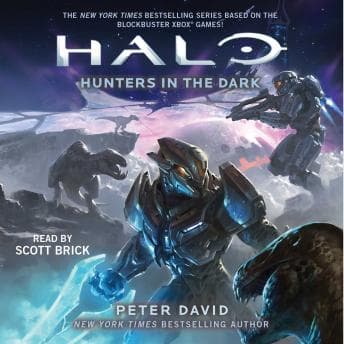

Look, I'll be honest - I went into this one expecting filler. The Halo expanded universe has this reputation problem where people assume everything that isn't Nylund or Staten is basically licensed fan fiction. And yeah, Hunters in the Dark isn't going to dethrone Fall of Reach anytime soon. But here's the thing: I was up until 2 AM on a Tuesday, thesis document open in another tab (untouched, obviously), completely locked into a joint Spartan-Elite mission on the Ark. That's not nothing.
Peter David does something clever here that I genuinely appreciated - he leans into the post-war awkwardness between humans and Sangheili. This isn't a buddy cop comedy where everyone's cracking jokes by hour three. These are species that spent thirty years trying to exterminate each other, and now they're sharing a dropship. The tension is chef's kiss. There's this scene where an Elite and a human are basically sizing each other up, and you can feel the weight of all that history pressing down on the moment. It's not subtle, but it works.
When Your Former Enemies Are Your Only Backup
The character progression is surprisingly solid for a tie-in novel. You've got your standard Spartan badassery, but the Elites get actual depth here - motivations, honor codes, the whole Sangheili package. It's giving me serious D&D party vibes, honestly. Like when you throw together a paladin and a reformed warlock and just watch the roleplay unfold. My D&D group would absolutely love the dynamic between these factions. The "we hate each other but we hate extinction more" energy is peak cooperative storytelling.
The Ark itself is basically a character, which - if you've played Halo 3 - you already know is this impossibly massive Forerunner installation floating outside the galaxy. That same sense of overwhelming scale shows up in 1986 - Book 3: At the End of Time, where the setting becomes as important as the characters navigating it. David doesn't skimp on the scale. You get that sense of ancient, incomprehensible technology that makes the Forerunners so compelling. Is it Sanderson-level world-building? No. But it's doing the work, building on established lore while adding enough new wrinkles to justify the story's existence.
Scott Brick Doing Scott Brick Things
Here's where I have to give credit where it's due. Scott Brick is one of those narrators who just gets military sci-fi. His delivery has this gravitas that sells the stakes without going full melodrama. The climactic showdown at the Ark hits harder because of how he modulates the tension - he's not screaming at you, but you can hear the weight in his voice. One listener quote I came across said his narration was "more engaging than reading the book," and honestly? I believe it. The guy knows how to make exposition feel like revelation.
That said, character differentiation isn't his strongest suit here. The humans blend together vocally more than I'd like, and while the Elites get a bit more distinction (that alien formality in their speech patterns), you're not getting Tim Gerard Reynolds-level character separation. It's a minor gripe. Brick's dramatic reading carries the load.
Roll for Initiative (Or Don't)
If you're a Halo lore junkie who's played the games and wants more universe content, this is a solid eleven hours. If you've never touched Halo and just want good military sci-fi, you might be lost - there's a lot of assumed knowledge about Covenant politics, Forerunner artifacts, and the whole thirty-year war. David doesn't hold your hand, which I respect, but newcomers will feel it. For straightforward military sci-fi without the lore baggage, Sabotage in Space delivers action without requiring a wiki open in another tab.
The pacing is steady rather than explosive. This isn't wall-to-wall action; there's genuine character work and political maneuvering. If you need constant firefights, you might find the middle sections drag. I didn't, but I also genuinely enjoy watching former enemies learn to work together. (Probably says something about my campaign preferences.) Skip this if you're looking for nonstop combat or have zero Halo background - you'll spend more time confused than entertained.
Campaign Complete?
Here's my honest take: Hunters in the Dark is a good Halo novel, not a great one. It's exactly what it promises - a covert mission with high stakes and interesting faction dynamics. Scott Brick elevates the material. The Ark setting delivers that sense of scale and mystery the franchise does so well. But it's not transcendent. It's not going to convert non-fans.
For Halo faithful? Absolutely worth your time. For everyone else? Maybe wait for a sale or catch it on your streaming service of choice. I don't regret the eleven hours - which is more than I can say for most of my thesis "research" sessions.