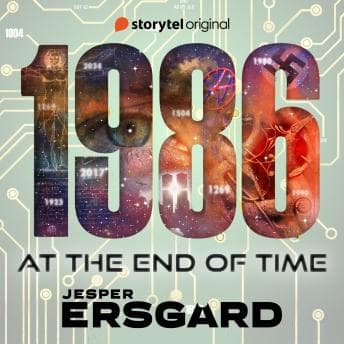

This series absolutely wrecked my thesis timeline. Three books, roughly 30 hours of time travel thriller, and exactly zero pages written for Dr. Patel. Worth it.
At the End of Time is the finale of Jesper Ersgård's 1986 trilogy, and it lands the ending in a way that time travel stories rarely manage. You know how most time travel plots eventually collapse under the weight of their own paradoxes? Ersgård actually thought this through. The Velotri mechanics - the system that lets Elias jump through time - have consistent rules that pay off across all three books. It's the kind of internal logic that makes a fantasy nerd like me deeply happy.
When Everything Goes Sideways
So here's where we're at: Elias knows the truth about himself now. He tried to save his parents in 1963 and failed - Diana outmaneuvered him completely. His only option is to jump forward, way into the future, to finally figure out who Diana is and what she wants.
But first, Maja's stuck in the 1960s. Elias has finally learned enough control over the Velotri to attempt bringing her back to 1986 with him. A tandem time jump.
It goes wrong. Badly wrong.
They make it to 1986, but something's happened to Maja, and I actually stopped mid-walk on my usual campus route because I needed a second. Just stood there like an idiot outside the engineering building, processing. The way Ersgård handles consequences is brutal - Elias is getting stronger, understanding his abilities better, but everything around him keeps breaking. That tension between power growth and personal cost? My D&D group would eat this up. It's exactly the kind of stakes that make character progression feel earned rather than cheap.
John Chancer Knows What He's Doing
I hadn't encountered much of Chancer's work before this trilogy, but the guy gets it. His approach is deliberate - not flashy, not showy, just clear and dramatic in the right moments. He knows when to let tension build slowly and when to push harder. The interpretation feels natural rather than performed, if that makes sense.
Now, fair warning: some listeners found the pacing too slow. I listened at 1.0x because I was enjoying the world-building (and avoiding my thesis, but that's beside the point), but if you typically speed up audiobooks, bumping to 1.25x might work better for you. The narration is measured and intentional. That worked for me. Might not work for everyone.
A few reviews mentioned the characters felt dense. I'm not sure I agree, but I understand where it's coming from. Elias makes choices that seem frustrating in the moment - but they track. He's a guy who's been through impossible things making decisions under impossible pressure. That reads as realistic to me, not dense.
The Comparison That Keeps Coming Up
If you've watched Dark on Netflix or read Blake Crouch's time travel stuff, you'll recognize the vibe here. Though honestly, if you want pure sci-fi spectacle on a massive scale, Battlefield Earth goes in the complete opposite direction—less psychological tension, way more explosions. But Ersgård brings something distinctly Scandinavian to it - there's a thriller sensibility that feels different from American sci-fi. Tighter, maybe. More focused on psychological tension than spectacle.
Ersgård is apparently one of the authors behind Black Star, which is now firmly on my list. The guy clearly understands how to write for audio specifically. These books feel designed to be listened to, not awkwardly adapted from print. The suspense builds in ways that work because you're experiencing them in real-time through your earbuds.
The Diana mystery kept me guessing across all three books. I had theories. Most of them were wrong. That's exactly what I want - to feel engaged enough to speculate but not so far ahead that the reveals feel obvious.
Should You Jump In?
If you're into sci-fi thrillers with actual internal logic to the time travel mechanics, absolutely. If you need fast-paced narration, maybe sample first and see if Chancer's style clicks for you. But honestly, most people who enjoy this genre will probably get hooked.
Nine and a half hours for this finale, roughly 30 for the whole trilogy. It's a commitment. But if you're the type who appreciates when an author actually thinks through the rules of their speculative elements, it pays off.
Now if you'll excuse me, I have a thesis chapter that's been "in progress" for six weeks and a copy of Black Star that just showed up in my library queue.