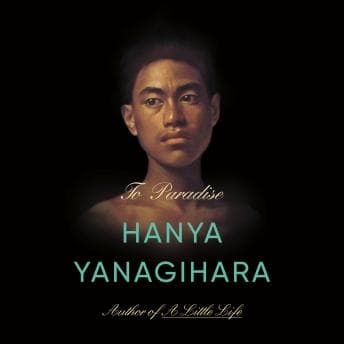

Look, I'm supposed to be writing my thesis on procedural generation. Dr. Patel sent me another email yesterday with the subject line "Checking In (Again)." Instead of responding, I started a 29-hour audiobook about alternate Americas and totalitarian futures. My priorities are impeccable.
Here's the thing about To Paradise that nobody warned me about: this isn't really a fantasy novel. I know, I know—it's shelved in Science Fiction & Fantasy, there's an alternate 1893 where New York is part of the "Free States," and the 2093 section has plagues and authoritarian governments. But if you're coming in expecting Sanderson-level world-building with hard magic systems and detailed maps, you're going to have a bad time. This is literary fiction wearing speculative fiction's clothes, and once I made peace with that, I fell completely into it.
Three Americas That Rhyme (Or: Why Your Thesis Can Wait)
Yanagihara does something genuinely clever here—she creates three distinct versions of America across three centuries, and they echo each other in ways that kept me pausing my code to just... think. The 1893 section imagines a New York where same-sex relationships are legal and normalized, which sounds utopian until you realize the social hierarchies and family pressures are just as suffocating. The 1993 section hits the AIDS epidemic head-on with a young Hawaiian man hiding his past from his wealthy older partner. And 2093? That's the one that made me miss my bus stop twice—a post-pandemic totalitarian state where a scientist's granddaughter tries to piece together her husband's secrets.
I'll be honest: the first section was a slog. Other listeners have said the same thing, and they're not wrong. The alternate history feels undercooked—Yanagihara sets up this fascinating premise about the Free States and then doesn't really do much with it. The protagonist is hard to root for. I almost bailed around hour four. But something kept me going, and by the time I hit the 1993 section, I understood why people call this a symphony. The recurring motifs—Washington Square, illness, the desperate need to protect loved ones—they build on each other until the 2093 section hits you like a truck you didn't see coming.
Five Narrators, Zero Weak Links
This is where the audiobook format genuinely elevates the material. Five narrators handle different characters across the three sections, and the casting is chef's kiss. BD Wong's performance in the 2093 section is the kind of thing you remember years later—haunting doesn't cover it. There's this melancholic quality to Kurt Kanazawa's work that perfectly captures his character's emotional ambivalence, that sense of being trapped between grief and numbness.
Catherine Ho and Feodor Chin round out the cast beautifully. Chin voices a father figure with this weight of responsibility that comes through in every line. And Ho? Her sections hit different when you're listening at 2 AM because you can't sleep and definitely aren't thinking about your thesis deadline. The full cast approach means you never lose track of who's speaking, which matters when you're 20 hours deep and the timeline connections are clicking into place.
The Emotional Damage Report
If you've read A Little Life, you know Yanagihara doesn't pull punches. That same emotional devastation shows up in Little Men, though Alcott's version comes wrapped in 19th-century propriety instead of modern rawness. To Paradise is less brutal in some ways but more insidious in others. The content warnings are real—violence, abuse, sexual content—but the real damage is quieter. It's the slow realization that every version of paradise these characters chase is fundamentally broken. It's watching people try to protect each other and fail. It's understanding, by the end, that the longing for utopia might be the most human thing there is.
My D&D group would probably not love this. It's not escapist fantasy. There are no dragons, no progression systems, no satisfying power-ups. But if you're in the mood for something that sits with you, that makes you stare at your ceiling at 3 AM thinking about what America means and whether any version of it could ever be truly free—yeah, this is that book.
Who Should Commit 29 Hours (And Who Should Run)
This is for literary fiction fans who don't mind speculative elements, not the other way around. If you need fast pacing and tight plots, skip it. If you bounced off A Little Life, this won't convert you. If you're looking for background listening while gaming, absolutely not—you'll miss the connections between sections that make the whole thing work.
But if you want something ambitious, something that rewards your attention, something that five incredible narrators pour their souls into? Clear your schedule. Tell your advisor you're "working on your literature review." (She doesn't need to know what literature.)
Roll for Emotional Damage: Natural 20
I finished To Paradise at 4 AM on a Tuesday. I did not respond to Dr. Patel's email. I did think about family, and loss, and how every generation tries to build something better and mostly just builds something different. The audiobook format—with its distinct voices for each section, its 29-hour commitment that forces you to live with these characters—is genuinely the best way to experience this. BD Wong alone is worth the credit.
Just don't expect Sanderson. Expect to feel things you weren't planning to feel.