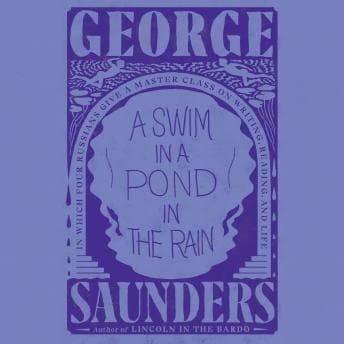

"We're going to enter seven fastidiously constructed scale models of the world." That's Saunders in the introduction, and when I heard it - walking the lakefront with Denise on a Saturday morning cold enough to make my ears ring - I actually stopped walking. She asked if I was okay. I was better than okay. I was hearing someone describe exactly what I've been trying to tell my students for twenty years, only he said it better than I ever have.
Here's the thing about this book that the casual listener needs to understand upfront: this is not a novel. This is not even really a collection of short stories, though it contains seven of them. This is George Saunders sitting you down in his Syracuse MFA classroom and walking you through Chekhov, Turgenev, Tolstoy, and Gogol with the patience of someone who genuinely believes these dead Russians still have something urgent to tell us. And he's right. He's annoyingly, beautifully right.
The Professor You Wish You'd Had
Saunders narrates his own essays, and his voice carries this quality I can only describe as academic passion without academic pretension. He sounds like a guy who's been thinking about Chekhov's "In the Cart" for decades and still gets a little giddy about it. There's an easy humor to his delivery - he'll be deep in analysis about how a story's escalation works, then pull back with a self-aware joke that keeps you from feeling lectured at. As someone who lectures for a living, I'm taking notes. (Literally. I have a Notes app full of timestamps I made while pretending to review midterm essays.)
But the real trick of this audiobook - the thing that makes it worth the audio format over print - is the cast reading the stories themselves. Nick Offerman reads Turgenev's "The Singers" and leans into the natural comedy of it with this sly, unhurried timing that makes you realize Turgenev was funnier than anyone ever told you in your undergrad survey course. Keith David handles Tolstoy's "Master and Man" with this meticulous pacing - he knows exactly when to slow down and let a sentence breathe, when to let the cold of the Russian steppe settle into the silence between words. The narrator understands that pause is punctuation. Both of them do.
Phylicia Rashad. Glenn Close. Renée Elise Goldsberry. BD Wong. Rainn Wilson. These aren't celebrity vanity readings. Each performer brings genuine interpretive choices to their story. It's like watching seven different directors stage the same playwright - you learn as much from the performance choices as you do from Saunders' analysis that follows.
Why Your Brain Needs to Be Awake for This
Let me be honest about something: some listeners have called this "too much like a school text." And I get it. I do. Because it IS a school text - it's literally adapted from a class Saunders has been teaching for twenty years. The structure is: read a story, then Saunders unpacks it. Read another story, unpack it. Sometimes he stops a story partway through and asks you to predict what happens next, which is a teaching technique I use with my juniors and which works just as well when you're a 48-year-old man walking past Navy Pier.
This is not background listening. You cannot half-pay-attention to this while scrolling your phone. (I tried during a particularly brutal stack of sophomore essays at 11 PM. Had to rewind twenty minutes.) The analysis sections demand focus because Saunders is building an argument about how fiction works at the sentence level - how each line either earns the reader's continued attention or loses it. He talks about stories as "page-turn machines" and then shows you the gears.
My students would hate this. I love it.
But here's where I push back on the "too academic" crowd: Saunders keeps circling back to life. Not just craft. Life. He uses these stories to ask questions about kindness, about self-deception, about what it means to actually pay attention to another human being. The Gogol story - "The Nose," read with perfect absurdist energy by the cast - becomes a launching pad for Saunders to talk about how we construct identity. The Chekhov stories become lessons in empathy that feel more urgent than any TED talk.
Who Should Clear Their Schedule
If you've ever wondered why we still read the classics - genuinely wondered, not just nodded along when your English teacher said so - this is your answer. If you write, even casually, even just emails you care about, Saunders' framework for thinking about escalation and specificity will change how you approach a blank page.
If you want a story to get lost in, this isn't it. If you need fast pacing and plot momentum, you'll bounce off this hard. And if you're the kind of listener who treats audiobooks as ambient noise while doing dishes - respect, but not this one.
This reminds me of what Hemingway said about prose being architecture. Saunders shows you the blueprints, the load-bearing walls, the reason this door opens onto that room. And he does it with enough warmth and humor that you don't feel like you're in a lecture hall. You feel like you're in a good conversation.
At 14 hours and 44 minutes, it's a commitment. Worth every minute. The prose deserves to be savored. The closest thing I've encountered to that same slow, intentional attention is Newcomer, which asks you to sit with ordinary moments the same way Saunders asks you to sit with a Chekhov sentence.
Worth Pausing the Faculty Meeting For
I've listened to plenty of writing books. Most of them make me feel like I should be writing. This one made me feel like I should be reading - more carefully, more generously, with more willingness to sit with a sentence and ask what it's actually doing. Saunders gave me back something I didn't realize I'd lost after twenty years of teaching: the belief that close reading isn't just an academic exercise. It's a way of being alive.
Principal Martinez, if you're reading this, I promise my next faculty meeting will have my full attention. (It won't. I'm starting the Chekhov stories over.)