
What if the secret to workplace happiness isn't another productivity hack or a corner office, but something your parents figured out in their dry cleaning shop forty years ago?
I was prepping for a client meeting at 6 AM—one of those "we need to pivot our culture" startups that thinks ping pong tables solve burnout—when I put this on. Six hours later, I had notes for the client and a mild existential crisis about my own career trajectory. Not a bad Tuesday.
The Dalai Lama Meets McKinsey (Sort Of)
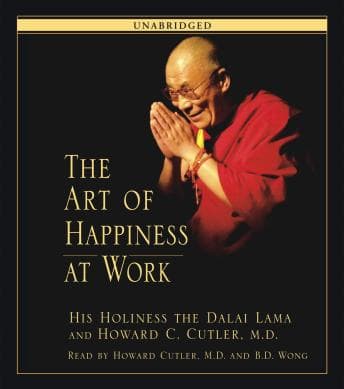
Here's the framework that actually matters: survival, career, calling. Three levels of work motivation. Simple enough that my parents understood it instinctively—they were operating at survival level for years, then gradually shifted toward something resembling calling as they built community through their business. Now it has a book deal and B.D. Wong doing a Chinese accent.
The accent thing—look, I'll be honest. First twenty minutes, I was skeptical. Wong affecting the Dalai Lama's voice felt like it could go very wrong. But he commits to it fully, and somehow it works. You stop noticing the performance and start hearing the wisdom. The man won a Tony for a reason.
What doesn't work? Howard Cutler narrating himself. And I say this as someone who's sat through thousands of hours of monotone consultant presentations. Cutler sounds like he's reading a teleprompter at a shareholder meeting. Every. Single. Word. Delivered. With. The. Same. Weight. Jenny would say I'm being harsh. Jenny is right. But also—I'm right.
The ROI Section: Self-Awareness and Work Identity
Skip to the sections on self-awareness and work identity. That's where the value lives.
The Dalai Lama's point about our misery being tied to over-identifying with our jobs? I've seen this fail at three different companies. Founders who couldn't separate their self-worth from their startup's valuation. Senior partners who retired and literally didn't know who they were anymore. The book doesn't offer a twelve-step solution, but it reframes the problem in a way that's actually useful.
What frustrated me: Cutler's questions sometimes feel like he's setting up softballs. The psychiatrist-spiritual leader dynamic could've created more productive tension. Instead, you get a lot of "Yes, and here's another way to think about that..." It's collegial. It's respectful. It's occasionally boring.
At 2.0x speed, this became tolerable. At 1.0x, Cutler's monotone would've had me switching to a podcast.
Who Gets Value Here (And Who Doesn't)
If you're in crisis mode—just got laid off, hate your job, questioning everything—this is actually solid. The Dalai Lama's perspective on impermanence and work applies whether you're a CEO or a barista. That universality is rare in business books.
If you're looking for tactical advice on salary negotiation or career advancement? Wrong book. This is philosophy, not strategy. Skip it.
If you're a consultant like me, there's something almost meta about listening to Eastern wisdom while billing by the hour. Make of that what you will.
Two Narrators, Two Very Different Experiences
B.D. Wong: 4 out of 5. Engaging, committed, occasionally moving.
Howard Cutler: 2 out of 5. Functional at best, sleep-inducing at worst.
The contrast is jarring. You'll be genuinely interested in the Dalai Lama's perspective, then Cutler comes in with his nasally monotone and you're reaching for the +15 seconds button. It's like a business book co-authored by someone who understands audiobook performance and someone who... wrote a book.
Worth Your Commute, Not Your Full Attention
My parents worked fourteen-hour days at that dry cleaning shop. They didn't need a book to tell them work could be meaningful—they made it meaningful through sheer will and community connection. But they also didn't have language for why some days felt like survival and other days felt like purpose. Character explores similar territory around what makes work meaningful, though from a more Western philosophical angle.
This book provides that language. It's not revolutionary, but it's grounding. The framework is simple enough to actually remember and apply. And B.D. Wong's performance elevates material that could've been a slog. For a different take on self-optimization that's equally grounded but more tactical, Bulletproof Diet applies similar first-principles thinking to physical performance.
Just... speed it up when Cutler's talking. Trust me.