
Bottom Line: Worth your commute if you treat it like a podcast playlist, not a cohesive book.
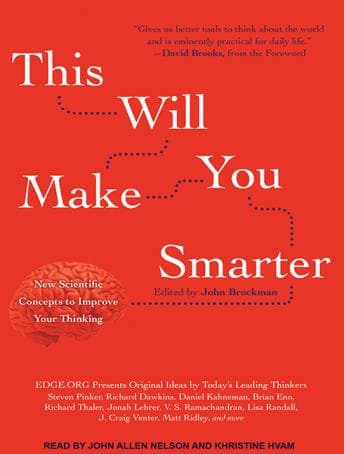
So here's the thing about essay collections—they're basically the audiobook equivalent of a conference talk compilation. Some sessions blow your mind, some make you check your phone, and a few have you questioning why you paid for the ticket. This Will Make You Smarter is exactly that, except the conference is Edge.org and the speakers are people like Daniel Kahneman, Steven Pinker, and Richard Dawkins. The ROI on this audiobook is... complicated.
I finished this over about two weeks of commutes, and honestly? The format worked perfectly for the Caltrain zombie shuffle. Each essay is short enough that you can absorb one between stations, and if a particular thinker loses you (looking at you, overly abstract philosophy tangents), another one's coming in ten minutes.
The Buffet Problem
Here's my main issue: when you cram 150+ thinkers into 12 hours, you get breadth at the expense of depth. Daniel Kahneman's bit on the focusing illusion? Brilliant, but it's basically a teaser for Thinking, Fast and Slow. I got that same "wait, there's a whole book on this?" feeling from Business Adventures, where each chapter teases deeper business concepts without fully unpacking them. Nicholas Carr on cognitive load? Super relevant to anyone drowning in Slack notifications (so, all of us), but it's a blog post worth of content.
Some essays genuinely expanded my mental models—the stuff on path dependence from John McWhorter actually changed how I think about legacy code decisions at work. Radium Girls had a similar impact on how I think about corporate risk management, though it gets there through narrative instead of theory. Others felt like intellectual throat-clearing.
The science actually holds up, mostly. These are real researchers sharing real concepts, not pop-sci fluff. But the quality variance is wild. One essay will have you pausing to jot notes, the next will have you zoning out somewhere around Millbrae station.
Two Narrators, Two Vibes
John Allen Nelson and Khristine Hvam split the narration duties, and this is where it gets interesting. Nelson has that authoritative NPR-adjacent delivery that works great for the denser scientific content. Hvam brings a slightly warmer tone. The switching between them actually helped me stay engaged—it's like having two podcast hosts instead of one droning voice for 12 hours.
That said, I saw some reviews complaining about finding the narration off-putting. I didn't have that experience, but I also listen at 1.5x, which tends to smooth out any pacing issues. At normal speed? Yeah, I could see some of the more abstract essays feeling like a lecture you didn't sign up for.
Production is clean. No weird audio artifacts, no jarring transitions between essays. Professional stuff.
Best For: Caltrain, Gym, Dishwashing
This is basically a TED Talk playlist for your ears. Perfect for semi-distracted listening where you can tune in and out. I'd catch myself really locked in during the behavioral economics content (Kahneman, Thaler), then mentally drafting code reviews during some of the more philosophical entries.
The 80/20 rule essay by Clay Shirky was ironic, because that's basically how I experienced this book—20% of the essays delivered 80% of the value. But that 20% was genuinely good. The bits on cognitive load, collective intelligence, and living with uncertainty (Lawrence Krauss) actually gave me frameworks I've used since.
Who This Is (and Isn't) For
If you want narrative, skip. If you want a single coherent argument building across chapters, skip. If you're sensitive to the "could've been a blog post" phenomenon, definitely skip—this is literally a collection of what are essentially long-form tweets from smart people.
But if you're the type who listens to optimization podcasts and actually enjoys when someone explains a mental model in 8 minutes? This is your jam. I found myself wishing I could rate individual essays instead of the whole thing, because my experience ranged from "oh that's genuinely useful" to "okay, we get it, you're smart."
Speed recommendation: 1.25x minimum. Some of the slower essays really benefit from the tempo boost. At 1.5x, I got through it in about 8 hours of commute time, which felt right.
Treat It Like a Reference Library
Would I listen again? Probably not straight through. But I've already gone back to specific essays when I wanted to revisit a concept. That's honestly the best use case—treat it like a reference library you can dip into, not a book you finish and shelve.




![Steve Jobs [unabridged audiobook] audiobook cover](/_next/image?url=https%3A%2F%2Fcovers.audiobooks.com%2Fimages%2Fcovers%2Ffull%2F9788499923406.jpg&w=1920&q=75)