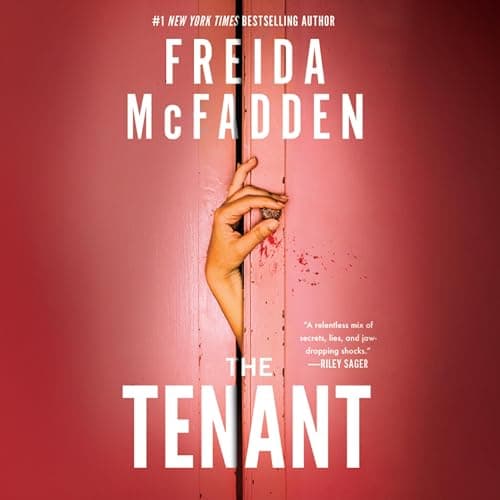

I started this one at 6:10 a.m., parked in my driveway, engine off, still in scrubs, while the Arizona sun was doing that rude bright thing it does when you've been awake all night. I told myself I'd sit there for five minutes before going inside to make breakfast for the kids. Twenty minutes later I was still gripping the steering wheel, listening to Blake Porter convince himself things were manageable when his life was very obviously sliding into the ditch.
That is very much the energy of The Tenant: a man insisting he still has control while the house, the neighbors, and his own secrets start turning against him.
When the house starts smelling wrong
The setup is pure nightmare fuel if you're an adult with bills. Blake loses his VP of marketing job, can't keep up with the mortgage on the brownstone he shares with his fiancée, and decides the practical fix is renting out a room. Enter Whitney — attractive, pleasant, seemingly easy to live with. Which, in a thriller by Freida McFadden, is basically the universe hanging a neon sign that says BAD IDEA.
What worked for me wasn't just the tenant premise. It was the slow contamination of Blake's everyday life. The neighbors start treating him differently. There's that persistent smell of decay in the house that he can't scrub away no matter how hard he tries. Strange noises keep jarring him awake at night. Those details matter because they make the story feel less like "big twist coming" and more like living in a home that has turned hostile one weird little inch at a time.
And honestly? That smell detail got under my skin. Hospitals have smells. Houses have smells. When something smells off and nobody can explain it, your nervous system notices before your brain does. I don't care how many candles you light.
This isn't McFadden at her fastest or nastiest. If you're coming in expecting the breakneck momentum of The Housemaid or the sharper snap of The Inmate, you may spend part of the first half waiting for the story to hit the gas. It takes its time with Blake's unraveling. I didn't mind that as much as some listeners clearly did, because the book is building a domestic paranoia machine. But yes — if you want a twist every thirty minutes, this one may feel a little more patient than advertised.
Blake whining, Whitney smiling, and why that actually works
The dual narration is the best reason to choose the audio version.
Will Damron plays Blake with this pinched, increasingly panicked frustration that fits a man watching his professional image and home life rot in real time. Fair warning: if you have zero tolerance for male protagonists who sound stressed, defensive, and a little self-pitying, you may find him whiny. I get why some listeners did. But I think that performance choice helps. Blake isn't supposed to sound cool. He's supposed to sound like a guy white-knuckling his way through consequences.
Christine Lakin has the trickier job, and she nails the tonal slipperiness. Her voice can sound warm, almost reassuring, and then she'll add just enough pause or edge to make you sit up straighter. That mattered a lot in the perspective-shift sections involving Whitney and Krista, because the book relies on your uncertainty — is this person trustworthy, manipulative, terrified, dangerous, or all four? Lakin keeps that ambiguity alive without turning it into cartoon villain stuff.
The back-and-forth between narrators gives the story more tension than I think the print version probably has on the page. When viewpoints shift, the air pressure changes. You feel Blake spiraling in one section, then another perspective comes in and suddenly you're reassessing the entire room.
Production-wise, clean. No weird volume jumps, no distracting effects, no nonsense. Night shift approved.
The twist question, because that's why most people are here
Let's be honest. You pick up a Freida McFadden book because you want the rug yanked out from under you.
Did The Tenant shock me on the level of her best work? No.
Did it keep me locked in anyway? Yeah, pretty much.
Some of the turns are predictable if you read a lot of psychological thrillers. You can feel certain gears clicking into place before the book reveals them. I had a couple moments of, okay, I see where you're going. So if your one requirement is complete narrative whiplash, lower your expectations a notch.
But here's what the book does well: it weaponizes Blake's panic. The story keeps tightening the screws through embarrassment, suspicion, and that awful sense that other people know something about you that you don't know they know. That's a very specific flavor of stress. Less jump scare, more social and domestic suffocation. That slow-burn dread of watching someone spiral through their own bad choices reminded me of what made Some Choose Darkness stick with me long after the last chapter.
The final stretch lands better in audio because Damron really leans into Blake's desperation without overselling it. By the climax, he's not just scared — he's cornered, angry, and finally forced to look directly at the mess he helped build. I wasn't stunned speechless. I was satisfied. Different thing.
So. Where does this sit in the McFadden ranking? For me, middle tier. Strong premise, solid audio execution, good tension in the house itself, but not her sharpest or most devious plotting. Still, I never felt like I'd wasted my time, and on a post-shift listen that's saying something. If a book can keep me in the driveway when I should be going inside to flip eggs and pretend I'm a functioning day person, it did its job.
Who gets the keys (and who should keep walking)
Pick this up if you like psychological thrillers where the home becomes the threat, and you're okay with a slower simmer before the knife comes out. Pick it up if you enjoy dual narration that adds suspicion rather than just splitting chapters. Skip it if you need relentless pacing or if a stressed male lead voice makes you want to throw your earbuds.
For me, this is a wait-for-sale McFadden, not top-shelf McFadden.
But on audio? Better than average. Creepy in the right places. And very good at making "renting out a room" sound like the worst decision a person can make outside of texting their ex.