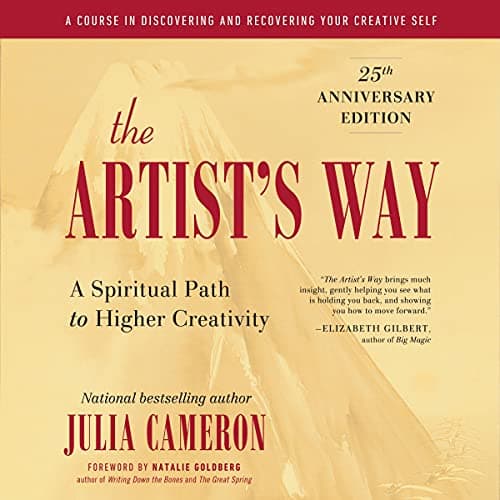

I was sitting on my back porch one Saturday morning, coffee getting cold, half-listening to this audiobook while pretending I was about to start a creative project I'd been avoiding for months. That's the kind of person Julia Cameron wrote The Artist's Way for — the procrastinator who knows they have something inside them but can't quite reach it. And honestly, by the time I finished Eliza Foss's narration a few days later, I'd actually started writing again. Take that however you want.
Bottom Line: Treat the audiobook as your first pass — a way to absorb Cameron's philosophy — then grab a notebook for the real work. Foss's narration grounds the spiritual elements without losing warmth. Not the ideal format for a workbook, but a surprisingly effective companion piece.
The Artist's Way has been around since 1992, and this 25th Anniversary Edition doesn't reinvent the wheel. Cameron's core framework remains the same: morning pages (three pages of longhand stream-of-consciousness writing every day), artist dates (solo excursions to refill your creative well), and a twelve-week program of exercises designed to dismantle the internal blocks keeping you from making art. The anniversary edition adds a new introduction where Cameron reflects on how the book traveled through the world and what she's learned since. It's a nice touch, but the real substance is the original material, which holds up remarkably well.
Here's where the audiobook format gets interesting — and a little complicated. The Artist's Way is fundamentally a workbook. Cameron wants you to do things: write morning pages, complete weekly tasks, answer journaling prompts. Listening to someone read those instructions while you're walking your dog or doing dishes creates an odd disconnect. You're absorbing the philosophy and the motivation, but you're not actually doing the work. I found myself treating the audiobook as a first pass — a way to internalize Cameron's approach — with the understanding that I'd need the physical book or at least a notebook nearby for the real work. If you go in with that expectation, it works beautifully. If you expect the audiobook alone to unlock your creativity, you'll be disappointed.
Eliza Foss narrates with a voice that splits the difference between therapist and friend. There's warmth there, genuine warmth, but also a quiet authority that keeps the spiritual elements from floating off into the ether. Cameron's writing leans heavily on concepts like synchronicity, God (or whatever higher creative force you're comfortable with), and the idea that creativity is a spiritual practice. In lesser hands, this could come across as preachy or new-agey to the point of alienation. Foss grounds it. Her pacing is deliberate and calm, almost meditative, which works wonderfully when you're in the right headspace — a focused walk, a quiet evening, a long stretch of uninterrupted time. That meditative quality actually reminded me of another audiobook that rewards the same kind of unhurried attention — Aware: The Science and Practice of Presence has a similar cadence, though I found it leaned a little too clinical for my commute.
But that pacing is also where some listeners will check out. I'll be honest: there were stretches where I bumped the speed up to 1.25x because the delivery felt a touch too slow for my energy level. A few passages drifted toward the somber side, and I can see why some people describe the narration as slightly gloomy. It's not gloomy exactly — it's serious. Cameron takes creativity seriously, and Foss matches that tone. If you're coming to this expecting the peppy, energetic delivery of something like Big Magic, you'll need to recalibrate. This is more like a long, honest conversation with someone who genuinely believes you have untapped creative potential and isn't going to rush through telling you why.
The book's spiritual framework will be the make-or-break element for most listeners. Cameron talks about God frequently, though she's careful to define it broadly — your creative source, the universe, whatever language works for you. Still, if you're allergic to any spiritual language in your self-help, this will test your patience. I'd say push through it. The practical tools — morning pages especially — are genuinely useful regardless of your belief system. I've been doing morning pages on and off for years, and every time I come back to them, I'm reminded how effective they are at clearing mental clutter.
What struck me most on this listen was how much of Cameron's advice has been absorbed into the broader creative self-help genre. You can hear echoes of The Artist's Way in everything from Austin Kleon's work to Steven Pressfield's The War of Art. Coming back to the source material, you realize how much of what we now take for granted about creative blocks, inner critics, and permission to make bad art originated here. The twelve-week structure gives the whole thing a sense of progression that most creativity books lack — it's not just theory, it's a program.
Foss has won five AudioFile Earphones Awards, and you can hear why. The production is clean, her enunciation is precise, and she sustains quality across the full ten hours without any noticeable dips. For a book this long and this dense with exercises and reflections, that consistency matters.
Who Should Listen (And Who Should Skip)
If you've been circling a creative project you can't quite start — writing, painting, music, whatever — and you want a structured nudge that's part spiritual, part practical, this is your audiobook. Skip it if spiritual language in any dose is a dealbreaker, or if you need a workbook you can actually work through hands-free. (You can't. Grab the print copy too.)
Is the audiobook the ideal format for The Artist's Way? Probably not — you really do need pen and paper to get the full benefit. But as a companion piece, as a way to absorb Cameron's philosophy and let it percolate before you sit down to do the actual work, it's excellent. Foss's narration turns what could be a dry instructional experience into something you actually want to keep listening to, even when Cameron is asking you to confront uncomfortable truths about why you've been avoiding your creative life.