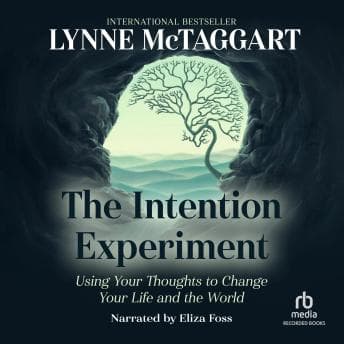

Somewhere around hour three, stirring a pot of dal that was definitely going to burn because I'd stopped paying attention, one phrase hit me differently than it had the first two times McTaggart repeated it: "The observer changes the observed."
Here's the thing about The Intention Experiment: it's asking you to believe something that sounds like complete pseudoscience—that your thoughts can literally, measurably change physical reality. And as someone who has spent her career studying why humans believe what they believe, I went in skeptical. Deeply, professionally skeptical.
When Quantum Physics Meets Wishful Thinking
McTaggart's approach is fascinating from a psychological perspective. She's not just throwing woo-woo concepts at you and hoping they stick. She's building a case, study by study, experiment by experiment. Random number generators affected by group meditation. Water crystals changing structure based on intention. Plants responding to human thought.
The research actually shows... well, it shows something. Whether that something is what McTaggart claims it is? That's where my inner academic starts getting twitchy. The studies she cites exist. They were conducted by real scientists at real institutions. But the leap from "we observed this anomaly" to "therefore you can manifest your dreams" is—psychologically speaking—exactly the kind of pattern-seeking our brains are wired to do.
What makes this book compelling is that McTaggart seems aware of this tension. She's not asking you to take it on faith. She's presenting evidence and inviting you to participate in ongoing experiments. That's actually... kind of rigorous? For this genre?
Eliza Foss Makes Quantum Physics Listenable
Nearly eleven hours of dense scientific material could have been a slog. Foss handles it with what I'd call "engaged neutrality"—she's clearly invested in the content without tipping into breathless evangelism. When McTaggart gets into the weeds of photon behavior or the mechanics of the zero-point field, Foss maintains a pace that lets you actually process what you're hearing.
I found myself wishing for a bit more vocal variety during the longer experimental descriptions. Around hour seven, during an extended section on remote intention studies, my attention started drifting. (The dal, by the way, was salvageable. Barely.) But that's less about Foss's performance and more about the inherent challenge of narrating what is essentially a very long research paper with a self-help wrapper.
The Psychology of Why This Works (On Some People)
Here's what I kept coming back to: whether or not intention literally changes physical matter, the act of focused, positive intention absolutely changes the person doing the intending. Placebo effect isn't fake medicine—it's real neurochemistry. Belief changes behavior. Behavior changes outcomes.
McTaggart knows this. She weaves in enough legitimate psychology and neuroscience to create what we'd call in my field a "coherent narrative framework." Your brain wants this to be true. It's looking for evidence. And she provides just enough to satisfy that need.
Is that manipulative? Maybe. Is it also potentially helpful? Also maybe.
My therapist would have thoughts about this book. Specifically about the section where McTaggart discusses how negative intention can harm—the research on "death prayers" and hexing. That's a fascinating case study in how the same mechanism that might heal could also hurt. The ethics get murky fast.
Who This Is (and Isn't) For
If you're already convinced that intention affects reality, this will feel like validation with extra citations. If you're a hardcore materialist who thinks consciousness is just neurons firing, you'll probably hate-listen (which, honestly, is a valid choice—I've done it). Skip this if you need definitive answers or can't tolerate ambiguity in your science.
The sweet spot is people like me: curious skeptics who can hold two ideas simultaneously. The science might be real. The interpretation might be wishful thinking. Both things can be true.
This is NOT a background listen. The scientific content requires actual attention. I'd recommend focused sessions, maybe during a commute where you're not also trying to prevent kitchen disasters.
Case Closed (Sort Of)
The Intention Experiment is a genuinely interesting artifact of the intersection between quantum physics, consciousness studies, and self-help culture. McTaggart is a skilled science journalist, and it shows—she makes complex concepts accessible without dumbing them down completely.
Do I believe my thoughts can change water crystals? I'm... not convinced. Do I believe the act of focused intention might change my brain chemistry in beneficial ways? The research actually suggests that's more plausible than we'd like to admit. Astrophysics for People in a Hurry operates in that same fascinating space where legitimate science meets accessible storytelling, though Tyson stays firmly on the materialist side of the fence.
Worth the eleven hours? If you're interested in the psychology of belief, the edges of legitimate science, or just want something to argue with in your head while cooking—yes. Just don't expect to come away with easy answers. The human mind has patterns, and one of those patterns is desperately wanting to believe we have more control than we do.









![Steve Jobs [unabridged audiobook] audiobook cover](/_next/image?url=https%3A%2F%2Fcovers.audiobooks.com%2Fimages%2Fcovers%2Ffull%2F9788499923406.jpg&w=1920&q=75)