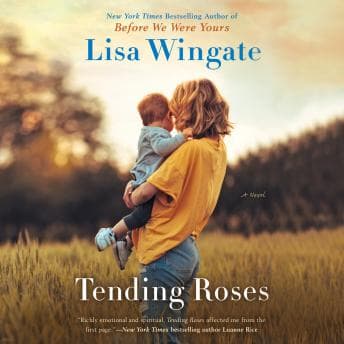

"The lessons that most enrich our lives often come unexpectedly."
That line hit me somewhere around hour three, parked in my driveway with the engine still running, breakfast for Carlos and the kids completely forgotten. I'd just come off a brutal night - two traumas back to back, a code that didn't end the way we wanted, and the kind of quiet that settles over a unit at 4 AM when everyone's just trying to hold it together. I needed something that wasn't adrenaline. Something that felt like sitting on someone's porch with sweet tea and nowhere to be.
Tending Roses was exactly that.
Grandma Rose Reminds Me of My Lola
Here's what got me. The whole premise - Kate's family sends her to convince Grandma Rose to leave her farm and move into a nursing home - I've lived a version of this. Not on a Missouri farm, but in a small house in Glendale where my Lola refused to stop cooking for thirty people even when she could barely stand at the stove. The eldest daughter (that's me, always me) gets the job of having The Conversation. You know the one. The one where you're supposed to be practical and instead you end up crying into a plate of lumpia.
Lisa Wingate gets the family dynamics of this situation so right it made my chest hurt. Kate's guilt about wanting her own life while feeling the pull of obligation to her grandmother? That push-pull between duty and self-preservation? As the eldest of five, as a Filipina-American daughter whose mom still thinks she should've been a doctor - yeah. I felt that in my bones.
And Grandma Rose's journal entries - these little handwritten stories about family and faith scattered throughout the narrative - they function almost like parables. They're simple. Some might say too simple. But when you're exhausted and running on hospital coffee and three hours of sleep, simple wisdom lands different. It lands harder. Jhumpa Lahiri does something similar in Interpreter of Maladies - deceptively quiet stories that hit like a slow-moving freight train precisely because they don't announce themselves.
Allyson Ryan's Southern Charm Does the Heavy Lifting
Allyson Ryan narrates with this warm, unhurried southern cadence that feels like she's telling you this story specifically, maybe over the back fence. She shifts her voice enough between characters that I never lost track of who was talking - Grandma Rose gets this particular weathered quality, a little raspy, a little stubborn, while Kate sounds younger, more uncertain. The differentiation isn't dramatic or showy, but it's consistent, which matters way more over ten hours than flashy voice acting.
What I appreciated most is Ryan's pacing during the emotional beats. She doesn't rush through the family reconciliation scenes or oversell the moments of grief. She trusts the silence between sentences. That restraint? That's the narrator equivalent of a good bedside manner. You don't have to perform empathy. You just have to be present.
No complaints on audio quality. Clean production, no weird background hiss, no jarring volume changes. Night shift approved - I could listen at low volume during charting without missing anything.
Where It Gets a Little Too Sweet
Look. I'm not going to pretend this book reinvents anything. The family-secrets-on-a-farm-with-a-wise-elder structure is well-worn territory, and there are moments where Wingate leans into sentimentality hard enough that my inner cynic (she's loud, she works night shift, she's seen things) raised an eyebrow. Some of the resolutions come a bit too neatly. Real family dysfunction doesn't wrap up in a chapter. Trust me - my family group chat is evidence.
And Kate's husband Ben is... fine? He's supportive, he's there, he says the right things. He's basically a golden retriever in husband form. Carlos would have opinions about this. (Carlos has opinions about everything.)
But here's the thing - I don't always need gritty realism. Sometimes I need the literary equivalent of a warm blanket and someone telling me it's going to be okay. After the shifts I work, after the things I see, a book that believes in the goodness of family and second chances and handwritten journals? That's medicine too.
Who This Is For (and Who Should Keep Scrolling)
If you want fast pacing, twists, or anything resembling a thriller - this isn't it. Walk away. If medical inaccuracies are what get you going (same, honestly), there's nothing here for your dashboard-yelling needs.
But if you're someone who carries heavy things - heavy shifts, heavy family dynamics, heavy expectations - and you need ten hours of something gentle and grounding? Get this. If you've ever been the eldest daughter tasked with an impossible family conversation? Get this yesterday.
Perfect for that post-shift decompression. Perfect for long drives where you need to come down from whatever life just threw at you.
Carlos asked why I was crying in the car. I blamed allergies. It was 97 degrees in Phoenix. He did not believe me.