
When's the last time a business problem actually kept you up at night - not the spreadsheet kind, but the kind where you're staring at the ceiling wondering if you're fundamentally broken because you can't stop feeling the weight of something you can't quantify?
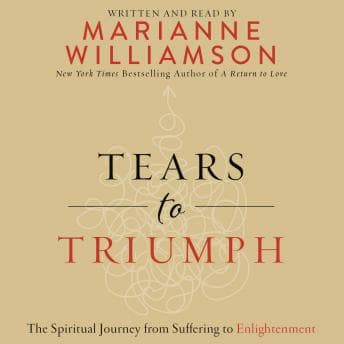
I was in that place last Tuesday. Not a startup crisis. Something personal. Jenny was asleep, and I was scrolling through my Audible library looking for something - honestly, I don't know what. Something that wasn't another framework or growth hack. Marianne Williamson's Tears to Triumph had been sitting in my queue for months, a recommendation from a founder I coached through a brutal layoff season. He swore it helped. I hit play at 1.5x (yes, I dialed it down from my usual 2.0x - that should tell you something).
The Anti-Optimization Argument
Here's what caught me off guard: Williamson's central thesis is essentially the opposite of every productivity book I've ever recommended. She argues that our obsession with avoiding pain - numbing it, medicating it, pivoting away from it - is the thing that's actually keeping us stuck. She's not subtle about it either. She calls out the pharmaceutical industry, the self-help-industrial complex (her own genre, which takes nerve), and our cultural addiction to "feeling better" over "actually healing."
Now. I'm a McKinsey guy. I optimize. I 2.0x my audiobooks. I measure ROI on everything. So hearing someone say "sit in your suffering and let it teach you" felt like being told to drive with the parking brake on. But here's the thing - I watched my mom do exactly this. When my dad's dry cleaning business almost went under in 2003, she didn't read a self-help book or hire a coach. She cried. She prayed at church. She sat with it. And then she got up and figured it out. This is what my parents did instinctively. Now it has a TED talk.
Williamson frames this through A Course in Miracles theology, which - look, if you're allergic to spiritual language, this book will give you hives. She talks about God, the Holy Spirit, divine love. It's not metaphorical. She means it. That same uncompromising commitment to a non-rational path to healing shows up in Tai Chi: The only introduction you'll ever need — a very different genre, but the same insistence that some things can't be thought your way through, only practiced. But strip the theology away and the underlying argument is actually sharp: our pain avoidance mechanisms have been industrialized and monetized, and the result is a population that's medicated but not healed.
Williamson Reading Williamson
She narrates this herself, and it matters. Her voice has this specific quality - warm but not soft, if that makes sense. She sounds like someone who has had this conversation a thousand times at kitchen tables and isn't performing compassion, she's just... in it. There's a section where she walks through specific prayers for people dealing with depression, and her pacing slows down naturally, like she's actually praying with you rather than reading to you. I'm not a prayer guy. But I didn't skip it.
The flip side: at 6 hours and 43 minutes, this book still could've been tighter. Williamson has a habit of circling the same point from multiple angles - spiritual suffering as opportunity, pain as doorway, tears as transformation - and by the fourth or fifth pass, even at 1.5x, I was checking how much time was left. The first half lays the philosophical groundwork. Skip to chapter 5. Thank me later. That's where she stops building the case and starts giving you actual tools.
What the Spreadsheet Won't Show You
I've coached maybe 40 founders through crisis moments. The ones who bounce back fastest aren't the ones who immediately pivot to solutions. They're the ones who let themselves sit in the wreckage for a beat. Process the failure. Feel the shame. And then move. Williamson would say that's spiritual work. I'd call it emotional intelligence with better branding. Either way, the mechanism is real.
But I need to be honest - this book isn't for everyone, and it's definitely not for the cynical. If you want evidence-based frameworks, go read Bessel van der Kolk. If you want spiritual conviction delivered by someone who genuinely believes divine love is the answer to clinical depression... that's this book. Jenny would say I'm being harsh. Jenny is right. But I'm also being accurate.
Who Gets the ROI
This lands hardest if you're in a season of genuine pain - grief, depression, a failure that shook your identity - and the usual "optimize your way out" playbook isn't working. If you grew up in a faith tradition and drifted away but still respond to that language, Williamson will feel like a conversation you've been missing. If you're a pure rationalist looking for peer-reviewed strategies, this will frustrate you.
The Consulting Rate for This One
Bottom line: There are maybe 3 hours of genuinely powerful content in here - the prayers, the reframing of suffering as spiritual curriculum, the direct challenge to our numb-and-move-on culture. The other 3+ hours are repetitive scaffolding. But those 3 good hours? They hit different at 1 AM when you're not trying to optimize anything. You're just trying to feel something real. And that might be worth more than any business book in my library right now.