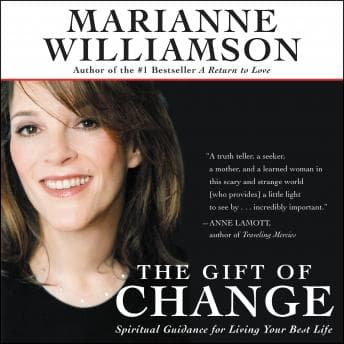

Marianne Williamson's The Gift of Change is not a bad book. I want to say that upfront because what follows might sound like I'm being harsh, and I'm not trying to be. It's more that I finished this audiobook feeling like I'd eaten a meal that was technically nutritious but somehow left me still hungry.
I was making dal from my mother's recipe — the one she insists I always get wrong, and she's right — when I started this. Chopping onions, letting the tadka splutter, the kind of meditative kitchen time where a spiritual self-help book should land perfectly. And for the first hour or so, it did. Williamson's central thesis is straightforward: we're collectively terrified, and that fear is running our lives. The antidote, she argues, is shifting from a fear-based to a love-based perception of reality, rooted in A Course in Miracles theology. Ten changes, ten chapters. Clean structure.
When the Sermon Starts Looping
Here's where my psychology brain kicked in and started getting restless. Williamson frames fear and love as binary opposites — you're operating from one or the other. The research actually shows that emotional processing is way messier than that. Fear can coexist with love. Anxiety can be a signal worth listening to rather than something to transcend. There's a flattening that happens when you reduce all human suffering to "you're choosing fear instead of God's love," and I found myself asking: why does Williamson keep circling back to the same point without deepening it?
Because she does. By about hour three, I noticed the arguments were essentially recursive. Love dissolves fear. Fear blocks love. God is love. Trust God. Fear dissolves. It's not that any single statement is wrong — some of her observations about how anger masks vulnerability are genuinely sharp. But the repetition made me feel like I was listening to a 5-hour-49-minute expansion of what could've been a tight 90-minute talk. One listener's complaint stuck with me: "I have read all her books and listened to all her tapes, perhaps it is starting to repeat." That's a loyal reader saying the quiet part out loud.
Compared to A Return to Love, which felt like Williamson at her most urgent and personal, The Gift of Change reads like the follow-up lecture tour version — same ideas, slightly less fire. This is a fascinating case study in what happens when a writer revisits their core material without substantially evolving it.
The Author-as-Narrator Problem
Williamson narrates her own book, and this is where things get complicated. Author-narrated self-help can be incredible because you're getting the ideas straight from the source, unfiltered. But Williamson's delivery has this persistent perkiness — an upbeat, almost motivational-speaker cadence — that doesn't always match the weight of what she's discussing. When she's talking about collective anxiety and the ways fear has paralyzed us as a society, the tone sometimes feels like it's selling me vitamins.
It's not that she's insincere. I actually think she means every word. But there's a disconnect between content and delivery that kept pulling me out. No sound effects, no music, no production flourishes — just Williamson, solo, for nearly six hours. Which is fine for a focused listen, but the monotone energy means this is not your background-while-doing-dishes audiobook. (I tried. The dal turned out fine. My attention did not.)
My therapist would have thoughts about this character — and yes, I'm calling Williamson-as-narrator a "character" because when you read your own spiritual self-help book aloud, you're performing a version of yourself, whether you intend to or not. The performed self here is confident, certain, warm. But certainty without vulnerability gets exhausting. Tony Robbins runs into the same wall in Awaken the Giant Within — that performer-certainty register that's meant to feel empowering but starts to feel like it's sealing off the very doubts that make the work meaningful.
Who Gets the Most Out of This
If you're new to Williamson and to A Course in Miracles-based spirituality, this might hit differently for you. The framework of choosing love over fear is genuinely useful when you encounter it fresh. But if you've already read A Return to Love or spent any time in this spiritual lane, you'll recognize the furniture. It's been rearranged, not replaced.
This is best suited for someone who wants a structured, devotional-style listen — ten chapters, ten changes, something to sit with one section at a time rather than binge. Rushing through it amplifies the repetition problem.
Skip it if you need psychological specificity, if you want practical exercises rather than philosophical reframing, or if a consistently upbeat narrator tone makes you twitchy.
My Clinical Notes
I respect what Williamson is trying to do here. The idea that our collective fear is worth examining rather than just medicating or ignoring — that's a conversation worth having. But The Gift of Change doesn't push that conversation far enough. It states and restates rather than building. The same tension shows up in Do Yourself a Favor...Forgive, which also promises transformation but delivers something closer to extended comfort — not worthless, but not quite what it says on the tin. Psychologically, this doesn't track as a book about change so much as a book about reassurance. And sometimes reassurance is exactly what you need. Just know that's what you're getting.