
It was 11:15 PM on a Tuesday. I had three more essays to grade on the symbolism of the green light in The Great Gatsby (spoiler: it's money, kids, it's always money), and my eyes were burning. I needed something to listen to that wasn't a teenager misinterpreting Fitzgerald or my own internal monologue wondering if I should retire.
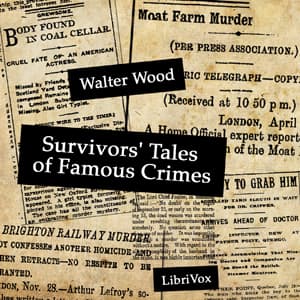
So, I stumbled onto Survivors' Tales of Famous Crimes.
My students are obsessed with true crime. They listen to podcasts where hosts crack jokes about murders while selling mattress subscriptions. This isn't that. This is Walter Wood, back in the early 20th century, actually interviewing people who were there. Not the detectives. The survivors. The acquaintances.
(I may have fallen asleep with this playing and had very strange Victorian dreams. Don't tell my wife.)
The "LibriVox Roulette"
Let's address the elephant in the recording booth first. This is a LibriVox production. If you've never listened to one, here's the deal: it's read by volunteers. I had the same experience with Complete Hypnotism, Mesmerism, Mind-Reading and Spiritualism—same volunteer narrators, same delightful chaos. Regular people.
That means the quality is... let's call it "eclectic."
One chapter, you get a narrator who sounds like a classically trained British thespian who understands that a pause is punctuation. The next chapter? It sounds like someone recording on a laptop microphone in a bathroom while their cat scratches the door.
Honestly? I kind of love it.
(My students would hate this. They need 4k video and studio sound or they claim they "can't focus." I tell them Shakespeare was performed in an open-air pit with people throwing fruit, but whatever.)
There's a charm to the inconsistency. It reminds me that these stories belong to the public domain. It feels like a community storytelling project rather than a polished product sold to you by Amazon. Does it jar you sometimes when the narrator changes? Yes. Does it ruin the book? Surprisingly, no. After about two minutes of a new voice, your brain adjusts. You stop hearing the microphone hiss and start seeing the foggy London streets.
Victorian Noir
What really grabbed me—and what made me pause grading that terrible essay on Nick Carraway—is the tone. This is true crime before it became an industry.
Walter Wood isn't trying to be sensational (mostly). He's documenting. The stories cover the late 19th and early 20th centuries, so we're talking about an era where forensic science was basically just "he looked suspicious."
The perspective is fascinating. Hearing from the people who knew the deceased or the criminal gives it this weird, intimate texture. It's not about the gore; it's about the social ripples. The scandal. The shock.
It reminds me of reading Sherlock Holmes, but stripped of the brilliant detective who solves everything in the end. Sometimes, it's just messy human tragedy. That same archaic-but-fascinating vibe shows up in Memoir of Jane Austen, another LibriVox gem from the same era. The prose is a bit archaic—Wood writes with that dense, formal style of the 1910s—but if you love history, it's candy.
Who Should Listen (And Who Should Skip)
Look, if you need high-fidelity sound design and professional actors doing distinct character voices, you're going to bounce off this hard. Go listen to a BBC radio drama instead.
But if you're the kind of person who:
- Loves historical context more than plot twists.
- Can forgive some background static for the sake of a good story.
- Wants to hear what true crime sounded like before the internet.
Then give it a shot. It's perfect for doing chores or—hypothetically—pretending to listen to a budget meeting. It's raw history, unpolished and a little crackly. Just how I like it.