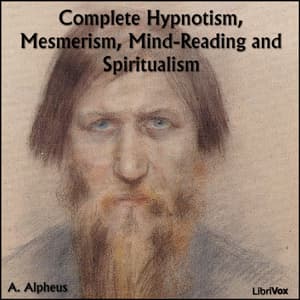

Okay, let's be real for a second. I listened to this while meal-prepping for the week—chopping onions usually makes me cry, but honestly? This narration might've contributed.
I have a complicated relationship with the history of my own field. On one hand, you have to respect the pioneers. On the other hand, psychology in 1903 was basically the Wild West with better vocabulary. Complete Hypnotism, Mesmerism, Mind-Reading and Spiritualism is exactly what it sounds like: a time capsule from an era when we thought we could explain the human mind with the same confidence a toddler has when explaining why they ate the crayon.
When Psychology Was a Parlor Trick
A. Alpheus (which, let's admit, sounds like a pseudonym for a wizard in a bad fantasy novel) wrote this back when Freud was just getting warmed up. Listening to this is fascinating if you treat it like an archaeological dig.
The author treats hypnotism not just as a medical tool, but as this... life hack. He talks about "Mesmerism" with a straight face. As a behavioral psychologist, I found myself constantly pausing to mutter, "That is absolutely not how the amygdala works." But that's the charm, right? It's a snapshot of human curiosity. The book tries to bridge the gap between science and the spiritual—a gap my colleagues are still arguing about in the faculty lounge today. But don't go into this expecting to learn actual mind-reading. (My students ask me about this every semester. No, I cannot read your mind. Yes, I know you didn't do the reading.)
The "Lecture Hall" Vibe
Here's where we hit a snag. The production is LibriVox.
Now, I love the idea of LibriVox. Volunteers reading public domain books for free? That is a beautiful example of prosocial behavior. However. The delivery here is... let's call it "academic sedative." It's clear. It's articulate. It is also incredibly monotone.
The same LibriVox volunteers tackle Grimms' Fairy Tales with similar flatness—turns out even enchanted forests sound beige when read like a tax document.
There is zero emotional variation. None. The narrator reads a section on the dangers of hypnosis with the same urgency as a grocery list. If you're looking for a performance that captures the mystery or the "spookiness" of the title, you won't find it here. It felt like being stuck in a 3-hour lecture with that one professor who has tenure and stopped caring in 1998. I found myself zoning out during the sections on technique, which is ironic for a book about focus and trance states.
Why We Still Read This Stuff
Despite the robotic delivery, there's something compelling about the content. It strips away the modern gloss we put on therapy. The author is obsessed with influence—how one mind controls another.
It's a classic power dynamic. Humans have always been desperate for a manual on how to control their environment (and the people in it). Alpheus provides that, in a very 1903 way. It's not occult—sorry to the goth kids looking for a spellbook—it's practical, almost dryly so. It reminds me that the desire to understand why people do what they do hasn't changed in a century. We just have better data now. Usually.
Adult Children of Emotionally Immature Parents is a much better example of psychology done right—evidence-based, compassionate, and actually useful for modern listeners.
Final Thoughts Over Coffee
Is this a "good" audiobook? Not really. The pacing is flat, and the science is obsolete. But is it a fascinating case study in the history of psychology? Absolutely.
Who should listen: History buffs, hypnotherapists curious about their profession's origins, or psych nerds who enjoy cringing at outdated science. Who should skip: Anyone wanting practical techniques or an engaging narrator.
Just crank the speed up to 1.5x. Trust me. My therapist says I need to slow down, but in this case, speed is the only thing saving you from a nap.