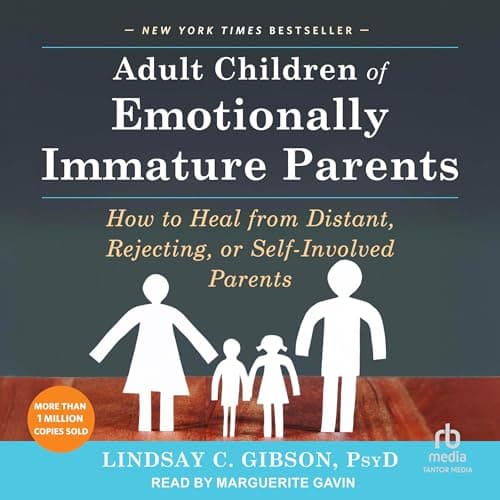

Can we talk about how annoying it is that a self-help book made me cry in my car? I was not prepared. I had my coffee, I had my route, I had my whole "productive morning commute" energy going, and then Lindsay Gibson casually describes the kid who learned to read everyone else's emotions while completely losing track of their own—and suddenly I'm sitting in a parking lot trying to get it together before a meeting.
Here's what surprised me as I kept listening: this book is tight. At just under seven hours, Gibson doesn't waste a single minute recycling the same insight in different wrapping paper. She categorizes emotionally immature parents into four types—emotional, driven, passive, and rejecting—and each one lands with the kind of uncomfortable specificity that makes you think she's been eavesdropping on your family dinners since 1994. The framework isn't about blame. Gibson is careful about that. She's describing a system, not building a prosecution. But the descriptions are so precise that you'll probably text someone mid-listen with "oh my god, read this book."
The concept that stuck with me hardest was what Gibson calls "healing fantasies"—the idea that adult children keep unconsciously hoping their emotionally unavailable parent will finally show up, finally get it, finally see them. She explains this with such clarity that I genuinely think it could shortcut years of circling the same issue in therapy. Not replace therapy—but give you the map so you're not wandering. She also introduces the distinction between "internalizers" and "externalizers" among siblings, which explained about fifteen years of family dynamics I'd never been able to articulate.
The practical strategies are real strategies, not vague encouragements to "set boundaries" without telling you what that actually looks like on a Tuesday afternoon when your mother calls. Gibson walks through specific interaction patterns, the "maturity awareness" approach for managing your reactions, and how to identify "relationship people" versus people who just drain you. Each chapter builds on the last. I found myself pausing after heavier sections—chapters on emotional neglect hit hard—and I'd recommend giving yourself permission to do the same. This isn't a binge-in-one-sitting book. It works great in commute-sized chunks, but some chapters need breathing room.
Now, Marguerite Gavin's narration. This is where I went back and forth. Gavin is a five-time Audie Award nominee, and her voice has real authority—rich, steady, with a weight that makes clinical concepts feel important rather than dry. When Gibson describes the quiet devastation of growing up unseen, Gavin's delivery gives those passages genuine gravity. I appreciated that she didn't flatten the material into a monotone lecture.
But—and this is a real but—there are stretches where Gavin's intensity runs hot for the genre. She sometimes reads passages about childhood emotional neglect with the dramatic tension of someone revealing a murder suspect. It's not constant, and it's not a dealbreaker, but if you're coming to this book feeling raw and expecting a gentle, warm voice to walk you through hard truths, the first twenty minutes might feel jarring. I'd say give it until chapter two. My brain adjusted, and by mid-book I actually liked that she took the material seriously rather than delivering it in that breathy, Instagram-therapist whisper that a lot of self-help narrators default to. But I get why some people bounced off it. If narrator tone is a dealbreaker for you, try a sample first or consider the print version.
Gavin also narrates White Witch, Black Curse, and honestly that one might be a good low-stakes way to road-test her voice before committing to something this emotionally heavy.
Where the book falls slightly short: the healing strategies, while genuinely useful, feel like they're just getting started when the book ends. Gibson introduces strong frameworks but doesn't always give them the runway they deserve. The sequel, Recovering from Emotionally Immature Parents, picks up exactly where this leaves off, which feels intentional but left me wanting more from this single volume. It's the one place where the book's tight runtime works against it.
If you've read Running on Empty by Jonice Webb, Gibson covers adjacent territory but with a sharper lens on the parent-child dynamic specifically. Compared to The Body Keeps the Score, this is far more targeted—you finish with concrete language and strategies for your specific family patterns rather than a broad trauma education. It's a focused tool, not an encyclopedia.
The book's real power is naming things. Gibson puts words to experiences that a lot of people have carried for decades without language for them. Hearing those descriptions spoken aloud—in a human voice, through headphones, during your regular life—hits differently than reading them on a page. Multiple listeners describe feeling "seen" for the first time, and that tracks. This isn't fluffy self-help. It's a clear, structured explanation of what happened and why you adapted the way you did, delivered by someone who's spent thirty years watching these patterns play out in her practice.
Who Should Listen (And Who Should Skip)
If you grew up feeling like you were the emotional adult in your family—managing moods, reading the room, never quite getting seen—this book will hand you the vocabulary you didn't know you were missing. Skip it (or at least grab the print version) if you need a very warm, gentle narrator voice to process heavy material; Gavin's authoritative delivery is polarizing, and it's worth sampling first.
At 4.79 stars across thousands of ratings, the consensus earned its number. The narration won't work for everyone, but the content is the real thing.