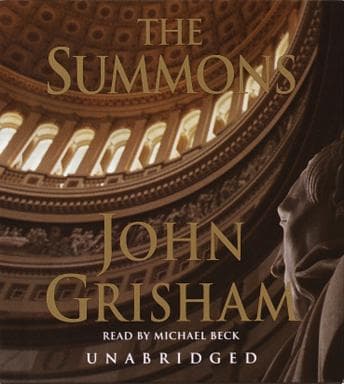

Everyone talks about Grisham's courtroom fireworks - the dramatic cross-examinations, the last-minute evidence reveals, the sweaty-palmed jury deliberations. So when I started The Summons, I was bracing for that. What I got instead was something quieter. And honestly? More psychologically interesting.
Look, I'm going to be upfront: this isn't your typical legal thriller. It's a character study wearing a mystery's clothing. And as someone who analyzes fictional characters like case studies (occupational hazard, don't judge me), I found myself way more engaged than I expected.
The Psychology of Secrets and Siblings
The premise hooked me immediately: Ray Atlee, law professor, returns home to Mississippi at his dying father's summons. Except dear old Judge Atlee dies before they can talk, leaving behind a secret that - and this is where it gets interesting - Ray can't quite bring himself to share with anyone. Including his brother Forrest.
This is a fascinating case study in how secrets reshape family dynamics. Ray's decision-making throughout the book exhibits classic avoidant attachment patterns mixed with what I'd call protective deception. He tells himself he's shielding Forrest (the family's black sheep, recovering addict, all the usual complications). But is he? Or is he just rationalizing?
Grisham understands human nature here. The way Ray keeps circling back to the secret, the way it starts eating at his relationships, his sleep, his sense of self - that tracks. My therapist would have thoughts about this character. Many thoughts.
Michael Beck's Southern Gothic Voice
I listened to this during my morning jogs through Cambridge, and I'll say this: Michael Beck's narration made those runs feel shorter. His Southern accents are strong without tipping into caricature - which, having grown up watching my share of badly-accented Bollywood villains, I appreciate more than you know.
Beck gives distinct voices to each character. Judge Atlee sounds appropriately weathered and authoritative. Forrest has this loose, slightly unpredictable energy that fits his character arc. Ray himself comes across as measured but increasingly frayed - exactly right.
Now, I've seen some listeners complain that Beck's attempt at an English accent (there's a minor character, apparently) falls flat. I honestly don't remember it being that distracting? But I was also dodging joggers and trying not to trip on uneven sidewalks, so take that with a grain of salt.
The pacing is smooth. Almost too smooth in places - there are stretches in the middle where the mystery kind of... drifts. I found myself zoning out during some of the real estate and estate-planning details. (Sorry, but detailed discussions of property values don't exactly get my heart racing.)
Where the Narrative Shifts
Here's the thing about The Summons that I think frustrates some readers but worked for me: the mystery isn't really the point. The resolution is almost anticlimactic - I won't spoil it, but if you're expecting a Grisham-style courtroom showdown, you're going to be disappointed.
What makes Ray compelling is watching him unravel. He exhibits classic symptoms of moral injury - he's done something (or rather, not done something) that conflicts with his self-image as the "good son." And Grisham traces that internal conflict with surprising subtlety.
Forrest, the black sheep brother, is actually the more psychologically honest character. He knows who he is. He's made peace with his failures. Ray, for all his success, hasn't. There's something almost tragic about that dynamic.
I found myself asking: why does Ray really keep the secret? The surface answer is obvious. But the deeper answer - the one Grisham hints at but never quite states - is messier. More human.
Would I Listen Again?
Probably not, if I'm being honest. It's a one-and-done experience. But it's a good one-and-done.
If you're coming to this expecting The Firm or A Time to Kill, recalibrate. This is Grisham in a more reflective mode. Less thriller, more... meditation on family, inheritance, and the lies we tell ourselves to keep functioning.
Michael Beck's narration elevates the slower sections. His voice has this warm, unhurried quality that suits the Mississippi setting. Perfect for long drives or - in my case - pretending my research papers will write themselves while I listen to someone else's family drama instead.
The ending didn't fully satisfy me. It felt like Grisham ran out of steam rather than building to something. But the journey there? Worth it. Especially if you're interested in how people rationalize their way into moral corners.
Who should listen: Character-study enthusiasts and anyone who wants Grisham without the courtroom theatrics. Skip it if: you need plot momentum or a satisfying mystery payoff.
Just don't expect fireworks. Expect a slow burn that illuminates character rather than plot. That's exactly why Ninth didn't work for me—it promised character depth but delivered neither that nor plot momentum. For some of us, that's enough.