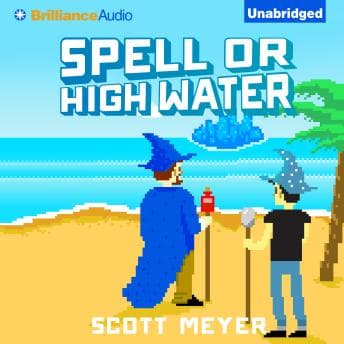

This book is basically what happens when a programmer watches Monty Python and goes, "What if reality was just a really janky database and wizards were just hackers with terrible fashion sense?"
I was deep into a coding sprint for my thesis—well, "thesis work" in the loosest possible sense, the kind where you have your IDE open on one monitor and you're really just refactoring the same function for the third time because you're avoiding writing your literature review. Perfect state of mind for Spell or High Water, which is itself a book about a guy who should be doing something productive but keeps getting sidetracked by increasingly ridiculous complications.
The Magic System Is Literally Just SQL Queries and I'm Here For It
Scott Meyer's whole premise—that reality is a computer simulation and time travelers figured out how to edit the source code—is the kind of thing that would absolutely dominate a session zero conversation in my D&D group. Book two takes Martin Banks to Atlantis, which turns out to be a matriarchal society run by female time-travelers who got tired of medieval Europe's nonsense. (Fair.) The world-building here isn't Sanderson-level—let's be honest, Meyer isn't trying to build a cosmere—but the internal logic of the magic system, where every "spell" is basically a shell script with a fancy gesture stapled on, scratches an itch that pure fantasy sometimes doesn't reach. It's LitRPG-adjacent without the stat blocks. The rules are consistent, the limitations matter, and when characters find clever workarounds, it feels earned rather than handwaved. That same sense of earned progression—where the system has real teeth and victories feel like they cost something—is what hooked me about Golden Son, even though that book plays it way less comedically.
The Atlantis setting gives Meyer room to play with gender politics in a way that's clearly meant as parody, though your mileage will vary on whether the satire lands or just feels like a dude writing a lady-kingdom for laughs. I thought it was mostly funny, occasionally clumsy. The murder mystery subplot that drives the back half is where the book picks up real momentum—someone's trying to kill the summit attendees, and Martin stumbles into detective mode the way he stumbles into everything: awkwardly, with maximum self-deprecation.
But here's where people split. There are genuinely too many subplots competing for attention. The romance with Gwen, the political dynamics between the time-traveler colonies, the mystery, Martin's ongoing identity crisis about whether he's actually a wizard or just a nerd with admin access—it's a lot of plates spinning for an eleven-and-a-half-hour book. Some of those plates wobble. Gwen in particular suffers: she's supposed to be the emotional anchor, but she reads as more of a plot device than a person, and the book never quite convinces me that Martin's obsession with her is based on anything beyond "she's the girl character."
Luke Daniels Could Narrate My Error Logs and I'd Listen
Luke Daniels is doing heavy lifting here, and for about 85% of the book, he's nailing it. His comedic timing is genuinely excellent—the kind of delivery where a mediocre joke in print becomes laugh-out-loud funny because of a perfectly placed pause or a slight vocal shift. His Philip voice has this dry, condescending British energy that makes every Philip line automatically 30% funnier. Martin sounds appropriately hapless. The wizard voices are consistent from book one, which matters when you're dealing with a cast this size.
The weak spot—and other listeners have flagged this too—is the female characters. Gwen's voice lands somewhere between flat and school-principal-lecturing-you, which doesn't help a character who already struggles on the page. The Sorceresses fare a bit better because they're written with more personality, but Daniels clearly has more fun voicing the guys. It's not a dealbreaker. But when your romantic subplot is already the weakest thread, having the love interest sound like she's reading a PTA announcement doesn't exactly generate chemistry.
Who's Rolling Initiative on This One
If you liked Off to Be the Wizard, this is a solid continuation—same tone, slightly more ambitious plot, same "programmer humor meets fantasy tropes" energy. If you're a coder, a D&D nerd, or someone who's ever spent too long arguing about whether a prestidigitation cantrip could technically do something the DM didn't intend, this is your frequency. My D&D group would love this. (I already sent them the Audible link.)
If you need your female characters to be more than plot scaffolding, or if you find programmer-humor grating, this probably isn't going to convert you. And if the first book didn't click, book two isn't doing anything dramatically different enough to change your mind.
I Should've Been Writing My Thesis But Instead I Learned Atlantean Politics
I read this instead of writing my thesis. Dr. Patel, if you're somehow reading audiobook reviews on the internet: I was doing research on procedural generation. Atlantis is procedurally generated. Probably. (I used the same excuse when I spent a weekend on To Sleep in a Sea of Stars—alien linguistics totally counts as computational research, right?). Look, Luke Daniels is funny, the magic system is chef's kiss for anyone who's ever written a for-loop, and eleven hours went by faster than they had any right to. It's not perfect—the Gwen problem is real, and the subplot congestion means some threads feel undercooked. But as a comfort listen? As a "I need something entertaining while I pretend to be productive" pick? The progression is satisfying, the humor lands more than it misses, and Daniels sells it hard enough to paper over the structural cracks.