
"We're fighting a war we can't win, against an enemy we don't understand, while our own species tears itself apart."
That line hit different at 6:47 AM, somewhere around Millbrae, packed into a train car with forty other people who looked exactly as defeated as Andrew Grayson sounds in that moment. I actually missed my stop. Had to double back from Mountain View like an idiot.
The Sophomore Album That Actually Delivers
Bottom Line: Worth your commute. This is basically Starship Troopers meets The Expanse, but with the cynicism turned up to eleven and the propaganda turned way down. If you're craving that same blend of space opera scale and political intrigue, Dance with Dragons delivers—though with dragons instead of drop ships.
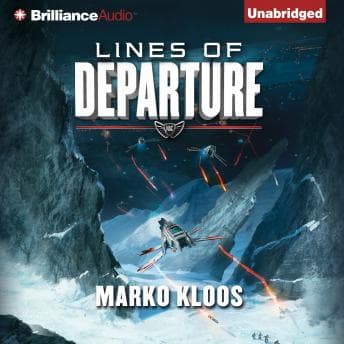
Look, I was skeptical. Terms of Enlistment was solid—good military sci-fi comfort food. But second books in military SF series have a tendency to either repeat the formula exactly or go completely off the rails trying to "expand the scope." Lines of Departure does something smarter: it zooms in while the universe falls apart around the edges.
The setup is grim in the best way. Humanity's getting crushed by the Lankies (alien species that makes the bugs from Starship Troopers look like reasonable negotiating partners), but instead of uniting against extinction, we're also fighting a civil war over the last scraps of habitable space. Grayson's stuck in the middle—a grunt who's seen too much, questioning everything while still pulling the trigger because what else is there?
There's this scene early on where Grayson has breakfast with his mother in a tiny Vermont diner. No action, no aliens, just... a soldier trying to remember what normal feels like. Kloos earns these quiet moments because he doesn't overwrite them. The man was a German immigrant who became a U.S. citizen, served in the military—and you can feel that authenticity in how he handles both the bureaucratic absurdity and the genuine camaraderie of military life.
Luke Daniels Does That Thing Again
Okay, I need to talk about Luke Daniels. He's not Ray Porter (my forever narrator crush), but he's in that same tier of "I will listen to this person read a phone book." His pilot voices versus his ground-pounder voices—you can hear the difference in training, in attitude, in class. The combat controller drawl versus the officer's clipped precision. It's not showy, it's just... right.
The combat scenes clip along at exactly the pace they should. Daniels keeps the action brisk without making it feel rushed—which is harder than it sounds. I've listened to audiobooks where the narrator either races through firefights like they're reading a grocery list or drags them out until you forget what anyone was fighting about. Daniels finds that sweet spot where you're actually holding your breath.
One listener quote I found said something like "in over 1000 audiobooks, this performance is unmatched"—which, okay, hyperbole, but I get it. There's a reason Daniels keeps getting cast in military SF. The man understands the genre.
The Tech Stack Checks Out (Mostly)
As someone who spends her days debugging distributed systems, I appreciate when authors think through their tech. Kloos doesn't over-explain the FTL mechanics or the weapons systems, but what he does show feels internally consistent. The tactical decisions make sense. The chain of command failures feel authentic rather than plot-convenient.
The Lankies remain genuinely alien—not just humans in rubber suits with different values. You don't understand them. The characters don't understand them. And that uncertainty drives a lot of the tension. Dawn of the Jedi takes a different approach to alien encounters, though it leans more toward the mystical than the terrifying. It's refreshing after too many "we learned to communicate and found common ground" alien first contact stories.
Perfect For: Train, Gym. Skip For: Falling Asleep
This is not a bedtime book. I made that mistake once around hour 6 and had weirdly stressful dreams about orbital drop pods. The pacing keeps you engaged enough that you won't zone out during your commute, but it's not so complex that you'll lose the thread if someone's having a loud phone conversation three seats over.
At 9 hours 12 minutes, I finished this in exactly 4 commutes. The ROI on this audiobook is solid—no padding, no "could've been a blog post" syndrome that plagues so much military SF. Every chapter moves something forward.
Skip if: you need your military SF to have clear good guys and bad guys. Grayson's side isn't heroic. The enemy humans aren't cartoon villains. Everyone's just... surviving. If that moral ambiguity frustrates you, this isn't your series.
Listen if: you want competent military SF that respects your intelligence, a narrator who makes 9 hours feel like 5, and a protagonist who's tired in a way that feels earned rather than edgy.
Commit and Push
I'm already queuing up book 3. Kevin asked if I wanted to do something this weekend and I said "maybe Sunday afternoon" because I need to know what happens to Grayson and Halley. He rolled his eyes. But he's also the one who got me into The Bobiverse, so he knows how this goes.
The Frontlines series is shaping up to be one of those reliable comfort listens—the kind where you know what you're getting, and what you're getting is good. Not revolutionary, not trying to reinvent the genre. Just solid, well-crafted military SF with a narrator who knows exactly what he's doing.
Worth your credit. Worth your commute. Worth missing your stop.