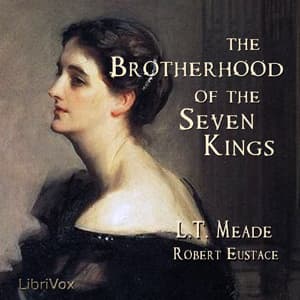

So I picked this up expecting some dusty Victorian mystery I'd fall asleep to after a brutal Saturday night shift - twelve-hour stretch, two traumas back to back, the kind of night where you seriously question every life choice that led you to this career. I figured a free LibriVox recording from 1903 would be gentle enough to ease me into Sunday morning unconsciousness. Instead I'm sitting in my driveway at 7:45 AM, engine off, genuinely annoyed at two fictional men for being so spectacularly bad at catching one woman.
Madame Sara Is the Nurse Practitioners Wish They Were
Let me set the stage. Madame Sara runs a beauty shop on the Strand in London. She does cosmetic procedures, sells mysterious potions, and basically operates as a one-woman med spa slash assassination ring. The two men trying to catch her - Dixon Druce, a private investigator type, and Eric Vandeleur, a police surgeon - keep stumbling onto her crimes after the bodies are already cold. Every. Single. Time.
And here's the thing that got me yelling at my dashboard: the medical details in this book, written over 120 years ago, are weirdly specific. Madame Sara uses dental work to poison a woman. She manipulates surgical procedures. She understands anatomy and pharmacology well enough to commit murders that look like natural causes or accidents. As someone who's actually worked a code, I was genuinely impressed by L.T. Meade's understanding of how the body can be weaponized through what looks like routine care. It's not modern-accurate, obviously - some of the science is Victorian pseudoscience - but the logic of it holds up. The idea that a healthcare provider could use their access and knowledge for harm? That's not fiction. That's a real thing we talk about in training.
What really struck me is that Madame Sara is essentially the villain because she's a brilliant woman operating outside the system men control. Druce and Vandeleur are so convinced she's guilty, and they're right, but they can never quite pin her down because she's smarter than both of them combined. This book was written in 1903 and the female character is running circles around every man in it. My mom would love this (she still thinks I should've been a doctor). Madame Sara basically IS a doctor. An evil one, but still.
The Structure Problem (And Why It Still Works at 3 AM)
This is a short story collection, not a novel, and that matters for how you experience it on audio. Each story is essentially a standalone case involving Madame Sara - she poisons someone, Druce investigates, Vandeleur provides medical insight, and Madame Sara slithers away. The episodic format means there's no real building tension across the five hours. You could listen to one story, take a three-week break, come back, and miss nothing.
For night shift people? That's actually a feature, not a bug. Perfect for that post-shift decompression. You get a complete little mystery in about 25-30 minutes, a satisfying dose of Victorian scheming, and then you can stop without a cliffhanger eating at you while you're trying to sleep.
But I won't pretend the repetitive structure doesn't get old. By story four or five, you know the formula: someone connected to Druce is in danger, Madame Sara is behind it, evidence is circumstantial, she escapes consequences. The frustration of the characters mirrors your own frustration as a listener. I kept thinking - just get a warrant. Search the shop. Do SOMETHING proactive. But this is 1903 London, and apparently two professional men cannot figure out how to stop one woman with good cheekbones and a chemistry set.
J.M. Smallheer Gets the Job Done
This is a LibriVox recording, so adjust your expectations accordingly. Smallheer is a solo narrator handling all characters, and the performance is competent - clear diction, steady pacing, no weird audio artifacts that I noticed. There's a pleasant formality to the reading that suits Victorian prose. It's not going to blow you away, but it doesn't get in the way either. I bumped it to 1.25x and it felt natural.
The narration doesn't differentiate voices dramatically between characters, which can get confusing in dialogue-heavy scenes between Druce and Vandeleur since they basically share one personality anyway. But for a free audiobook? Solid work.
Night Shift Prescription
If you're into the history of mystery fiction, this is genuinely interesting - Madame Sara predates most of the famous fictional female villains by decades. If you want a fast-paced modern thriller, this is not it. If you want something to listen to in 30-minute doses that won't keep you up when you desperately need to sleep after a twelve-hour shift, this is your book. Carlos asked why I was talking to myself in the driveway. I told him I was mad at a fictional Victorian detective. He didn't even blink. That man has heard worse. Speaking of women who run circles around everyone trying to stop them, Finlay Donovan Jumps the Gun scratches a similar itch if you want that same chaotic-competent-woman energy with considerably more swearing and a lot less Victorian poisoning.