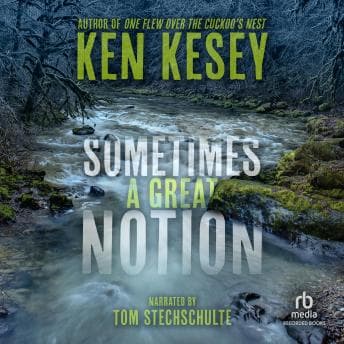

What happens when an author writes a novel so ambitious, so structurally wild, that most people skip it entirely in favor of his more famous first book?
That's the strange fate of Sometimes a Great Notion. Everyone knows One Flew Over the Cuckoo's Nest. I teach it. My students tolerate it. There's something about books that get overshadowed by their authors' more accessible work - I ran into a version of that with White Fang, which sits permanently in the shadow of The Call of the Wild even though it's doing something rawer and stranger. But Kesey himself considered Notion his real achievement - the bigger, harder, more dangerous swing. And after thirty hours and forty-five minutes with Tom Stechschulte in my ears, I think Kesey might've been right.
The Novel That Out-Faulkners Faulkner
Let me be honest about what you're getting into. This is not a clean, linear story about loggers in Oregon. Kesey shifts point of view mid-paragraph - sometimes mid-sentence - sliding between Hank Stamper's stubborn physicality, his half-brother Lee's bitter intellectualism, and the collective consciousness of an entire small town choking on a labor strike. The narrative voice drifts like river current, pulling you under one character's skin and then surfacing in someone else's memory. This reminds me of what Hemingway said about prose being like an iceberg - except Kesey shows you the whole damn iceberg, the water, the tectonic plates beneath it, and then asks you to swim.
I was grading sophomore essays on The Great Gatsby at about 11 PM when the Stamper family's Thanksgiving confrontation hit me so hard I had to put my red pen down. The tension between Hank and Lee isn't just sibling rivalry - it's two incompatible philosophies of American manhood grinding against each other like tectonic plates. Hank's "Never give an inch" motto isn't just stubbornness; it's a theology. And Lee's resentment isn't weakness; it's the wound of a man who grew up watching that theology crush everyone around him.
My students would hate this. I love it.
Stechschulte's Steady Hand on an Unsteady Ship
Here's where it gets complicated. Tom Stechschulte narrates this like a man reading aloud on a front porch - steady, measured, unhurried. His voice has a warmth and clarity that makes Kesey's labyrinthine prose followable, which is no small thing when the text is jumping between interior monologues like a pinball machine. During the logging scenes - the chainsaw work, the river drives, the sheer physical danger of felling old-growth timber - his delivery carries real weight. You feel the fatigue in those sequences.
But that steadiness cuts both ways. When Kesey shifts from Hank's voice to Lee's, from the union men's collective grumbling to old Henry Stamper's ornery monologues, Stechschulte doesn't shift much with them. The vocal register stays pretty consistent. In a 30-hour listen, that sameness becomes a problem - there were stretches where I genuinely lost track of who was speaking and had to rewind. The narrator understands that pause is punctuation, and his dramatic pauses work beautifully in the family conflict scenes. But character differentiation? That's where the performance falls short of what this particular novel demands.
For comparison - I listened to Frank Muller's work on Blood Meridian years ago, another dense, demanding American novel, and Muller found ways to shift his instrument for each voice without ever breaking the book's tone. Stechschulte doesn't quite get there. He's a reliable guide through difficult terrain. But this book needed a shapeshifter.
Thirty Hours Is a Relationship, Not a Commute
Let's talk about the commitment. Thirty hours and forty-five minutes. That's longer than most audiobooks I've listened to this year combined. And Kesey earns almost all of it - the Oregon landscape alone is worth the time, rendered in prose so physical you can smell the Douglas fir and feel the rain soaking through flannel. The river scenes, where the Wakonda Auga rises and threatens everything the Stampers have built, are genuinely breathtaking. The prose deserves to be savored.
But "almost all of it" isn't all of it. There are stretches in the middle third where the internal reflections loop and circle without advancing, and with Stechschulte's even-keeled delivery, those sections can feel like wading through mud. I caught myself drifting during a faculty meeting - which, fine, I was already not paying attention to Principal Martinez's facilities update - but I was drifting from the audiobook, which is a different problem entirely.
Listen at 1.0x. The author chose those words, and Kesey's rhythm - that rolling, recursive, almost jazz-like sentence structure - only works at natural speed. Speed this up and you'll lose the music entirely.
Who Gets to Take This Walk
If you loved Faulkner's As I Lay Dying or Absalom, Absalom!, this is its spiritual successor - an American family saga told through fractured perspectives with the landscape as a living character. If you have patience for demanding prose and 30+ hours of commitment, this is one of the great underappreciated American novels in audio form.
If you need distinct character voices to track a multi-POV narrative, or if pacing under 10 hours is your sweet spot, this will test you. Hard.
Worth Pausing the Faculty Meeting For
Kesey wrote a monster of a book - unwieldy, brilliant, sometimes frustrating, always alive. Stechschulte gets you through it with competence and genuine emotional depth in the big moments, even if the performance doesn't fully match the novel's wild ambition. I finished it on a Saturday morning walk along the lakefront with Denise, and I stood there for a full minute after the last line, just watching the water. That's not nothing. That's the sign of a book that got under my skin despite everything working against it.
This is why we still read the classics. Even the ones nobody reads.