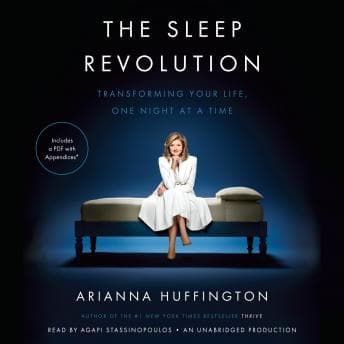

So here's the irony: I listened to a book about the importance of sleep while battling insomnia at 2 AM, making dal tadka I didn't need and wouldn't eat until tomorrow. My therapist would have thoughts about this. But there I was, stirring lentils and absorbing Arianna Huffington's argument that I — and pretty much everyone in modern Western culture — am slowly destroying myself by not sleeping enough.
Let me be upfront about something. I expected to be annoyed by this book. Celebrity wellness content often reads like a case study in confirmation bias dressed up in expensive athleisure. But Huffington actually does the work here, pulling from sleep science research spanning decades, and she structures her argument the way a decent researcher would: here's the crisis, here's the evidence, here's what you can do. The psychology nerd in me appreciated that she doesn't just hand-wave at "sleep hygiene" — she walks through the neurological mechanics of what sleep deprivation does to decision-making, emotional regulation, and memory consolidation. The research actually shows that chronic sleep loss mimics the cognitive effects of intoxication, and Huffington hammers this point with enough supporting data that it lands. Science of Living covers this same neurological territory and is worth cross-referencing if you want the sleep deprivation data without the memoir framing — though it lacks Huffington's cultural critique, which is honestly half the value here.
When Your Brain Won't Shut Up About Cortisol at 3 AM
What makes this book genuinely useful rather than just anxiety-inducing is the structure. Huffington spends roughly the first half building the case — the health consequences, the cultural glorification of exhaustion, the sleeping pill industry's uncomfortable economics — and the second half on practical application. She covers everything from bedroom environment to meditation techniques to the role dreams play in processing emotional memory. That last part caught my attention. As someone who studies how narratives shape identity, the section on dreams as a form of unconscious storytelling was the most psychologically rich territory in the book. I found myself asking: why does Huffington frame sleep itself as a kind of narrative reset? Because she's right that we construct meaning from our waking lives partly through what our sleeping brains do with the raw material.
The book does get repetitive. By hour six or seven, you've absorbed the core message — sleep matters, you're not getting enough, Silicon Valley hustle culture is a lie — and yet Huffington keeps circling back to it. At nearly ten hours, this could've been tighter. Some sections feel like padding, particularly when she lists celebrities and executives who've "converted" to prioritizing sleep. Cool, good for them. But anecdote stacking isn't evidence, and a book that otherwise respects the science shouldn't lean so hard on appeal to authority.
The Accent in the Room
Okay, the narration. Agapi Stassinopoulos — Arianna Huffington's sister — narrates, and she sounds strikingly similar to Huffington herself. There's a lilting Greek accent that, depending on your ear, either lends warmth and credibility or becomes a genuine comprehension barrier. I'll be honest: during the more data-heavy passages, I had to rewind a few times because certain words blurred together under the accent. It's not a dealbreaker, but it's a real factor for an audiobook that's asking you to absorb specific studies and statistics. The pacing is steady, almost meditative — which, sure, thematically appropriate for a sleep book, but it does mean your attention can drift during the middle chapters if you're not locked in.
Psychologically, this doesn't track as the best narration choice for a science-heavy self-help book. You want clarity above all else. And Stassinopoulos delivers conviction and familial authenticity, but at the cost of occasional intelligibility. It's a trade-off, and whether it works for you is genuinely subjective.
Who This Is Really For (And Who Should Grab the Print Version Instead)
If you're someone who intellectually knows sleep matters but needs the full evidentiary weight to actually change your behavior — this is a solid pick. Huffington treats the reader like an adult, not a child who needs to be scared into bedtime. The book is strongest as a comprehensive overview: history, science, cultural criticism, practical tips, all in one place. It's weakest when it gets redundant or leans too heavily on celebrity endorsement.
If you're a fast-paced audiobook listener or someone who struggles with accented narration, honestly? Grab the print or ebook version instead. The content deserves your attention, but the audio format introduces a friction that the text doesn't have.
My Prescription, If You'll Take It
I finished this at 4 AM. Made myself go to bed. Slept seven hours for the first time in weeks. So either Huffington's argument is genuinely persuasive, or I was just exhausted from standing in my kitchen for four hours. Probably both. The book won't revolutionize your understanding if you already follow sleep research, but as a one-stop synthesis with practical takeaways, it earns its shelf space. Just maybe not its audio runtime.