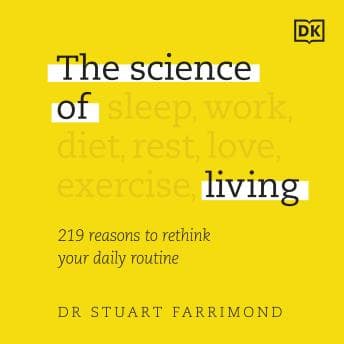

I was debugging a particularly nasty race condition at 11 PM—the kind where you've been staring at logs for three hours and your brain is just... done. Threw this on while making my fourth cup of tea, expecting background noise. Instead I got genuinely useful information about why my 2 AM debugging sessions are probably destroying my circadian rhythm. Thanks, Dr. Stu. Really needed that guilt.
Bottom Line: Worth your commute. It's basically Mythbusters for your daily habits, minus the explosions.
Your Wellness App, But Actually Backed By Papers
Here's what I appreciated—Farrimond doesn't just tell you what to do, he explains the mechanism. When he breaks down why the "8 glasses of water" thing is basically made up (your body has this incredible system called thirst, apparently), he walks through the actual physiology. As someone who spends her days understanding systems, I respect when someone shows their work.
Codependent No More does something similar in the self-help space—less physiology, more psychology, but the same satisfying "here's the actual mechanism" energy that makes you trust the author isn't just vibing.The 219 "reasons" format is both the strength and the limitation here. Each topic gets maybe 2-3 minutes of coverage, which means you're getting the executive summary, not the deep dive. For most topics—like why you shouldn't check your phone first thing in the morning (guilty) or the actual science of caffeine timing—that's plenty. But occasionally you hit something genuinely interesting and wish he'd kept going.
Perfect for: commute, gym. Skip for: deep work—there's too much interesting stuff to zone out on.
The Citation Problem (Let's Talk About It)
Some listeners flagged concerns about Farrimond citing studies without enough detail, and... yeah, I get it. When you're a software engineer, you learn to be skeptical of anyone claiming "studies show." Which studies? Sample size? Replication?
Farrimond's credentials are solid—medical doctor, food scientist, writes for New Scientist—but the audiobook format means you can't exactly check footnotes while you're on the Caltrain. The book version apparently has proper citations; the audio version requires some trust. I found myself making mental notes to verify a few claims later. (The breakfast thing checked out. The smartphone-depression nuance was more complicated than his summary suggested.)
The ROI on this audiobook is still positive—even if 10% of the advice turns out to be oversimplified, the other 90% is genuinely useful recalibration of stuff you thought you knew.
Author-Narrated: The Double-Edged Sword
Farrimond narrates his own book, which is always a gamble. Good news: his British accent is pleasant, his delivery is genuinely warm, and you can tell he finds this stuff fascinating. He sounds like that one professor who actually cared whether you understood the material.
The pace is... measured. I bumped it to 1.5x by hour two, which felt right. At 1x, there's a slight lecture-hall quality that made my commute brain want to drift. At 1.5x, it hits that sweet spot where information flows naturally without feeling rushed.
No sound effects, no music, no production gimmicks. Just a knowledgeable guy talking you through his research. For this type of content, that's exactly right.
Dense In The Good Way
I usually have zero patience for self-help books that pad a single insight into 300 pages. This is the opposite problem—it's almost too dense with discrete facts. I finished it in 3 commutes and retained maybe 40% of the specifics. Which is fine! The point isn't to memorize 219 factoids; it's to shift your mental model of what "healthy habits" actually means.
The structure follows a typical day—morning routines through evening wind-down—which makes it easy to apply. When Farrimond hit the section on optimal nap timing (10-20 minutes, early afternoon, don't fight it), I immediately thought about my post-lunch productivity crashes. When he covered the science of why we procrastinate, I felt personally attacked.
This is basically a firmware update for your daily operating system. Not revolutionary, but a lot of small optimizations that compound.
Push To Production?
Queue it if: You're the type who reads nutrition labels, optimizes your sleep schedule, or genuinely wants to understand why certain habits work. Also if you enjoy having ammunition for the next time someone tells you breakfast is essential.
Skip it if: You want deep dives rather than survey courses, you're skeptical of anyone claiming to have 219 pieces of advice, or you need high drama to stay engaged during commutes.
At under 7 hours, the commitment is low and the information density is high. Not every claim will survive your own fact-checking, but enough will to make this worth the listen. I've already adjusted my coffee timing based on his cortisol explanation, and my 6 AM train zombie brain thanks him for it.