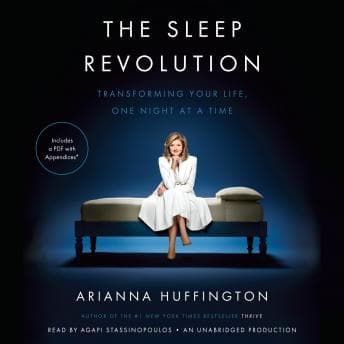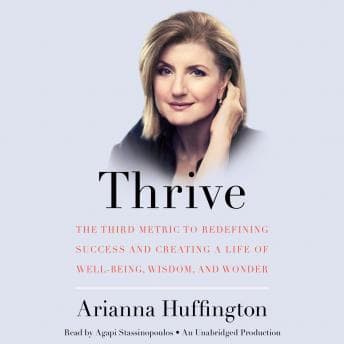

I started this audiobook fully expecting to roll my eyes. A billionaire media mogul telling me I'm working too hard? Please. But then Arianna Huffington opens with the story of collapsing from exhaustion, breaking her cheekbone on her desk, and waking up in a pool of her own blood—and suddenly I'm paying attention. Because that's not a motivational anecdote. That's a case study in what happens when achievement becomes pathology.
The research shows that high achievers often exhibit what psychologists call "contingent self-worth"—their sense of identity is completely fused with external markers of success. Huffington doesn't use that term, but she's describing it perfectly. And here's what makes this character compelling: she's not pretending she's cured. She's still Arianna Huffington. She still runs a media empire. She's just... trying to run it while also sleeping.
The Psychology Behind the "Third Metric"
Huffington's central argument—that success needs a third leg beyond money and power—is honestly pretty basic if you've read any positive psychology. Well-being, wisdom, wonder, giving. Sure. But what kept me listening during my morning jogs through Cambridge was her willingness to get specific about the mechanisms of burnout.
She cites sleep research extensively, and as someone who has definitely graded papers at 2 AM while telling myself I was "fine," the data hit different. The section on how sleep deprivation literally impairs the prefrontal cortex—the part of your brain responsible for judgment and impulse control—explains so much about why overworked people make terrible decisions. (My therapist would have thoughts about this entire section, honestly.) Surrender Experiment approaches this from the opposite angle—what happens when you stop forcing outcomes and just... trust the process.
What I found myself asking: why does Huffington frame this as a "revolution" when it's really just... boundaries? And I think the answer is that for her audience—ambitious, type-A professionals—the word "boundaries" sounds like weakness. Calling it a "third metric" makes it sound like a strategic advantage. Which, psychologically speaking, is actually pretty smart reframing.
Agapi's Voice—A Family Affair That Works
The narrator is Agapi Stassinopoulos, Arianna's sister, not her daughter as some reviews claim. (I looked this up because the family connection felt obvious in the delivery.) Her voice is warm, almost meditative—which fits the content but does create a pacing issue.
Honestly? It's a bit slow. I bumped it up to 1.25x around hour three and never looked back. At normal speed, the narration feels like it's asking you to breathe deeply between every sentence, which—sure, that's on brand for a book about slowing down. But I was trying to get through my run, not achieve enlightenment on the Charles River.
That said, Agapi nails the more personal sections. When she's reading Arianna's stories about her mother, or the struggles of raising two daughters while building HuffPost, there's a genuine tenderness there that you wouldn't get from a professional narrator. The family connection adds something. It's just that the pacing makes the more research-heavy sections drag.
Where the Argument Gets Thin
Here's my issue: Huffington is writing from a position of extreme privilege, and she knows it, but she doesn't fully grapple with it. She can afford to take digital sabbaticals and hire sleep consultants and redesign her bedroom for optimal rest. Most people listening to this audiobook cannot.
The book gets repetitive in places—she circles back to the same core ideas multiple times, which feels less like reinforcement and more like padding. And some of the anecdotes about meditation retreats and Greek philosophy quotes feel a bit... I don't know, aspirational lifestyle content rather than practical advice?
But here's the thing. I still found value in it. Not because Huffington has all the answers, but because she's articulating a problem that most achievement-oriented people won't admit they have. The protagonist exhibits classic denial patterns throughout—she kept working through exhaustion for years, ignoring every warning sign—and her wake-up call had to be literally hitting the floor. That's a fascinating case study in how we rationalize self-destruction when it comes wrapped in success. Golden Key tries to address similar patterns around scarcity thinking, though with way more metaphysical hand-waving and less actual neuroscience.
Who This Works For (And Who It Won't)
If you're already into mindfulness and work-life balance, this will feel basic. You've heard it. Skip this one. But if you're someone who secretly believes that sleeping less makes you more productive, and you need a successful person to give you permission to rest—this might genuinely help.
I'm recommending it with caveats. Speed it up. Skip the repetitive sections if they're losing you. And take the privilege-blind moments with a grain of salt.
The Diagnosis, If Not the Cure
The core message? That we've built a definition of success that's literally making us sick? Yeah. The research backs that up. And sometimes you need a billionaire to say it before certain people will listen.