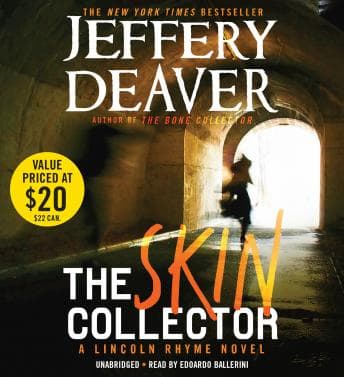

Everyone I know who listens to thrillers has a strong opinion about Jeffery Deaver. Either you're fully on board with his hyper-procedural, clue-dense style, or you bounced off book two and never came back. I'm solidly in the first camp - have been since The Bone Collector - so coming into Skin Collector, I wasn't exactly a neutral party.
I finished this one during a stretch of particularly brutal night shifts. The kind of week where you're running on four hours of sleep and cold brew and the vague memory of what sunlight feels like. I had it going on my drive home at 6 AM, windows down, Phoenix already heating up, and I kept missing my exit because I was too locked into what was happening underground in New York. That's the Deaver effect. It's not subtle.
Poison Ink and Procedural Rabbit Holes
Okay, the premise: a killer is stalking victims through Manhattan's underground tunnels and basement spaces, tattooing them with a poison-loaded gun. The tattoos carry cryptic messages. The killer has a connection to the Bone Collector case from fifteen years prior. Lincoln Rhyme - quadriplegic forensic consultant, certified genius, certified difficult person - gets pulled in.
The poison-tattoo mechanism is genuinely clever, and I say that as someone who has watched a lot of creative methods of harm come through my ER. The toxicology details Deaver uses aren't perfect, but they're close enough that I didn't yell at my dashboard. Which, for a medical thriller, is high praise. Last Trial earned similar respect from me on the procedural accuracy front - courtroom mechanics instead of toxicology, but that same sense that the author actually did the work. The underground New York geography - the tunnels, the forgotten infrastructure, the mole people culture - feels researched rather than invented, and that specificity matters. It's the difference between atmosphere that feels real and atmosphere that feels like a movie set.
The clue structure is classic Deaver: elaborate, layered, and occasionally maddening in the best way. He builds these procedural chains where one piece of forensic evidence leads to a location leads to a witness leads to a new clue, and you're either completely with it or completely lost. I was with it. Mostly. There's a stretch in the middle where the subplots multiply faster than I could track them during a 6 AM commute on three hours of sleep, and I had to rewind twice. That's on me, probably. But also maybe on the book.
The ending has multiple twists stacked on each other, and one of them genuinely got me. Not the first one - I saw that coming around hour ten. But the second one? Didn't see it. Appreciated it. Accidental Death pulled a similar move on me - the twist I braced for landed soft, and then the one I wasn't watching for hit hard.
Ballerini Doing What Ballerini Does
Edoardo Ballerini is an Audie Award winner, and it shows. His performance here is controlled in a way that actually serves Lincoln Rhyme specifically - Rhyme is contained, cerebral, not emotionally expressive in conventional ways, and Ballerini's steady delivery captures that without making him feel flat. It's a harder trick than it sounds. A lot of narrators overcorrect with a character like Rhyme and make him either robotic or secretly warm. Ballerini keeps him exactly where he should be: brilliant, a little cold, fascinating.
The tension sequences - and there are several good ones - land because Ballerini doesn't oversell them. He trusts the writing, and the writing mostly earns that trust. The pacing never drags, which at 13 hours is not nothing.
My one mild note: the character differentiation between secondary characters could be sharper. There's a point late in the book where I had to piece together from context who was speaking because the vocal distinctions were subtle enough to get blurry during a tired commute. Not a dealbreaker. Just something to know going in.
Night Shift Prescription
If you've read The Bone Collector and liked it, you'll like this. The formula is intact - probably too intact if you've done the whole series and are starting to feel the repetition - but it's a good formula. Deaver knows what he's doing.
If you're new to Lincoln Rhyme, you could start here and be fine. Deaver does enough catch-up that you won't be lost. But you'll enjoy it more if you've got the history.
If you bounced off Deaver before because the procedural detail felt like homework, this won't change your mind. That's still very much what this is.
For the rest of us? Night shift approved. Perfect for that post-shift decompression when your brain is too tired for anything that requires emotional investment but still wants to feel smart. Poison tattoos and underground tunnels and Lincoln Rhyme being insufferable in the best way. Exactly what I needed at 6 AM on a Tuesday.