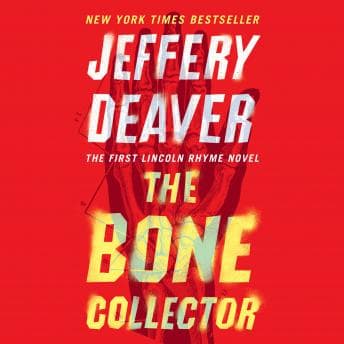

Look, I need to rant about something. Jeffery Deaver wrote one of the tightest, most forensically obsessive thrillers of the '90s — a book where a quadriplegic criminologist directs a crime scene investigation entirely through his mind and his words, where every grain of sand and fiber of rope becomes a breadcrumb toward a serial killer operating out of New York's buried infrastructure — and somebody decided the right voice for this was a narrator who sounds like he's reading you the safety data sheet for hydrochloric acid.
I'm frustrated. Because the book? The book is phenomenal.
Lincoln Rhyme Deserved a Performance, Not a Lecture
Here's what makes Deaver's writing work: Lincoln Rhyme is trapped. Paralyzed from the neck down after a beam collapse at a crime scene, the man's entire world is his bedroom, his equipment, and the people he can bully into being his eyes and hands. Amelia Sachs — young cop, claustrophobic, not remotely prepared for what Rhyme demands of her — becomes his proxy at increasingly horrifying crime scenes. Victims buried alive with cryptic evidence planted around them. The killer — the Bone Collector — isn't just murdering people, he's constructing puzzles. It's cat-and-mouse where both the cat and the mouse are uncomfortably intelligent.
Deaver's forensic detail is staggering. I'm talking pages of soil analysis, discussions about the specific patina on old coins, the way Rhyme can identify a neighborhood by the composition of dust. It's the kind of procedural nerdery that should make my librarian heart sing. And honestly? Reading it, or hearing it described, it does. But Connor O'Brien's delivery turns these passages — which should crackle with Rhyme's manic, frustrated energy — into something closer to a continuing education seminar.
The narrator commits... to sounding like a textbook. And that's the wrong commitment.
When the Voice Fights the Book
I was reorganizing my horror shelf — yes, I have a dedicated horror shelf, yes, it's organized by subgenre, no, I won't apologize — and I had this playing through my speaker. About two hours in, I actually stopped what I was doing and checked my playback speed because O'Brien's pacing felt oddly mechanical. Nope. Normal speed. That's just... how he reads.
The real problem isn't the pacing, though. It's the flatness. There's a moment where Sachs is forced to walk a grid pattern over an active crime scene — a scene with a victim who may still be alive underground — and the tension in Deaver's writing is palpable. You can feel Sachs's hands shaking through the prose. But O'Brien narrates it with the same even keel he uses for Rhyme's forensic monologues. There's no escalation. No sweat in the voice. The gender confusion on certain characters doesn't help either — there were at least two points where I had to rewind because the vocal characterization didn't match who was speaking.
Some people have said his clinical tone actually works for the forensic content, and I'll give that a partial nod. When Rhyme is cataloging evidence, the almost academic delivery does mirror how a scientist thinks. But Lincoln Rhyme isn't just a scientist. He's furious. He's suicidal. He's a man who lost everything and is clinging to relevance through sheer intellectual aggression. That fire needs to live in the narrator's voice, and it just... doesn't.
Deaver's Puzzle Box Still Works, Even Half-Muted
Here's the thing that saves this from being a total loss: Deaver's plotting is so tight, so relentlessly paced, that even a flat narration can't fully kill it. The Bone Collector's methodology — the historical connection to old New York, the way each crime scene is staged as a reference to the city's dark past — is genuinely clever. And the Rhyme-Sachs dynamic, this reluctant partnership between a man who can only think and a woman who can only act, builds into something surprisingly emotional by the final hours.
If you've only seen the Denzel Washington movie, the book goes deeper. Way deeper. The film simplified the puzzle structure and softened Rhyme's edges considerably. Book Rhyme is meaner, more desperate, and the killer's identity lands with more impact because Deaver earns it through 11 hours of forensic misdirection.
Shirley Jackson walked so Deaver could — okay, no. Different lanes entirely. But Deaver does understand something that the best horror and thriller writers share: dread isn't about what's happening. It's about what you're afraid might be happening three steps ahead.
Who Gets the File and Who Gets Redirected
If you love forensic thrillers and you've never read Deaver, start here. But maybe — and I don't say this lightly — consider the print version, or find an older audio edition if one exists. If narration doesn't bother you much and you're in it for plot, you'll survive O'Brien's delivery. If you're like me and you believe the narrator IS the audiobook experience, this one's going to test your patience.
My podcast listeners are going to love this recommendation with the massive asterisk I'm about to attach to it. Great book. Wrong voice. The procedural DNA here reminded me of the kind of methodical dread I sat with in Darkest Evening of the Year — though Koontz works his tension through emotional attachment rather than forensic obsession.