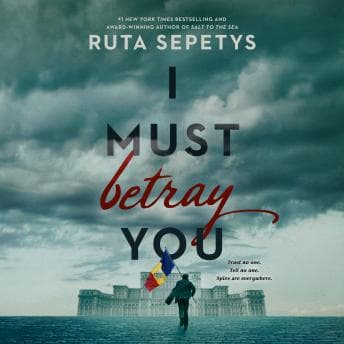

What would you do if a secret police officer sat you down and told you to spy on your own family - and refusing meant they'd destroy everyone you love?
That's where this book drops you, like page one, no warm-up, and I spent the next seven hours with my stomach in a knot. I started I Must Betray You during Sophie's nap on a Tuesday and finished it in the school pickup line two days later. Made me cry at school pickup. Worth it though.
The Kid Who Can't Trust Anyone - Including Himself
Cristian Florescu is seventeen, living in 1989 Bucharest, Romania, under Ceaușescu's dictatorship, and Ruta Sepetys does something brutal with his voice: she makes you paranoid right alongside him. Every conversation Cristian has, you're scanning for the informer. His best friend? Maybe. His girlfriend? Could be. The paranoia of not knowing who to trust reminded me of Serpentine, where the mystery hinges less on whodunit and more on who's been lying to your face the whole time. His own grandfather, who he clearly adores? There's this scene where Cristian realizes the Securitate (secret police) already know things about his family that only someone close could have told them, and I literally paused the audiobook and sat in my driveway staring at nothing for a full minute.
The paranoia is the point. Sepetys doesn't just tell you Romania was a surveillance state - she makes you feel what it's like when trust itself becomes dangerous. Cristian is recruited as an informer, given the code name "Oscar," and every time he has to file a report, you feel the walls closing in. What do you write? What do you leave out? Who are you protecting and who are you sacrificing?
And here's what got me: this is technically a YA novel. My Emma is only seven, but I'm already earmarking this for when she's older because the way Sepetys handles moral complexity - there's no easy hero moment. Cristian tries to be clever, tries to undermine the system from inside, but the system is bigger than him and it knows it.
Ballerini Made Me Forget I Was Listening to an Audiobook
Okay, I need to talk about Edoardo Ballerini's narration because it's the reason this book hit so hard in audio. His Cristian sounds young but not naive - there's this constant undercurrent of tension in his voice, like someone who's always bracing for bad news. Which, in communist Romania, tracks.
What impressed me most: his Romanian pronunciation. I don't speak Romanian, but there's a difference between a narrator who fumbles foreign words and one who clearly did the work, and Ballerini did the work. Character names, street names, the way he handles "Ceaușescu" - it all sounds natural, not like he's reading phonetic spellings off a card. He also gives distinct voices to the different characters without going cartoonish. Cristian's grandfather has this weary gravitas. The Securitate agent who recruits Cristian has a calm, almost friendly tone that's somehow more terrifying than shouting would be.
Ruta Sepetys records an author's note at the end, and honestly? Don't skip it. She talks about the real people and events behind the story, and it hit me harder than the novel's climax.
Seven Hours That Felt Like Being Held Underwater (In a Good Way?)
At seven hours, this is a quick listen - I finished it in roughly four sessions, which for me is basically speedreading. The pacing is relentless. Sepetys writes short chapters that end on these sharp little hooks, and even at 1.25x speed, I kept wanting to push through "just one more chapter" during nap time. (Sophie cooperated exactly once. Miracle.)
But here's my one caution: this is not a comfort read. I pick up a lot of books specifically because I want a predictable happy ending after cleaning yogurt off the ceiling fan. This is not that book. The Romanian revolution happens, yes, and there's hope woven through the story, but there's also real violence, real loss, and an ending that's more bittersweet than triumphant. The scenes during the revolution itself - gunfire in the streets, civilians being shot - are written with restraint but they still shook me.
Survived 47 pauses and still made sense, which is remarkable for a book with this much political context. Sepetys is smart about feeding you information in small doses through Cristian's daily life - the bread lines, the electricity rationing, the single state TV channel that only aired propaganda. You absorb the history without ever feeling lectured.
Who Needs This in Their Ears
If you've read Sepetys before (Between Shades of Gray, Salt to the Sea), you know what you're getting: hidden history made visceral and personal. If you haven't, this is a fantastic entry point - it's tight, it's focused, and it doesn't require any background knowledge.
Parents: this is incredible for older kids (12+) and would make a killer family listen on a road trip if you're okay with some heavy conversations afterward. Not groundbreaking to say YA historical fiction can be important, but this one earns it.
Skip if you're looking for light or escapist. This book wants your full attention and a piece of your heart.
The Mom in the Driveway Says Listen to This
I went in expecting "good YA historical fiction" and came out genuinely shaken by a period of history I knew almost nothing about. Ballerini's performance carries you through the darkest parts without letting you look away. My book club will love this (if I ever have time for book club again). Seven hours well spent. Now if you'll excuse me, I need to go hug my kids and be grateful they'll never know what a bread line looks like.