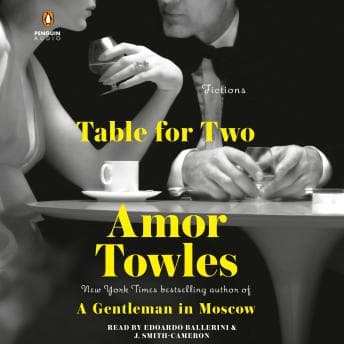

Amor Towles doesn't write short stories. He writes miniature novels that happen to end sooner than you'd like.
I need to say that upfront because if you're coming to Table for Two expecting the sprawling, single-narrative immersion of A Gentleman in Moscow or The Lincoln Highway, you're going to feel like someone handed you a tasting menu when you ordered the prix fixe. And look - some people were disappointed by that. I get it. But here's the thing: Towles at appetizer-portion size is still better than most authors at full entrée.
The New York Stories Hit Different After Midnight
I started this one during a faculty meeting about standardized testing benchmarks - Principal Martinez was presenting slides with clip art from 2008 - and the opening story, "The Line," immediately pulled me out of that fluorescent-lit conference room and into a New York City that feels both specific and mythic. The stories are mostly set around 2000, which is a clever choice. It's recent enough to feel familiar but far enough back that the city operates differently - no smartphones, no Uber, no Instagram. People actually have to show up somewhere and deal with each other.
What Towles does so well in these six New York pieces is explore what happens when two people sit across from each other and the power dynamics shift. Brief encounters with long consequences. A chance meeting that rewrites a marriage. That same tension between a single moment and its lasting fallout is what made 57 Bus stick with me too - though Towles works in fiction and that one is devastatingly real. The "delicate mechanics of compromise" the description mentions - that's not marketing copy, that's genuinely what these stories dissect. And they do it with the kind of precision that makes you realize Towles was an investment guy before he was a novelist. He understands leverage. He understands what people are willing to trade.
Edoardo Ballerini narrates these stories, and his pacing is - I want to say "surgical" but that sounds cold. It's more like a jazz musician who knows exactly how long to hold a rest. The narrator understands that pause is punctuation. His delivery in "The Line" especially caught me. There's an emotional weight he brings without ever tipping into melodrama. At 1.0x speed (because the author chose those words), Ballerini gives you time to catch the irony Towles buries in his sentences like little landmines.
Eve Ross Walks Into Hollywood and Steals the Whole Book
The novella - "Eve in Hollywood" - is where this collection transforms from very good to genuinely special. If you read Rules of Civility, you remember Evelyn Ross. If you didn't, don't worry - Towles gives you enough. Eve's train pulls into Chicago, her parents are waiting on the platform, and she just... keeps going. Extends her ticket to Los Angeles. That single decision powers a noir-inflected story told from seven different points of view, and every one of those perspectives feels distinct and earned.
This is where J. Smith-Cameron enters, and the dual narration works beautifully. The Hollywood sections have this smoky, golden-age atmosphere - dive bars and bungalows and studio lots - and when Olivia de Havilland shows up as a character, she's rendered with enough specificity that you buy it completely. Not as a cameo or a wink, but as a real person navigating a real industry. My students would hate this. I love it. The prose deserves to be savored, and at roughly the back third of a 13-hour listen, the novella has room to breathe in a way the shorter pieces can't.
This reminds me of what Hemingway said about prose being architecture. Towles builds rooms you want to stay in. The novella is a whole house.
Who Gets a Seat at This Table
Here's where I'll be honest: this is a focused listen. Don't put this on while you're running errands or pretending to grade vocabulary quizzes. The stories reward attention - they're constructed with clockwork precision, and if you zone out for three minutes, you'll miss the turn that recontextualizes everything before it. Denise and I walked the lakefront during "Eve in Hollywood" and I kept stopping mid-stride to process something, which she found annoying and I found necessary.
If you loved A Gentleman in Moscow, this is its spiritual successor in tone but not in form. Expect elegance, wit, a kind of warm intelligence - but in shorter bursts. Some listeners found the ending abrupt, and I understand that complaint. The novella doesn't wrap things up with a bow. It trusts you to sit with ambiguity, which is either confident writing or frustrating writing depending on your temperament.
Skip this if you need plot-driven momentum. Grab this immediately if you think a well-constructed sentence is its own reward.
Worth Pausing the Faculty Meeting For
Towles remains one of the few contemporary writers whose prose actually benefits from being read aloud. Ballerini and Smith-Cameron both understand that, and they serve the material with intelligence and restraint. The Earphones Award was deserved. At 13 hours, it's a commitment for a short story collection, but I never once reached for the speed dial. Every story earned its runtime. Most of them earned a second listen.
Let's talk about what the author is really saying with this collection: that small moments between people - a dinner, a line outside a restaurant, a decision made on a train platform - carry more weight than we give them credit for. This is why we still read the classics. And this is why, twenty years into teaching English, I still believe a great sentence can stop you on a lakefront path and make your wife walk ahead without you.