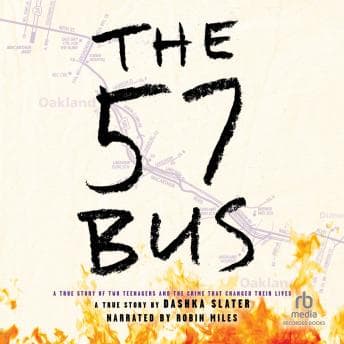

I was making dal makhani at 10 PM on a Tuesday—the kind of elaborate cooking project my mother would call 'unnecessary for one person'—when Robin Miles started explaining Oakland's geography. The flatlands versus the foothills. Eight minutes of overlap on a bus route. By the time my lentils were simmering, I'd completely forgotten about dinner.
This book broke me in ways I wasn't prepared for.
Two Case Studies, Zero Easy Answers
The protagonist exhibits classic—no, wait. I can't do that here. Because Dashka Slater refuses to let you see either Sasha or Richard as a 'case study.' And believe me, I tried. My brain kept wanting to categorize: victim, perpetrator, trauma response, environmental factors. Slater anticipated every clinical impulse I had and gently, persistently, dismantled it.
Sasha is agender, uses they/them pronouns, wears skirts to their small private school, and has a community that wraps around them like armor. Richard is a Black teenager from the flatlands who made a terrible, impulsive decision—lighting a sleeping stranger's skirt on fire—that the justice system immediately labeled a hate crime with life-imprisonment stakes. The research shows that adolescent brains are literally incapable of fully processing long-term consequences. Slater knows this. She weaves in the neuroscience without ever using it as an excuse.
What makes this book compelling is its refusal to pick a side while still acknowledging that something horrific happened. Sasha was burned. That's real. That matters. And Richard was sixteen, goofing around, not thinking—and now facing decades in prison. Both things are true. My therapist would have thoughts about how uncomfortable that makes most people.
Robin Miles Carries the Weight
Miles's emotional delivery never tips into melodrama. She reads Slater's journalistic prose with the gravity it deserves, but there's warmth there too. When the narrative shifts between Sasha's world and Richard's—the private school discussions about gender identity versus the chaotic energy of a public school hallway—Miles adjusts her register just enough that you feel the transition without it becoming performative.
At under six hours, this is a tight listen. No bloat. Slater's background as a journalist shows in the pacing—she moves between interview snippets, court documents, and contextual history with efficiency. I found myself asking: why does the criminal justice system treat a sixteen-year-old's impulsive act as equivalent to premeditated violence? Slater doesn't answer that directly. She just keeps presenting evidence until you're forced to sit with your own discomfort.
The Part That Haunts Me
There's a section—I won't spoil exactly when—where the book pivots from 'what happened' to 'what should happen next.' Restorative justice versus punitive justice. Sasha's family, despite everything, advocates for a sentence that doesn't destroy Richard's entire future. A study in forgiveness that doesn't require forgetting. In accountability that doesn't demand destruction.
Psychologically, this tracks. Revenge rarely heals trauma. But watching it play out with real teenagers, real families, real consequences—that's different from reading about it in a journal article nobody will cite.
(I burned the dal, by the way. Had to start over. Worth it.)
Who Should Listen—And Who Should Prepare Themselves
If you want clear villains and heroes, skip this. If you need your true crime with satisfying resolution, this isn't it. But if you're the kind of person who lies awake wondering why people do terrible things to each other—and whether our systems of punishment actually prevent anything—this book will live in your head rent-free.
Parents of teenagers should listen. Teachers should listen. Anyone who's ever thought 'well, they did the crime' without considering what 'justice' actually means should listen.
Robin Miles brings that same moral weight to Caste: The Origins of Our Discontents, another book that refuses to let you stay comfortable in your assumptions about how systems sort people into categories they never asked for.Content warning: there's violence here. A teenager is set on fire. Slater handles it with care, but it's not sanitized. You'll feel it.
The Diagnosis
I study why people do what they do. I've read hundreds of case studies, analyzed fictional characters until my colleagues beg me to stop, written papers about narrative psychology that gather dust in academic databases. And this book—a true story about two teenagers on a bus—taught me something new about the limits of categorization.
Some people are victims. Some people do terrible things. Some people are both. Slater doesn't ask you to forgive anyone. She just asks you to understand that the story is more complicated than the headline. And understanding, it turns out, is harder than judgment.
My dal turned out fine the second time. I ate it alone, thinking about Oakland, thinking about buses, thinking about all the lives that intersect for eight minutes and then diverge forever—or don't.









![Seis de cuervos [Six of Crows] audiobook cover](/_next/image?url=https%3A%2F%2Fm.media-amazon.com%2Fimages%2FI%2F51cRXzEIhiL._SL1200_.jpg&w=1920&q=75)