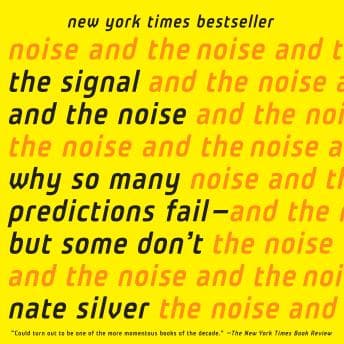

How many decisions did you make today based on a prediction that was basically garbage?
That question kept rattling around my head during week two of this book, right around the time Silver gets into weather forecasting versus earthquake prediction and you realize - oh, we are spectacularly bad at knowing what we don't know. I started this one during a particularly brutal stretch of on-call where I was staring at dashboards full of metrics at 2AM trying to figure out which signals actually mattered and which ones were just noise in our monitoring system. Felt a little too on-the-nose, honestly.
Bayesian Thinking Is Basically a Software Design Pattern
TL;DR: Worth your commute, but you'll need to be awake for it.
Silver's core argument is that good forecasters are Bayesian thinkers - they start with a prior belief, update it incrementally with new evidence, and resist the urge to be overconfident. If you've ever worked with probabilistic systems or even just debugged a flaky integration test, this framework clicks immediately. The book walks through prediction failures and successes across baseball (Silver's original playground with his PECOTA system), poker, weather, elections, financial markets, climate science, and terrorism.
The strongest chapters are the ones where Silver has actual skin in the game. His breakdown of how baseball scouting combines quantitative PECOTA projections with qualitative human judgment is genuinely fascinating - it's not pure Moneyball evangelism, it's more like "here's where the model breaks and the human eye catches what the numbers miss." The poker chapters hit similar notes, with Silver himself playing the World Series of Poker and walking through how Bayesian updating works in real-time when you're reading opponents and recalculating odds hand by hand.
Where it gets weaker: the financial crisis chapter and the terrorism chapter feel like Silver is operating outside his deepest expertise, and you can tell. The analysis gets broader, less surgical. The book is from 2012, so some examples feel dated - pre-pandemic, pre-2016 election (which is... ironic given Silver's own forecasting journey after this). But the underlying framework? Still rock solid. This is basically Thinking, Fast and Slow but for predictions specifically, with way more sports analogies.
Mike Chamberlain: The 6AM Problem
Here's where I have to be honest. At 16+ hours, this is a substantial listen - I finished it across about 8 commutes. Mike Chamberlain narrates with this kind of even-keeled, youthful energy that matches Silver's approachable writing style. It works well when you're alert. But at 6AM on the Caltrain, squeezed between someone's backpack and a guy who apparently bathes in cologne? Chamberlain's steady delivery nearly knocked me out twice. Not because he's bad - he's competent and clear - but because he doesn't have that dynamic range that keeps your brain locked in during low-energy moments.
I bumped it to 1.5x and that actually helped a lot. The pacing tightened up, Chamberlain's delivery got a little more punch, and the denser statistical chapters stopped feeling like they were stretching into infinity. At 1x, some of the middle chapters (looking at you, chess and Deep Blue section) drag. At 1.5x, the whole thing moves.
No sound effects, no production tricks - just straightforward narration. Clean audio, nothing to complain about technically.
The ROI Calculation
The ROI on this audiobook is solid but conditional. If you work with data in any capacity - engineering, product, analytics, even just making decisions based on dashboards - the mental models here are genuinely useful. I've already caught myself thinking "okay but what's my prior here and how confident should I actually be" during incident reviews. That's real value.
But could parts of this have been a blog post? Yeah, some chapters feel padded. The earthquake prediction chapter makes its point in the first 20 minutes and then keeps going for another 40. Silver sometimes falls into the classic nonfiction trap of "let me give you three more examples to prove the point I already proved." At 16 hours, there's probably a tighter 10-hour book hiding inside.
Perfect for: commute (at 1.5x), long flights, gym sessions where you want to feel intellectually productive. Skip for: bedtime (Chamberlain's voice + statistics = instant sleep), background listening (you'll miss the actual arguments and just hear anecdotes).
Who Gets the Most Signal Here
If you're a data nerd, a sports stats person, or someone who makes decisions under uncertainty (so... everyone in tech), this is worth your time. If you've already read Kahneman, Taleb, and Tetlock's Superforecasting, some of this will feel familiar but Silver's approach is more accessible and less academic than any of those.
Skip it if you want something you can half-listen to. This rewards attention. Also skip if you need your nonfiction to feel current - a 2012 book about predictions that doesn't cover COVID or the 2016/2020 elections feels like it's missing some important chapters. (Silver, if you're reading this, the updated edition would basically write itself.)
I'm giving it a solid recommend with the caveat that your speed settings matter more here than almost any other audiobook I've listened to this year. Contrast that with something like My First Summer in the Sierra, where the prose is so unhurried it's practically designed for 1x — totally different listening mode. Chamberlain at 1x is a sleep aid. Chamberlain at 1.5x is a solid commute companion. Choose wisely.