
What does it cost to be sold by your own father?
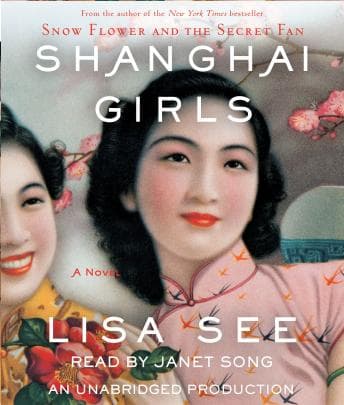
I don't mean philosophically. I mean the actual, gut-level reckoning of it — what happens to two sisters when their father gambles away everything and trades them like assets to settle his debts? That question sat with me through thirteen and a half hours of Lisa See's Shanghai Girls, and it's still sitting with me now, two days later, while I'm supposedly reviewing vocabulary quizzes at my kitchen table.
The Shanghai That Disappeared Between Chapters
See does something I wish more historical fiction writers would attempt: she makes you fall in love with a world she's about to destroy. The opening hours paint 1937 Shanghai in these gorgeous, almost intoxicating strokes — Pearl and May are "beautiful girls," modeling for artists, living this cosmopolitan life that feels impossibly glamorous for the era. And then the Japanese bombs fall, and everything collapses. Not gradually. Not with narrative warning. It just — ends. The transition from Pearl and May's carefree Shanghai life to their desperate flight through the countryside hits like a door slamming. See doesn't let you linger in the beauty. She yanks it away, which is exactly what happened historically, and that honesty matters.
What struck me hardest was the specificity of the immigration experience at Angel Island. I've taught excerpts about Ellis Island a hundred times. My students can practically recite the Statue of Liberty poem in their sleep. But Angel Island — the detention facility for Chinese immigrants in San Francisco Bay — gets maybe a paragraph in most textbooks. See spends real time here. The interrogations, the humiliation, the weeks of uncertainty. Pearl's voice during these passages carries a particular kind of fear that's different from the war scenes. War fear is primal. Immigration fear is bureaucratic, which somehow makes it worse. You're not running from bombs. You're sitting in a room while someone decides if you're human enough to let in.
Janet Song Knows When to Whisper
Janet Song earned that Earphones Award, and I'll tell you exactly why: restraint. She narrates Pearl's first-person perspective with subtle tone shifts between characters rather than broad vocal gymnastics, and it works because this is fundamentally an intimate story told by someone who's been trained by her culture to keep feelings inside. Song's Pearl doesn't wail or rage — she tightens. You can hear it in the delivery, this controlled quality that occasionally cracks. The emotional delivery during moments of fear and frustration feels earned, not performed.
The narrator understands that pause is punctuation. Song uses silence the way a good jazz musician uses rests — to make the notes around them louder. When Pearl processes betrayals or losses, Song doesn't rush to the next sentence. She lets the weight land.
My one reservation: the character differentiation is subtle to a fault. Pearl and May are the emotional center of this book, and while I could always tell whose dialogue I was hearing from context, I sometimes wished for a slightly more distinct vocal separation between the sisters. Pearl is the Dragon — strong, stubborn. May is the Sheep — charming, seemingly placid. Those differences could've been pushed just a touch further in the voice work without sacrificing the naturalism Song clearly values.
Pearl Is Difficult, and That's the Point
I know some listeners find Pearl less than lovable as a protagonist, and — look, I get it. She's jealous. She's rigid. She holds grudges with the tenacity of a student who got a B+ and will argue about it until June. But here's what I think those critics miss: Pearl is narrating her own story, and she's not always a reliable judge of her own sister. The petty jealousies she describes, the way she watches May charm every room — that's Pearl telling on herself as much as she's telling on May. See is doing something smart with point of view here. If you loved The Joy Luck Club for its exploration of mother-daughter bonds across cultures, this is its spiritual successor for sisterhood.
The Los Angeles chapters — Chinatown in the 1940s and '50s — gave me genuine pause. The Communist witch hunts targeting Chinese Americans, the impossible position of being "too Chinese" for America and "too American" for Chinatown. I ran into that same suffocating in-between-ness in Second Wife, where the pressure of competing cultural expectations quietly crushes the characters from the inside out. This reminds me of what Hemingway said about writing — the dignity of movement of an iceberg is due to only one-eighth of it being above water. See packs so much historical weight beneath the surface of domestic scenes.
My students would hate this. I love it. (Okay, my students would hate the pacing. They'd actually love the drama. There's betrayal, war, secrets, Hollywood — it's basically a prestige TV show in novel form.)
Who This Is For — and Who Should Wait
If you want historical fiction that treats the Chinese-American immigrant experience with specificity rather than generality, this belongs in your library. If you loved Snow Flower and the Secret Fan, you already know See's strengths. If you need a fast-moving plot to stay engaged, the middle section in LA does slow down as it shifts from survival story to domestic drama — fair warning.
Listen at 1.0x. The prose deserves to be savored, and Song's delivery rewards patience.
Worth pausing the faculty meeting for. Definitely worth pausing the vocabulary quizzes.