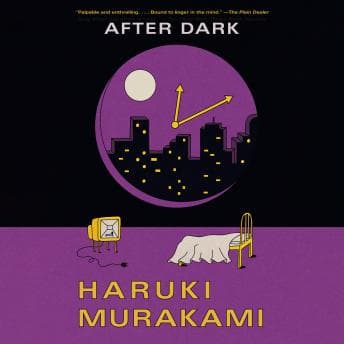

What happens when a novelist decides the most interesting thing about his characters isn't what they do, but how they exist in the space between doing things?
I was up late — not by choice, but because the dal I'd been simmering for three hours had finally hit that perfect consistency and I couldn't walk away. So I stood in my kitchen at 1 AM, stirring, with Murakami's After Dark playing through my earbuds, and I realized: this book is doing to me exactly what it's doing to its characters. Suspending me in a nocturnal limbo where time feels elastic and nothing quite resolves.
The Psychology of Watching Without Participating
Here's what fascinated me about this book from a narrative psychology perspective. Murakami uses a collective "we" — this disembodied camera-eye narrator that watches Mari and Eri and everyone else from a deliberate distance. The protagonist exhibits classic avoidant attachment patterns: Mari sits alone in a Denny's at midnight reading a book, clearly wanting connection but engineering her environment to prevent it. And then Murakami does something clever — he forces connection onto her anyway. The jazz trombonist Takahashi shows up, the love hotel manager Kaoru drags her into a crisis involving a beaten Chinese sex worker, and suddenly Mari's careful isolation collapses.
But here's what I found myself asking: why does Murakami keep cutting away to Eri, the sleeping sister? Eri literally does nothing. She sleeps. And yet those scenes — especially the deeply unsettling sequence where she appears to be pulled toward (or observed by?) something on the other side of her television screen — carry more psychological weight than anything in Mari's active storyline. The research actually shows that passive characters in fiction can function as mirrors for the reader's own inertia. Eri sleeping through her life while Mari stumbles through Tokyo's underbelly isn't subtle, but it works because Murakami commits to the eeriness of it completely.
Psychologically, though, some things don't track. The businessman Shirakawa — the one who brutalizes the Chinese prostitute — gets these clinical, detached observation scenes that feel like Murakami wanted to say something about the banality of violence but couldn't quite commit. He's less a character than a thesis statement. My therapist would have thoughts about this character, mainly that he reads like a textbook entry on compartmentalization rather than a living person.
Janet Song and the Art of the Ambient Voice
So here's where I'll be honest: Janet Song's narration is a genuinely interesting case study in matching form to content. Her voice is calm, measured, almost hypnotically flat. For a book that functions more like a film script — all precise descriptions of body language, clothing, spatial arrangement — this works. She shifts tone slightly between characters rather than doing full voice acting, which suits Murakami's observational distance.
But I understand the "Star Trek computer" complaint some listeners have. There were moments, particularly during the more emotionally charged scenes with the injured sex worker, where I wanted Song to let some heat in. The scene demands it. A woman has been beaten and left naked in a love hotel room, and Song narrates it with the same serene register she uses for describing a Denny's menu. That's either a deliberate artistic choice or a limitation. I genuinely can't tell.
At five hours and forty-four minutes, it's a short listen. Which is probably right. This book doesn't have the architecture for anything longer — it's a mood piece, a single night, a series of encounters that refuse to become a plot. I had a similar reckoning with Perfect Life: A Novel, another book that prioritizes atmosphere over momentum and makes you interrogate whether that trade-off was worth it.
Who This Is (and Isn't) For
If you come to Murakami expecting Wind-Up Bird Chronicle-level depth and payoff, you'll leave cold. Several listeners did. One called it "a partially completed novella," and honestly? That's not wrong. The open-endedness here isn't the satisfying ambiguity of a well-constructed mystery — it's more like Murakami sketched something beautiful and then walked away from the canvas.
But if you're interested in how stories can work as atmosphere rather than architecture — if you're the kind of person who finds a dimly lit Denny's at 2 AM philosophically interesting — this is a fascinating case study in what fiction can do when it stops trying to take you somewhere. It just sits with you in the dark and waits.
I finished it right as I was washing the last pot, kitchen finally clean, apartment silent. And I stood there for a minute doing nothing. Which I think was the point.
My Clinical Assessment
Worth experiencing once, especially if you're already a Murakami reader curious about his more experimental side. But I wouldn't burn a full-price credit on it. Borrow it, stream it, catch it on sale. It's a mood, not a meal — and at this length, the investment is low enough that even if it leaves you cold, you've only lost an evening. And sometimes that's what an evening is for.