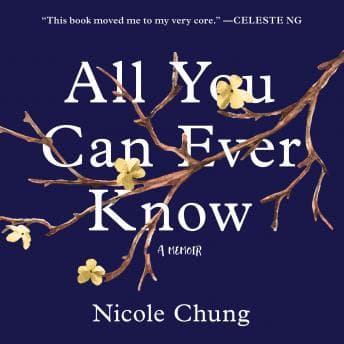

"Forever feeling slightly out of place was her fate as a transracial adoptee."
That line hit me somewhere around hour two, on a Wednesday morning Caltrain where I was sandwiched between a guy eating an egg sandwich and someone's oversized backpack. And I just... sat with it. Which is not something I normally do. I'm a 1.5x listener, I'm impatient, I want the next plot point. But this book made me slow down.
The Essay That Became a Book (For Better and Worse)
Let me get the elephant out of the room: the critics who say this could've been an essay aren't entirely wrong. There are stretches - especially in the last few chapters - where Chung circles the same emotional territory she's already covered. The "what does belonging mean" thread gets pulled in slightly different directions, but sometimes it felt like I was reading the same commit message with minor variations. You know the feeling when someone refactors code but doesn't actually change the logic? That.
But here's the thing - the core material is so genuinely raw that the repetition almost works as emphasis rather than filler. Chung grew up in a sheltered Oregon town as the Korean kid raised by white parents. She was told a tidy adoption story: your birth parents loved you so much they gave you up. A comforting myth, packaged like a fairy tale. And the book is basically her running git blame on that story, tracing every line back to its real origin.
The strongest sections are when she describes the specific texture of being a transracial adoptee - not the big dramatic racism moments (though those exist), but the micro-moments. The well-meaning comments that land wrong. The feeling of being conspicuously different in family photos. The way her adoptive parents loved her fiercely but couldn't always see what she was navigating. That specificity is what makes this memoir worth the listen, and it's what separates it from a generic "identity" book.
Janet Song Does the Quiet Parts Right
Janet Song's narration is interesting because it does something counterintuitive - it stays steady. Almost flat, in a deliberate way. There's no dramatic vocal performance here, no character voices to distinguish. It's a single person telling you their story with this calm, measured delivery that mirrors how Chung writes: careful, precise, a little guarded.
And honestly? For this material, it works. When Chung describes facing casual prejudice or the complicated dynamics with her biological family, Song's restraint makes those moments land harder. She doesn't oversell the emotion - she trusts the words to carry the weight. It's the narrator equivalent of a well-placed console.log instead of a full stack trace. You get exactly what you need.
That said, the steadiness means there's not much variation across nearly seven hours. If you're listening at 6AM and already struggling to stay conscious, Song's gentle pacing might lull you under. I'd bump this to 1.25x for commute listening - it tightens the pacing without losing the contemplative quality.
Where It Breaks Down (and Where It Doesn't)
The book's structure tracks two parallel timelines: Chung searching for her biological parents while pregnant with her first child. Smart framing. The pregnancy gives the adoption search an urgency it might not have otherwise - she's about to become a parent, which forces every question about her own parents into sharper focus.
But the back third loses momentum. Once the major revelations land (and I won't spoil them, but - there are family secrets, and they're not small), the book doesn't quite know what to do with itself. It wraps up with reflections that feel like they belong in a different, longer book about the aftermath. The emotional climax happens around hour five, and then you've got ninety minutes of denouement that could've been thirty.
Compare it to Dani Shapiro's Inheritance, which covers similar territory (surprise family revelations, identity crisis) but is leaner and more propulsive. The pacing discipline I wanted here is something I've only really found in nonfiction that comes from the business/self-help world — weirdly, Think and Grow Rich for Women is ruthlessly structured in a way memoir writers could actually learn from. Chung's writing is warmer and more intimate than Shapiro's, but Shapiro's is better paced. Trade-offs.
Who Gets the Most Out of This
Perfect for: anyone who's adopted, anyone who's a transracial adoptee, anyone who's ever had to reconcile the family story you were told with the family story that actually happened. Also solid for new parents - the pregnancy thread adds a layer that hit differently than I expected.
Skip for: people looking for a fast-paced memoir with constant forward motion. This is contemplative and interior. It sits with feelings. If that's not your thing at 6AM on a packed train, I get it.
The Commit Log
TL;DR: Worth your commute, but barely. The core story is powerful and specific enough to justify the listen, but the pacing issues in the final stretch keep it from being a must-credit situation. At 6 hours 43 minutes, it's a three-commute book - and the first two commutes are genuinely great. Janet Song's steady narration serves the material well even if it won't keep you awake through the slower sections. The ROI on this audiobook is decent if you connect with the subject matter, middling if you don't. Borrow it, give it two hours, and you'll know which camp you're in.