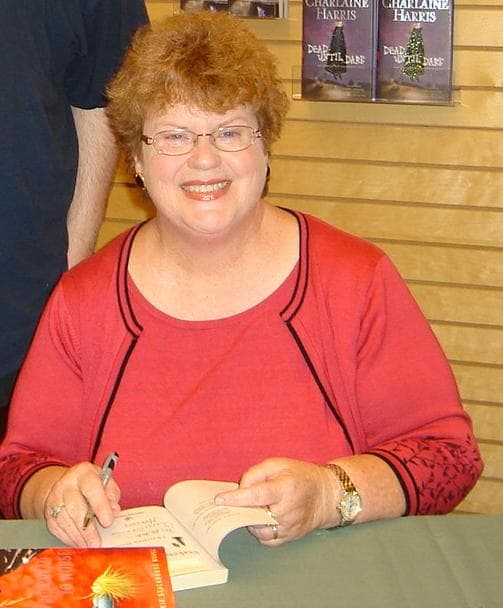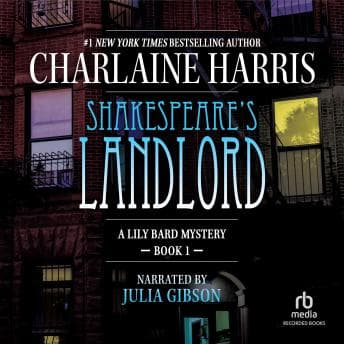

So here's the thing everyone keeps telling me about Charlaine Harris: start with Sookie Stackhouse. Obviously. The vampires, the Southern Gothic charm, the HBO adaptation. But I didn't come to Harris through Sookie. I came through a cleaning lady in a tiny Arkansas town called Shakespeare who does karate and doesn't talk to her neighbors. And honestly? I think that says more about me than I'd like to admit.
I was shelving returns at the library on a slow Tuesday afternoon — one of those shifts where the loudest sound is the fluorescent lights buzzing — and I had this queued up because at under seven hours, it felt like the right kind of commitment for a midweek listen. Quick, contained, small-town mystery. The kind of thing I'd recommend to patrons who say they want something "like a cozy but darker." And Shakespeare's Landlord is exactly that — except it's also something stranger and pricklier than I expected.
Lily Bard Is Not Here to Make You Comfortable
Let me address the elephant in the room because I've seen the discourse: a lot of listeners bounce off Lily Bard. They find her cold, abrasive, unlikable. And I get it — Gibson's narration leans into a tone that makes Lily sound, at times, like she's judging everyone in Shakespeare, Arkansas from behind a wall she built herself. One listener I saw put it perfectly: "It's more tone of voice than actual words that make you think the main character is mean and a huge snob."
But here's where I disagree with the popular read. Lily is guarded. She is prickly. She's a woman with a violent past who chose to disappear into a nowhere town and clean other people's houses because she wants control over her physical space. That guardedness isn't a bug — it's the entire architecture of the character. Harris wrote a protagonist who doesn't perform warmth for your comfort, and Gibson's vocal choices — that clipped, slightly cool delivery — actually track with who Lily is. The problem isn't that Gibson makes Lily unlikable. The problem is that Lily isn't designed to be liked easily, and some listeners aren't ready for that in a mystery protagonist.
Does Gibson push it too far sometimes? Yeah, probably. There are moments where Lily's internal observations about her neighbors tip from wary into condescending, and Gibson doesn't soften those edges. A different narrator might have warmed up those interior monologue sections, given us more vulnerability earlier. Gibson keeps it tight and controlled, which is a choice I respect even when it made me wince.
Small-Town Surveillance as Horror's Quiet Cousin
Here's what my podcast listeners would appreciate: this book understands that horror isn't about gore — it's about dread. And Shakespeare's Landlord isn't horror, technically, but it borrows horror's best trick. The dread here is surveillance. Everyone in Shakespeare watches everyone else. Lily watches her neighbors from her window at night. Her neighbors watch her. The murder of the landlord, Pardon Albee, cracks open the town's careful performance of normalcy, and suddenly every sideways glance means something.
Harris does something clever with the small-town mystery format — she makes the town itself feel claustrophobic. That slow-building suffocation reminds me of what Stephen King pulls off in If It Bleeds — that sense that the ordinary world is just slightly wrong, and the walls are closing in. Shakespeare is one of those places where your business is everyone's business, and Lily, who desperately wants to be invisible, keeps getting dragged into visibility. When she finds the body and reports it, she becomes a suspect precisely because she's private. In Shakespeare, privacy is suspicious. That's a quietly terrifying premise if you think about it for more than five seconds.
The pacing is brisk — at 6 hours 49 minutes, Harris doesn't waste time on filler. The mystery itself is fairly straightforward, and experienced mystery readers will probably narrow down the suspect list early. But the whodunit isn't really the point. The point is watching Lily navigate a town that wants to crack her open.
Gibson's Performance: The Polarizing Choice That Almost Works
I keep going back and forth on Julia Gibson's narration, and I think that tension is actually the most interesting thing about this audiobook. She's got solid pacing — the book never drags, never rushes through the investigation scenes. Her vocal energy during Lily's karate sequences has a physicality to it that works. But the character differentiation is thin. Side characters blur together, and in a small-town mystery where the suspect pool is your neighbor roster, that's a real problem.
Gibson is at her best when Lily is alone with her thoughts — those quiet, tightly wound internal passages where Lily is assessing threats, cataloging exits, thinking like someone who has survived something terrible. Gibson commits to that hypervigilance. That's rare. But when Lily interacts with other people — potential love interests, nosy townsfolk, the cops investigating the murder — Gibson doesn't shift enough. Everyone sounds like they're being filtered through Lily's suspicion, which is interesting as an artistic choice but exhausting over seven hours. I ran into a similar narrator fatigue issue with Cat & Mouse, where the performance kept me at arm's length from characters I wanted to get closer to.
I listened to this at 1.0x speed, and I'd actually suggest bumping to 1.25x. The prose is clean and direct, and a slight speed increase tightens the tension without losing anything.
Who Gets a Key to Shakespeare
If you love Charlaine Harris and you're expecting Sookie energy — the humor, the supernatural charm, the warmth — recalibrate. This is Harris in a completely different register. Colder. More grounded. More interested in trauma than in banter. If you're into character studies wrapped in mystery packaging — think Tana French's early work but in a rural Southern setting — Lily Bard might be your person.
If you need to like your protagonist immediately, skip this. Lily earns your investment over time, but she makes you work for it.
Shirley (my cat) was unimpressed. But she's unimpressed by everything that doesn't involve tuna. I was quietly absorbed — not terrified, not thrilled, but genuinely curious about this strange, defensive woman and the town that won't stop watching her. That's enough to keep me going to book two.