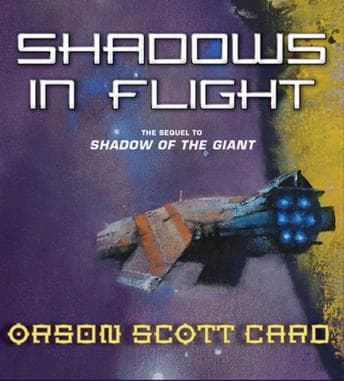

So there I was, 11:47 PM on a Tuesday, wide awake after deploying a fix for a cache invalidation bug that had been haunting us for three days. Brain too wired to sleep, too fried to read code. Perfect time for a 6-hour audiobook about genetically engineered children slowly dying in space. You know, light stuff.
I'd been putting off Shadows in Flight for a while. I burned through the Shadow series back-to-back last year - Ender's Shadow through Shadow of the Giant - and honestly? Bean's arc hit me harder than Ender's ever did. The kid who grew up eating from trash heaps on the streets of Rotterdam, who became the actual tactical genius behind the Formic War victory, who then had to watch himself slowly grow into a giant because his engineered genes wouldn't stop - that's a story with real weight. So the idea of following Bean and three of his kids on a relativistic escape from death? I was in.
The Ship Is Small and So Is the Book
TL;DR: Worth your commute, but barely - this is a novella wearing a novel's price tag.
Let's get the elephant out of the airlock. Shadows in Flight is 6 hours and 25 minutes. At my standard 1.5x, that's basically four commute segments. I finished it in two nights of insomnia. And it feels short. Not tight-and-efficient short. More like setup-for-something-bigger short. The core premise - Bean and his three hyper-intelligent children (Ender, Carlotta, and Sergeant) discover a derelict Formic colony ship while drifting through space - is genuinely cool. A locked-room mystery meets first-contact biology meets family drama, all happening in a relativistic bubble where centuries pass on Earth while they age years.
But Card spends a surprising chunk of the runtime on the kids bickering about who's smartest and who gets to be in charge. The three children are supposed to be around five years old but with adult-level intelligence, and - look, I get what Card's doing. He's exploring how hyper-intelligence doesn't equal emotional maturity. It's the same thing he did with Bean in Ender's Shadow. But where Bean's precociousness felt earned and heartbreaking, the Delphiki kids sometimes just feel... bratty. There's a stretch in the first third where Sergeant is basically throwing tantrums about autonomy while Bean - now enormous, barely mobile, his body failing - tries to parent them. It's not bad writing. It's just not the payoff I wanted after waiting five books.
The Formic Ship Is Where It Gets Good
The second half picks up considerably. When the kids actually board the Formic vessel and start exploring the biology of what killed the colony - that's vintage Card sci-fi problem-solving. Carlotta working through the genetic puzzles, trying to reverse-engineer both the Formic disease and their own Anton's Key mutation, felt like watching a debugging session. You have incomplete data, you have theories, you test them, some fail. The science doesn't hold up to hard scrutiny (this is Card, not Weir), but the process of discovery felt right. That's the stuff I listen to sci-fi for. That same itch for biological puzzle-solving and survival logic with a pulpy undertow got scratched when I listened to Extinction War a few months back — different vibe entirely, but that same propulsive satisfaction of watching smart characters work a problem under pressure.
And Bean. Poor, dying, massive Bean. His sections are genuinely moving. He's a father who knows he can't protect his children forever, racing against his own body's timeline. There's a quiet devastation to his POV that the book earns even when the plot feels thin.
Three Narrators, Uneven Results
Stefan Rudnicki handles Bean, and - yeah. His deep, measured delivery for a man whose body is failing but whose mind is still razor-sharp? Perfect casting. That sonorous voice carrying the weight of a father's resignation and determination simultaneously. He's doing the heavy emotional lifting here. Scott Brick takes other sections and he's solid as always (the man is a machine - I've heard him narrate probably fifteen different books at this point). Emily Janice Card - Orson Scott Card's daughter - narrates the children, and she's surprisingly good. Not great, but good. The kids' voices are distinct enough that I could track who was speaking on a packed 6AM Caltrain, which is my baseline test.
No one here is Ray Porter (need I say more about that man), but the three-narrator setup works for a book with clearly delineated POVs. Clean production, no jarring transitions between readers.
Who Gets the Ansible Signal, Who Doesn't
Perfect for: die-hard Enderverse completionists, commutes where you want contained sci-fi. Skip for: anyone who hasn't read at least Ender's Shadow and Shadow of the Giant - you'll be completely lost. And if you're hoping for the emotional gut-punch of Bean's early story, calibrate your expectations down.
This is basically a bridge episode of a TV series but for the Ender saga. It sets up the next chapter, it has some genuinely interesting biological mystery stuff, and it gives Bean a bittersweet send-off (of sorts). But the ROI on this audiobook is low for a full credit when you factor in the runtime. At 6 hours, this should've been a $5 Audible Daily Deal, not a full-price purchase.
Commit to Main or Stash for Later
I don't regret listening. But I also wouldn't recommend it to anyone who isn't already deep in the Shadow series and hungry for more. It's a 3.5-star book elevated to 3.7 by Rudnicki's performance and one genuinely affecting father-children dynamic. If you've got a Libby card, that's your move here.