
What happens when a stay-at-home mom who needs books that survive 47 pauses picks up a 14-hour sci-fi novel about time travel and multiple parallel worlds?
She learns her limits, that's what.
This Is Not a Nap-Time Book (And I Mean That Literally)
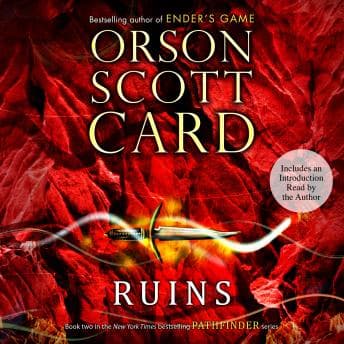
Look, I grabbed Ruins because my oldest Emma is on an Ender's Game kick after her second-grade teacher mentioned it (thanks, Mrs. Patterson, now my seven-year-old wants to discuss military strategy at dinner). I figured I'd read the Pathfinder series so we could have A Thing. Mother-daughter bonding through Orson Scott Card. Sweet idea, right?
Except this book requires the kind of sustained focus I haven't had since 2017. The time travel mechanics - where Rigg can see paths people walked in the past and Umbo can push people's consciousness backward through time - layer on top of each other in ways that made me rewind constantly. There's this whole thing where they're trying to manipulate events across different timelines while stuck in a new wallfold with Vadesh, this creepy expendable (basically a humanoid robot programmed to manipulate them), and every conversation between the kids circles back to "can we trust each other, can we trust him, what are the rules of our powers now." The circular arguments got exhausting. Like listening to my five-year-old explain why he NEEDS the blue cup - just going around and around the same point.
I tried listening during school drop-off. Bad idea. I'd pull into the pickup line later that day having completely lost the thread of which timeline we were in. This is a sit-down-and-pay-attention book, which is basically a unicorn in my life.
Four Narrators, One Family Affair
Here's what actually works really well: the multi-narrator setup. Each narrator takes specific character perspectives - so when the story shifts from Rigg's point of view to, say, the sections about what's happening on the alien ships heading toward Garden, you get a different voice and your brain automatically resets. Kirby Heyborne and Stefan Rudnicki carry most of the heavy lifting, and they're solid. The perspective shifts that could be disorienting actually become your anchor points because the voice change is like a chapter break your ears can feel.
Orson Scott Card reads his own introduction, which is a nice touch - author intros always feel more personal that way. And Emily Janice Card (his daughter) handles her sections competently. It's basically the Card family business, audiobook edition. The narrators were the thing that kept me going when the plot made my brain hurt.
But here's the thing - four narrators can't save you when the story itself is more interested in characters having the same trust argument for the third time in two hours. Rigg and Umbo going back and forth about whether they can rely on each other, Param being suspicious of everyone, Vadesh being transparently sketchy while everyone debates HOW sketchy. I get that teen paranoia and political maneuvering is Card's thing, but it felt like sitting through a really long meeting that could've been an email.
The 14-Hour Elephant in the Room
At 14 hours and 25 minutes, this is not a quick listen even at 1.25x speed. That's almost two weeks of my available listening windows. And because you genuinely cannot zone out - one reviewer nailed it when they said you'll miss important details if you lose focus for even a minute - I found myself re-listening to chunks. So really it was more like two and a half weeks.
The world-building IS impressive if you're into that. The concept of Garden as a planet divided into wallfolds by massive walls, each developing its own civilization, with an alien threat approaching from space - that's genuinely cool sci-fi. And there are moments where the time travel clicks into place and you feel smart for following it. That feeling of getting rewarded for paying attention is something The Count of Monte Cristo does brilliantly too — layers of plot that click together if you stick with it — except that one's even LONGER, so, you know, plan accordingly. But those moments are buried under a lot of mental circling.
Also: this is book two. It ends setting up book three. So don't expect a satisfying ending. Just - be warned. No closure. I didn't ugly-cry at pickup, but I also didn't feel much of anything because we're clearly mid-story.
Who Gets the Car Keys to This One
If your kids are getting into Card's work and you want to keep up - honestly, maybe just read the plot summary. If YOU are a Card fan who loved Pathfinder and wants to continue, the audiobook production is well done and the narrators earn their keep. But if you're a multitasking mom who listens in stolen 20-minute windows? This one will punish you for it. Now Fallen Angels — that one's sci-fi I could actually keep up with in parking lot chunks, and it hit way harder for me.
Not groundbreaking for me, but I can see why it works for people who can give it their full attention. I am simply not those people right now. Maybe when Sophie's in kindergarten.