"You're a gatemage."
That line hit me somewhere around the three-hour mark, and I actually paused the audiobook to sit with it. Because here's the thing about Orson Scott Card - the man knows how to build to a revelation. Even when you see it coming (and honestly, you will), the execution lands.
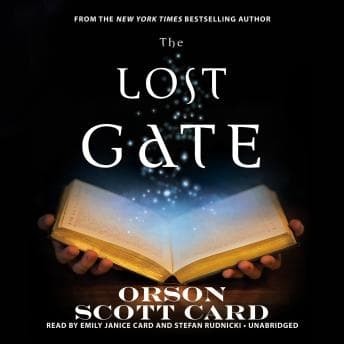
I've been a Card fan since my forbidden-book-reading days. Ender's Game was one of those titles I snuck into the house like contraband. So when I finally got around to The Lost Gate, I was expecting that same sense of discovery, that same careful construction of a world that feels both ancient and immediate. And yeah, it's here. Mostly.
The Dual Narrative Gamble
So we've got two narrators - Emily Janice Card and Stefan Rudnicki - handling parallel storylines. Danny North's modern-day coming-of-age in the Virginia mountains, and... well, I won't spoil the other thread. The gamble with dual narration is always the same: will the transitions feel jarring? Will one narrator outshine the other so much that you start dreading certain chapters?
Here's my honest take: they balance it pretty well. Emily Janice Card has this light, almost gentle quality that works beautifully for the darker material (counterintuitive, I know, but it works). Rudnicki brings that deep baritone gravitas that fantasy fans know and love. The contrast actually serves the parallel narratives - you're never confused about which thread you're in.
But - and this is where I have to be real with you - there are stretches where the narration goes a bit... flat. Not bad, just neutral. Like the emotional dial got stuck at a comfortable six when the story needed an eight. I noticed it most during some of Danny's internal monologue sections. The words are there, the performance is competent, but the spark flickers.
Where Card Does What Card Does Best
Look, if you've read any of Card's work, you know his thing: he takes young protagonists and puts them in impossible situations where they have to be smarter, faster, more ruthless than anyone expects. Danny North fits this mold perfectly. He's the kid who can't seem to manifest any magical talent in a family where magic is literally everything - until he discovers he has the one talent his family fears most.
The worldbuilding here is genuinely interesting. That same attention to magical systems and their consequences shows up in Once and Future Witches, though Harrow takes it in a completely different direction. These aren't your standard fantasy mages. The North family (and the other mage families scattered across the world) are descendants of gods - actual Norse gods, Greek gods, you name it - who've been exiled from their home world for millennia. The gates between worlds have been closed, and anyone who shows gate-making ability gets killed. Because the families are terrified of what happened last time.
I listened to most of this during late-night shelving at the library (yes, I'm that person who puts on audiobooks while working alone in a dark building). The pacing worked for that - not so fast that I lost track while scanning barcodes, not so slow that I started zoning out. Though I'll admit, there were moments in the middle where Card's tendency toward over-explanation kicked in. The man sometimes tells you things three different ways when once would do.
The "Card Problem" (Let's Just Address It)
I can't review an Orson Scott Card book without acknowledging the elephant in the room. His personal views have made him a controversial figure, and I know plenty of people who won't touch his work because of it. That's a valid choice. I'm not here to tell you what to do with your listening hours.
What I will say is that the book itself doesn't really engage with those controversies. It's a fantasy adventure about a kid discovering his powers and running from people who want to kill him. Make of that what you will.
Would I Listen Again?
Honestly? Probably not the whole thing. But I'm definitely continuing the series. The ending sets up something genuinely intriguing, and I want to know where the gate leads.
The audiobook production is clean - no weird audio artifacts, good balance between the two narrators. At 12+ hours, it's a commitment, but it didn't feel like a slog. I'd recommend 1.25x speed if you're an experienced audiobook listener; Card's prose can handle it, and it helps with some of those slower exposition sections.
Who This Is For (And Who Should Skip)
If you're a fantasy fan who appreciates worldbuilding over action, and you can handle a bit of uneven pacing, this is worth your time. If you need constant momentum and dynamic narration to stay engaged, sample first - those flat stretches in Danny's internal monologue might lose you.
Shirley (my cat) slept through the whole thing. But she sleeps through everything except the sound of a can opener, so that's not really a useful metric.