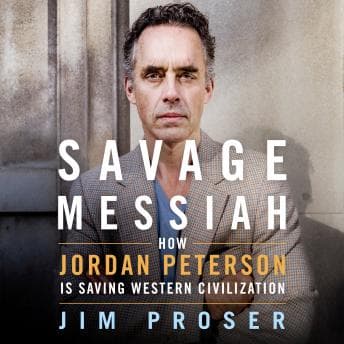

So here's the thing — I knew this book would be a departure for me. My usual rotation is romance audiobooks that wreck me emotionally, memoirs that make me feel less alone, and the occasional queer love story that would've made my abuela cross herself three times. A hagiographic biography of Jordan Peterson? Not exactly my brand.
But I grabbed it because I wanted to understand something. A client asked me to design branding for a speaking event featuring Peterson-adjacent self-help figures, and I realized I didn't actually know the full story. Just fragments from Twitter fights and memes. So I figured: eleven and a half hours, let me hear the whole pitch.
The Subtitle Tells You Everything You Need to Know
Let's start there. "How Dr. Jordan Peterson Is Saving Western Civilization." That's not a question. That's not even an argument. It's a declaration. And the book lives inside that declaration the entire time, never once stepping outside to breathe.
Jim Proser traces Peterson's life from small-town Alberta — the confirmation class where teenage Peterson challenges his minister about reconciling the Bible with science, which is genuinely interesting as a character origin moment — through Harvard, through the University of Toronto, through the Bill C-16 controversy. The biographical scaffolding is there. You get the early psychology career, the Jungian obsessions, the Maps of Meaning years where Peterson was basically an eccentric professor nobody outside academia knew.
But here's my problem: every single biographical detail gets filtered through this lens of inevitability. Like Peterson was always destined to become this culture-war prophet. The kid who questioned his minister? Future truth-teller. The professor who clashed with colleagues? Brave dissenter. There's no moment where Proser sits with ambiguity or lets Peterson just be a complicated, sometimes contradictory person. And that made me feel... nothing. Which for me is the worst possible outcome of eleven hours.
Danny Campbell Does the Heavy Lifting on a Lopsided Load
Campbell narrates the bulk of this, with Proser reading his own introduction. And honestly, Campbell is perfectly competent — steady pacing, clear delivery, professional tone. He sounds like a documentary narrator, which fits the book's self-serious energy. But there's not a lot of dynamic range here. When the text shifts from biographical storytelling to lengthy explanations of Jungian archetypes or Peterson's philosophical positions, Campbell doesn't shift with it. The emotional temperature stays the same whether we're hearing about Peterson's childhood or his views on postmodern neo-Marxism (a phrase I heard so many times I started counting — I lost track around hour six).
Proser's introduction reading is fine but unremarkable. You can tell he's not a performer. It's brief enough that it doesn't matter much.
Where's the Mess? Where's the Human?
What frustrated me most — and I say this as someone who reads biography and memoir specifically for the raw, ugly, human parts — is that Proser had access. Exclusive interviews with Peterson, conversations with family and friends. That's real material. That could've produced something with emotional texture. Instead, those interviews mostly serve to reinforce the thesis that Peterson is a misunderstood genius fighting the good fight.
There are glimpses of something richer. Peterson's struggles with depression and his later health crisis involving benzodiazepine dependency — that's genuinely harrowing stuff, and when those sections come up, I actually leaned in. I wanted more of that vulnerability. More of the man behind the lectures. But Proser pulls back almost immediately to resume the hero narrative.
Compare this to, say, a memoir like Educated by Tara Westover, where the author lets you sit in the discomfort of her own contradictions. Or even a biography like Becoming by Michelle Obama where the subject's flaws and doubts are part of the architecture. This book is afraid of its subject's complexity, and that fear makes it feel thin even at nearly twelve hours. I ran into similar hagiographic treatment in Karl Marx: An Essay — different ideology, same reverent handling that smooths over all the interesting contradictions.
Who This Is Actually For (And Who Should Walk Away)
If you're already a Peterson fan and want an affirming, comprehensive timeline of his career and ideas — this will do that for you. It's well-organized chronologically and covers the major beats.
If you're coming in curious but skeptical, or if you want genuine critical engagement with Peterson's ideas (not just a recounting of them), you'll be frustrated. I was. And if you're someone like me who needs emotional depth to stay invested in a biography — the kind where you feel the weight of a life, not just the trajectory of a brand — this isn't it.
I listened to most of this while working on a logo redesign, and honestly? By hour eight I was barely processing it. Diego was asleep on my keyboard and I envied him.
Not Every Book Has to Make Me Cry, But It Has to Make Me Feel
I didn't cry. Not once. Not even close. And that's fine — not everything needs to be a four-tissue experience. But I also didn't feel challenged, or surprised, or moved, or uncomfortable in a productive way. The book felt like a Wikipedia article with a thesis statement stapled to the front. Abuela would've changed the channel.