
"The plaintive cry of a dying piano."
I don't remember the exact timestamp, but somewhere around hour three, Finn Murphy describes a piano being moved badly — the sounds it makes as it's damaged, the way a musical instrument protests its own destruction. And I sat there at my kitchen table, red pen frozen over a stack of sophomore essays on The Great Gatsby, thinking: this man writes about furniture the way Steinbeck writes about land.
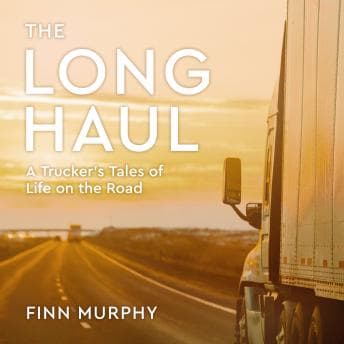
Let me back up. Long Haul is a memoir by a guy who dropped out of college to become a long-haul mover — not a freight trucker, but the kind of trucker who packs your grandmother's china, wraps your dining table in quilted pads, and hauls your entire life across state lines. Murphy spent thirty-plus years doing this, and he's got the stories and the philosophical framework to prove it.
The Dignity of Hauling Other People's Lives
What struck me first is how much this book reminded me of Shop Class as Soulcraft by Matthew Crawford — that same insistence that manual labor is intellectual labor, just wearing different clothes. Murphy doesn't romanticize trucking. He's honest about the loneliness, the physical toll, the way the industry has changed (and mostly not for the better). But he's also precise about the craft of it. There's a hierarchy among movers — "bedbuggers" who do local jobs versus the long-haul guys who handle high-value cross-country moves — and Murphy maps this social structure with the careful eye of an anthropologist.
The anecdotes are where this book earns its keep. Early on, there's a scene where Murphy's truck takes out a stand of trees at a Virginia property, and the homeowner's rage is rendered with such specific, cringing detail that you feel secondhand shame radiating off the page. Or rather, out of your earbuds. Then there's the hoarder in New Hampshire, the widow transporting her archaeologist husband's remains to a Navajo burial ceremony in New Mexico — each story is its own short film, and Murphy knows exactly how long to linger before moving on.
This is why we still read the classics, by the way. Because good nonfiction, like good fiction, is about observation. Murphy watches people at the most vulnerable moment of their lives — the moment they're uprooted — and he pays attention to what that reveals about them. He's not judging. He's cataloging. There's a generosity to it. Beautiful Country has that same quality — a narrator cataloging their own uprooting with clear eyes and almost no self-pity, and I found myself underlining the same kinds of sentences in both.
Danny Campbell Knows When to Get Out of the Way
Danny Campbell's narration is a smart match here. He doesn't try to perform Murphy's voice — no gravel-throated trucker affectation, no attempt to sound like he's calling from a CB radio. Instead, he reads with a clean, conversational clarity that lets Murphy's natural wit do the heavy lifting. The narrator understands that pause is punctuation, and Campbell uses silence well, particularly in the more poignant passages — the dying piano, the quiet loneliness of truck stops at 2 AM.
Is it the most dynamic narration I've ever heard? No. There are stretches where the delivery stays pretty level, and during some of the more technical passages about DOT regulations and industry economics, a little more vocal variation might've helped. But Campbell never gets in the way, and for a book like this — where the prose is doing real work — that's exactly right. At eight hours, the pacing feels natural. Nothing dragged for me, though I'll admit the regulatory sections are less riveting than the human stories.
If I'm comparing, the best memoir narrations — like the audiobook of Bill Bryson's A Walk in the Woods — make you forget you're listening to a performance. Campbell doesn't quite disappear like that, but he comes close.
Who Should Ride Shotgun
If you loved Zen and the Art of Motorcycle Maintenance or Studs Terkel's Working, this is their spiritual successor — a book about labor that's secretly about meaning. My students would hate this. I love it. (Though honestly, a few of my juniors who are already working part-time jobs might actually get it. The ones who show up tired on Monday because they spent the weekend at their uncle's shop.)
Skip this if you need plot momentum or a traditional narrative arc. Murphy meanders. He follows tangents. He'll stop mid-story to explain the physics of jackknifing on a mountain pass, and then loop back to the human moment he was building toward. It's structured like a long drive — you're not always sure where you're headed, but the scenery holds your attention.
Worth Pausing the Faculty Meeting For
I finished this one walking the lakefront with Denise on a Sunday morning, and when it ended, I just stood there watching the joggers go by, thinking about all the invisible labor that keeps the world running. The people who move our things, who carry the physical weight of our transitions. Murphy made me see a profession I'd never thought twice about, and he did it with humor and honesty and zero self-pity. The prose deserves to be savored. I kept it at 1.0x the whole way through.
Not every book needs to be Tolstoy. Sometimes the best literature is a guy in a truck, telling you what he's seen.







![Steve Jobs [unabridged audiobook] audiobook cover](/_next/image?url=https%3A%2F%2Fcovers.audiobooks.com%2Fimages%2Fcovers%2Ffull%2F9788499923406.jpg&w=1920&q=75)