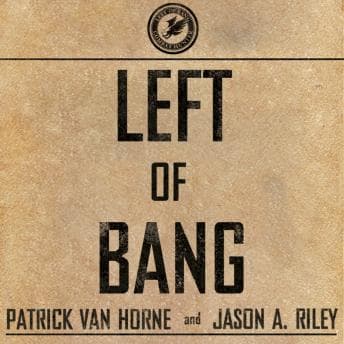

My parents never read a book about situational awareness. They didn't need to. Running a dry cleaning business in Koreatown for thirty years meant they could clock a shoplifter before the door finished closing. They knew which customers were about to bounce a check. They could feel when the neighborhood was about to get rough on a Friday night. This book is trying to teach you what immigrant small business owners learn through survival.
And honestly? It does a pretty solid job.
What General Mattis Wants You to Know
Here's the premise: most people operate "right of bang"—reacting after the explosion, the attack, the crisis. The Marine Corps' Combat Hunter program trains operators to recognize threats before they materialize. Van Horne and Riley have distilled this military methodology into civilian applications, and the framework is genuinely useful.
The core system breaks human behavior into domains—kinesics (body language), biometrics (physiological responses), proxemics (spatial relationships), and atmospherics (environmental baselines). Sounds academic, but they keep it practical. The concept of establishing a "baseline" for any environment and then scanning for anomalies? That's exactly what my mother did every time someone walked into the shop. Why We Get Fat operates on a similar principle—establishing what normal metabolic function looks like before identifying what's breaking down. She just didn't have a fancy acronym for it.
At just under six hours, this book respects your time. I've sat through eight-hour business books with less actionable content. The military examples are concrete—how Marines learned to spot IED emplacers in Iraq, how they identified threats in crowded Afghan markets. Then they translate those lessons to your world: job interviews, parking garages, that restaurant that suddenly feels wrong.
Danny Campbell Gets the Mission
Campbell's narration took about thirty minutes to find its rhythm—there's a slight stiffness in the opening chapters that some listeners have noted. But once he locks in, his delivery matches the material perfectly. This isn't a book that needs theatrical range. It needs clarity, authority, and pacing that lets you absorb tactical concepts. Campbell delivers all three.
The Earphones Award winner brings a professional crispness that suits the military source material without sounding like he's barking orders. When he's walking you through the six domains of human behavior or explaining the difference between a dominant stance and a submissive one, you're getting information efficiently. No dramatic pauses. No over-emoting. Just clean transfer of knowledge.
The ROI Calculation
Let me be direct about what this book is and isn't.
It IS a practical framework for reading people and environments. The profiling clusters—dominant, submissive, uncomfortable, comfortable—give you a vocabulary for what you're already noticing subconsciously. The concept of "establishing baseline" is immediately applicable. I caught myself doing it at a client meeting last week.
It ISN'T going to turn you into Jason Bourne. Some of the military application sections feel less relevant to civilian life, though they're still interesting context. And there's occasional repetition—the authors really want you to remember that baseline concept.
Skip to the behavior clusters section if you're impatient. That's where the practical payoff lives. The kinesics chapter alone—understanding what posture, gestures, and facial expressions actually communicate—is worth the credit.
Who Gets Value Here (And Who Won't)
This is for anyone in a role where reading people matters. Consultants, salespeople, managers conducting interviews, anyone who walks into rooms and needs to assess dynamics quickly. Also solid for the generally paranoid among us who want to feel more confident in public spaces.
If you're looking for entertainment, look elsewhere. This is a training manual in audiobook form. Effective, but not exactly a page-turner. Jenny would probably tap out by hour two. (She'd also say I'm being paranoid about parking garages now. She's not wrong.)
Combat-Tested Intuition, Civilian-Priced
My parents would have loved this book. Not because they needed it—they already lived it—but because it validates what they knew instinctively. Sometimes the feeling that something's wrong IS the data. This book teaches you to trust that feeling and sharpen it.
At 2.0x speed, you can absorb the whole thing in three hours. That's a reasonable investment for a framework you'll use forever. I've seen companies spend thousands on "reading the room" training that delivers less than this audiobook.
The baseline concept alone is worth the listen. The occasional repetition? Skip forward. Thank me later.