
Can a story that was never quite finished by its original creator ever get the ending it deserves?
I've been chewing on that question for about twenty hours now. I pulled up Sandworms of Dune during a late-night coding session — the kind where I'm supposedly debugging my procedural generation pipeline but really just staring at a terminal while my brain processes something else entirely. Dune felt appropriate. Complex systems, emergent behavior, the illusion of control over chaos. You know, thesis stuff. (Dr. Patel, if you're reading this, I was absolutely working.)
The Ghost of Frank Herbert's Outline
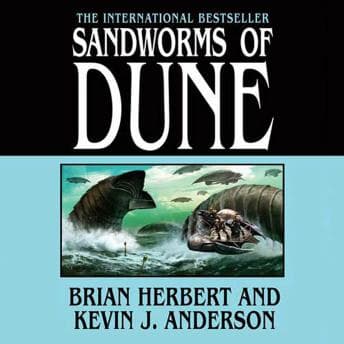
So here's the thing about Sandworms of Dune: it's positioned as THE answer. The big resolution. Brian Herbert and Kevin J. Anderson found Frank Herbert's notes in safe-deposit boxes and built the finale around them, wrapping up the Honored Matres mystery, the fate of Arrakis, the Kwisatz Haderach endgame, and the whole Man vs. Machine thread that's been lurking since the Butlerian Jihad prequels. That's a lot of narrative debt to pay off in one book.
And honestly? Some of it pays off. The ghola resurrections — Paul Muad'Dib, Lady Jessica, and others brought back through genetic technology aboard the fleeing no-ship — that's a genuinely cool premise. It's like someone handed Brian and Kevin a party of legendary NPCs and said "run a campaign with these." My D&D group would love this concept on paper. The problem is execution. Where Frank Herbert would let ideas simmer and breathe, letting you marinate in the philosophical weight of prescience or the ecology of Arrakis, the Anderson-Herbert approach is more... direct. Plot-forward. Things happen because the outline says they should happen, not because the world demands them.
The pacing is weird. Dense stretches where you're juggling multiple POVs across the galaxy — the no-ship crew, the machinations of the thinking machines, the political chess on Chapterhouse — followed by sequences that resolve massive plot threads almost too quickly. It's like they had Frank's bullet points but not his sense of rhythm. If you don't like info-dumps, this isn't for you (but you're wrong). Except here, the info-dumps don't quite have the same gravity. They feel more like exposition than revelation.
Scott Brick and the Weight of Arrakis
Scott Brick is a workhorse narrator. The man has basically narrated the entire extended Dune universe at this point, and there's something to be said for consistency — you sit down with Sandworms and you immediately know you're in Dune territory. His tone is measured, authoritative, and he handles the dense sci-fi terminology without stumbling. For a nearly twenty-hour listen, he keeps the energy surprisingly level. Not electric, but steady.
But here's where it gets divisive. Brick's character differentiation leans on subtle tone shifts rather than big vocal performances. If you're coming from, say, Steven Pacey's work — where every character is a fully inhabited human being with their own vocal DNA — Brick's approach can feel a bit flat. Paul Muad'Dib and Duncan Idaho don't sound dramatically different. You learn to track who's speaking through context more than voice. And then there's the German accent he pulls out for Liet Kynes, which is... a choice. On a desert planet inspired by Middle Eastern ecology and Bedouin culture, the random German lilt is genuinely confusing. It pulled me out of the scene every time.
That said, his narration of the thinking machine sequences and the broader existential threats works well. He's got the right gravitas for apocalyptic-scale sci-fi. He just doesn't have the range for a cast this large. It's a similar narration-versus-cast tension I noticed in Doctor Who (From Darker Projects), where the sheer number of characters pushes any single performer past their limits.
The Sanderson Test (And Why Dune Fails It Here)
I keep coming back to magic systems — or in Dune's case, the systems of prescience, the spice economy, Bene Gesserit training, mentat computation. Frank Herbert built systems that felt like they had rules even when those rules were deliberately opaque. This is Sanderson-level world-building in the original six books. But in Sandworms, the systems feel more like plot devices than living mechanics. The ghola awakenings happen when the story needs them to. The final confrontation with the Enemy resolves in a way that I can see working as a bullet point in an outline but doesn't quite earn its weight as a 600-page novel.
The progression is satisfying in spots — watching Paul and Jessica grapple with their resurrected identities has genuine emotional texture. But the big reveals about Omnius and the thinking machines lean heavily on the prequel trilogy lore, so if you skipped Butlerian Jihad through Battle of Corrin, you might feel lost.
Who Rolls Initiative On This One
If you've read (or listened to) all seven preceding books and you need closure — like, it's been gnawing at you since Chapterhouse ended on that cliffhanger — then yes, grab this. It answers the questions. Whether those answers satisfy you is another matter. Yes, it's nearly 20 hours. It's worth it if you're already invested.
If you're a Dune purist who considers Frank Herbert's prose sacred text, this will frustrate you. The writing doesn't have the same density or philosophical ambiguity. If you're new to Dune, for the love of Shai-Hulud, do not start here.
I read this instead of writing my thesis. Was it worth the lost productivity? Mostly. It scratched the itch. But it's the difference between a homebrew campaign finale run by a solid DM versus the one the original DM had planned before they left the table forever. You can see the shape of what was intended. The execution just doesn't quite cast the same spell.
The Spice Must Flow (But It Trickles Here)
Scott Brick delivers a professional, reliable performance through a book that's carrying more narrative weight than its prose can fully support. It's a serviceable conclusion to one of science fiction's greatest sagas, built from genuine authorial intent but filtered through different creative sensibilities. Worth the listen for completionists. Just manage your expectations — this is a closing chapter, not a crescendo.