
I was elbow-deep in a lamb rogan josh — the kind that takes three hours and makes your entire apartment smell like your grandmother's kitchen — when I decided to throw this on. A sales book. Me. The woman who studies fictional characters for a living and has never sold anything except, arguably, my dissertation committee on the idea that Hamlet exhibits textbook avoidant attachment. But here's the thing: sales books are secretly psychology books. They just won't admit it.
And David Mattson's Sandler Rules? It almost admits it.
Forty-Nine Rules, One Big Behavioral Pattern
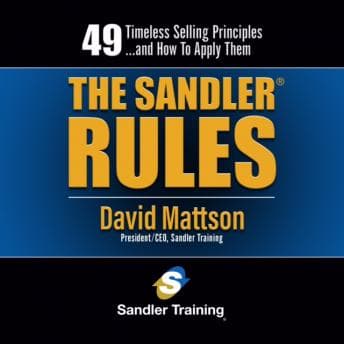
The premise is deceptively simple: here are 49 principles from the Sandler Selling System, each with a short chapter explaining the rule and how to apply it. Think of it as a listicle with ambition. Some rules are genuinely sharp — the idea that you should never answer an unasked question, for instance, is basically a lesson in cognitive restraint that my therapist would cosign. Others hit on what I'd call strategic vulnerability: the rule about being okay with hearing "no" early is a fascinating case study in how ego defense mechanisms sabotage professional outcomes.
What makes this book work — when it works — is that Mattson understands something most sales trainers don't: selling is a psychological interaction, not a performance. The rules about mirroring buyer pain, about not "unpacking your briefcase" too early, about letting the prospect feel in control — this is applied behavioral psychology dressed in a sales suit. The research actually shows that perceived autonomy increases compliance (self-determination theory, Deci & Ryan, look it up), and Mattson is basically operationalizing that without ever citing a single study. Science of Living at least has the decency to cite its sources, and honestly reading it alongside Mattson is a slightly unhinged but genuinely illuminating exercise in how the same behavioral science gets dressed up for different audiences. Which is both impressive and mildly infuriating to the academic in me.
But I found myself asking: why does this book feel both useful and repetitive? Because 49 rules is too many. By rule 30, several principles start blurring together — the distinction between "don't spill your candy in the lobby" and the adjacent rules about not over-presenting feels like the same insight repackaged three different ways. A tighter 25 rules would've been a stronger book. The format — short chapter, anecdote, principle, application — is effective for about the first 20 entries, then becomes predictable enough that your brain starts pattern-matching ahead of the content.
Psychologically, this tracks with what we know about cognitive fatigue in instructional formats. Your brain craves variation in structure, not just content.
Sean Pratt Makes Business Sound Like It Has a Pulse
Here's where the audiobook earns its keep. Sean Pratt narrates this with the kind of energy that makes you forget you're listening to a management book while stirring cardamom pods. His pacing is genuinely excellent — he knows when to punch a key phrase and when to let a concept breathe. For a book that's essentially a list of rules with commentary, he creates enough tonal variation between chapters that each one feels like a fresh conversation rather than the next slide in a PowerPoint deck.
At under four hours, this is a quick listen, and Pratt's delivery makes it feel even quicker. He handles the anecdotal sections with a warmth that gives them weight, and shifts into a more direct, almost coaching-style register for the prescriptive parts. It's not flashy narration — no character voices needed here — but it's the kind of clean, professional performance where you never once think about the narrator, which is honestly the highest compliment for nonfiction audio.
One small note: at 1x speed, some of the more straightforward rules feel a bit leisurely. I bumped to 1.25x about halfway through and it hit a better rhythm.
The Unasked Question This Book Doesn't Answer
Here's my psychologist's complaint, and it's a real one: Mattson opens with this genuinely interesting observation about how sales is the only department without a shared language or process. That's a great insight. It's practically begging for a deeper exploration of why — what is it about the psychology of salespeople, about identity and autonomy and the mythology of the lone-wolf closer, that makes them resist systematization? He raises the question and then... moves on to the rules. The protagonist exhibits classic avoidance of the most interesting problem in the room.
I wanted the "why" behind the "what." The rules themselves are solid — practical, grounded, not the kind of motivational fluff that makes you feel good for 20 minutes and then evaporates. But the book stays at the tactical level when the strategic-psychological level was right there, waiting.
Who This Is Really For (And Who Should Keep Scrolling)
If you manage a sales team or you're early-to-mid career in sales and want a framework that isn't just "believe in yourself and hustle harder," this is genuinely useful. The Sandler system has endured because it's built on real behavioral principles, even if Mattson doesn't frame it that way. Commute listen. Morning jog listen. Cooking-something-complicated listen.
If you're looking for deep strategic thinking about organizational psychology or sales as a discipline — this isn't that book. And if you need fewer than 49 reasons to do anything, you might find the format taxing.
My Clinical Note
Solid applied psychology wearing a sales badge. Too many rules, not enough "why," but the ones that land genuinely land. Sean Pratt's narration elevates instructional content into something you can actually absorb while your hands are busy. At four hours, the commitment-to-value ratio is pretty good — just don't expect it to change how you think about selling. Expect it to change a few specific things you do. Which, honestly, might matter more.