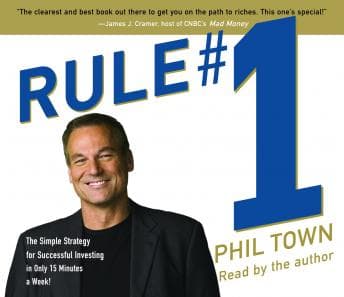

I was sitting in a client's empty conference room at 9 PM waiting for their CEO to finish a board call so we could prep for a morning pitch, and I figured - why not knock out another investing book. Phil Town's Rule #1 had been sitting in my Audible library for months, judging me. So I hit play.
Bottom line: There's a solid 3-hour investing framework buried inside 11.5 hours of padding. The core thesis - buy wonderful companies at attractive prices using a few key financial metrics - is genuinely useful for individual investors. The other 8 hours? Phil Town really, really wants you to know he used to be a river guide making $4,000 a year.
Buffett for People Who Can't Get Into Berkshire's Annual Meeting
Let's be honest about what this book actually is: it's Warren Buffett and Charlie Munger's value investing philosophy, repackaged with a folksy "aw shucks, I'm just a regular guy" wrapper. Town is upfront about this - he credits Buffett's Rule #1 ("Don't lose money") and Rule #2 ("Don't forget Rule #1") as the foundation. Where he earns his keep is in the mechanical breakdown. He walks you through four specific metrics - the "Big Five" numbers (ROIC, equity growth rate, EPS growth rate, sales growth rate, and free cash flow growth rate) - and teaches you to calculate what he calls the "Sticker Price" and "MOS" (Margin of Safety) price for any stock.
This is where my parents' dry cleaning business comes to mind. My dad never knew what ROIC stood for, but he instinctively understood every principle Town spends chapters explaining. Buy things worth more than you pay. Don't follow the crowd. Know what you own. This is what my parents did instinctively. Now it has a TED talk. The same repackaging-common-sense-as-revelation move shows up in Becoming Bulletproof, where hard-won professional instincts get dressed up in framework language for civilian consumption—useful, but you can feel the original simplicity straining under the branding.
The "don't diversify" advice will make your financial advisor's eye twitch, and honestly, it should. Town argues you should own 8-10 stocks max, know them deeply, and concentrate your bets. For someone with the time and temperament to do real research? Sure. For the average listener who bought this book because the subtitle promised 15 minutes a week? That's a dangerous mismatch.
The 15-Minute Lie and Other Creative Marketing
Here's where I get irritated. The subtitle - "in Only 15 Minutes a Week" - is doing a LOT of heavy lifting. Town eventually gets around to explaining that the 15 minutes refers to maintaining your portfolio after you've done all the upfront research, learned the metrics, built your watchlist, calculated sticker prices, and developed the emotional discipline to buy when everyone else is selling. That's like saying running a marathon only takes 15 minutes... once you've trained for six months.
I've seen this fail at three different companies - not the investing strategy itself, but the promise of easy. People hear "15 minutes" and skip the hard work. Town buries the real time commitment, and that's a disservice to his audience. If he'd called it "Rule #1: A Serious Investing Education That Will Take You Months to Implement But Could Change Your Financial Life," I'd respect it more. But that doesn't sell books.
The audiobook format creates an odd problem here too. Town references charts, calculations, and specific financial tables that you simply cannot process by listening. I found myself rewinding sections three or four times trying to follow the math. This is one of those books where you probably need the physical copy open alongside the audio. Marc Cashman's narration is clean and professional - the man won an Earphones Award for good reason - but no narrator can make "now multiply the EPS growth rate by the PE ratio" compelling at 2.0x speed. Even my 2.0x speed couldn't save this one from the calculation-heavy middle chapters.
Who Gets Value Here (And Who's Wasting 11 Hours)
If you're someone who's been throwing money into index funds and wants to understand what active value investing actually looks like - the real mechanics, not just the philosophy - there's legitimate value here. Skip to the chapters on the Big Five numbers and Sticker Price calculation. Town explains these concepts more accessibly than most business school textbooks.
If you're already reading 10-K filings and know what a discounted cash flow analysis is? You'll spend 11 hours nodding along to things you already know, peppered with river rafting anecdotes.
Cashman keeps the pace steady and his delivery is clear enough that the financial concepts land without confusion - when they're conceptual. The production is straightforward, no music or effects, which is exactly right for this kind of material. You don't need a sound effect when someone explains price-to-earnings ratios.
The Consulting Engagement Is Over
The CEO finally showed up, by the way. I was six hours into Rule #1 by then and kept thinking about how Town's approach to stock analysis is basically what consultants do with companies - deep due diligence on a few targets rather than shallow analysis of hundreds. He's not wrong about that. Jenny would say I'm being harsh. Jenny is right. There IS a good investing education in here. But the packaging oversells and under-delivers on the "easy" promise, and at 11.5 hours, it desperately needed an editor willing to cut the origin story by 60%. The key takeaway is worth the listen. The other 7 hours? Not so much.