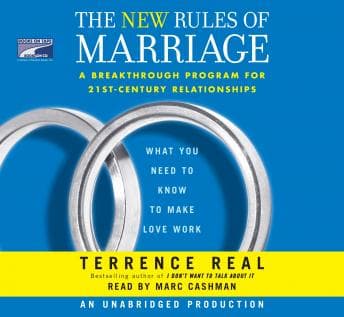

Kevin and I had one of those Sunday arguments about — honestly, I don't even remember what — and he half-jokingly said "maybe we should read a relationship book." So I downloaded this at 11 PM while he was already asleep, because apparently I handle conflict by throwing audiobooks at the problem. Classic.
The Framework Underneath All That Filler
Here's the thing: Terrence Real actually has a useful model. He lays out what he calls the "Five Losing Strategies" — being right, unbridled self-expression, controlling your partner, retaliation, and withdrawal. And when he laid those out, I felt personally attacked. I am absolutely the "being right" person in every argument. (Kevin, if you're reading this: I know. I'm sorry. Sort of.)
The "relationship grid" concept — mapping out your grandiose behaviors versus your adaptive ones — is the kind of framework my engineer brain can actually latch onto. It's basically a state diagram for dysfunctional patterns, and honestly? Seeing relationship dynamics broken down into categorizable behaviors made them feel solvable for the first time.
But here's where it falls apart: Real takes about 4 hours of actual content and stretches it across 10 and a half hours. The case studies start blurring together — couple after couple cycling through the same pattern with slightly different names and slightly different presenting complaints. By hour 7, even at 1.75x, I was thinking "didn't you literally just say this three chapters ago?"
The "Women Are Right, Men Are Broken" Thesis
The book's central pitch is: women have evolved, men haven't caught up. And... there's truth in there somewhere, but the framing gets exhausting fast. It reads like it was written for a very specific audience — heterosexual women trying to get their emotionally unavailable husbands to show up. Which, fine, that's a real demographic.
But what about same-sex couples? What about women who struggle with emotional availability? What about the fact that Kevin is genuinely better at emotional communication than I am? I handle feelings like error logs — acknowledge, categorize, close ticket, move on. The irony of reading a book that assumes women are the emotionally evolved ones while I'm the one who literally debugs distributed systems instead of processing my own feelings... not lost on me. It makes me wonder if his earlier work, I Don't Want to Talk About It, digs into that missing complexity with more nuance—it's entirely about male emotional shutdown, so maybe it fills the gaps this one leaves wide open.
The tools themselves are surprisingly gender-neutral even when the packaging isn't. The "feedback wheel" — where you describe what you observed, what story you made up about it, how you feel, and what you'd like — is solid communication protocol. It's basically structured logging for human interaction. And I mean that as a compliment. I actually used it with Kevin last week about something dumb and it... worked? Which is more than I can say for most self-help books.
Marc Cashman Reads You the Manual
Cashman is competent. He's got the Earphones Award, his voice is clear, his pacing is steady. But for a book about emotional intimacy, the delivery feels clinical. Like someone reading you well-organized documentation — technically correct, zero warmth. For a 10+ hour self-help listen, you need some energy to carry you through the repetitive stretches, and it just isn't there. He's not bad. He's just... neutral. Which for this material feels like a mismatch. That analytical detachment could actually work in a different context—his narration of Your Inner Fish channels that clinical precision into a story that's genuinely better for it.
Who Should Queue This Up
If you've never read a relationship book and you want one actionable framework: this works. Speed it up, power through the redundant case studies, and pull out the 4-5 tools that are actually useful. If you've already read Gottman's Seven Principles or you're deep into Esther Perel territory, you'll find a lot of overlap and you'll feel like you're re-running the same test suite with different variable names.
Perfect for: weekend chores, laundry folding. Skip for: the commute — Cashman's even delivery plus repetitive content is a recipe for sleeping through your stop.
The Merge Request
The ROI on this audiobook is middling. Good underlying framework, poor signal-to-noise ratio, narration that doesn't elevate the material. But that feedback wheel tool actually saved Kevin and me from a dishes argument last Tuesday, so I guess it earned its 3 stars. Borrow it from the library. Don't spend a credit.