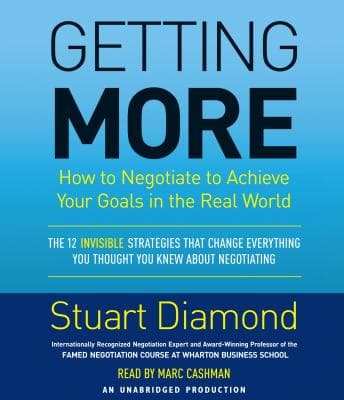

"Make them feel valued, and they'll give you what you want." Somewhere around hour three, Diamond drops this so casually it almost sounds obvious - and then spends the next fifteen hours proving that almost nobody actually does it. I was on the 6:47 AM Caltrain, wedged between a guy stress-eating a breakfast burrito and someone whose laptop brightness could double as a weapon, and I caught myself mentally replaying my last sprint planning meeting thinking: oh. Oh no. I've been doing it wrong.
Here's the thing about negotiation books: most of them are basically PvP combat manuals. BATNA this, leverage that, power moves everywhere. Getting More isn't that. Diamond's whole thesis is that the adversarial model is broken, and that emotional intelligence and understanding the other party's perceptions - not yours, theirs - produces dramatically better outcomes. He calls it "Getting More" not "Getting Everything" or "Crushing It" because the framework is about incremental value, not zero-sum domination.
The Anti-BATNA Playbook
TL;DR: Worth your commute. But - and this is a big but - you need to be ready for an 18.5-hour commitment that could've been trimmed by about 6 hours.
Diamond structures the book around twelve core strategies, and the strongest ones are genuinely different from what you'll find in Never Split the Difference or Influence. His emphasis on "being dispassionate" while simultaneously reading the other party's emotions is this weird productive contradiction that actually works in practice. The example where he coaches a student to get on a flight after the gate has closed by making the gate agent feel respected rather than pressured - that stuck with me for days. Not because it's some magic trick, but because the logic is so straightforward it's almost embarrassing that we default to arguing instead.
The cross-cultural negotiation chapters are where his Wharton research really shows up. He doesn't just say "different cultures negotiate differently" (thanks, every business book ever). He gets into specifics - how perception of time, hierarchy, and relationship-building varies across sixty countries of research data. For anyone working on globally distributed teams, this section alone justifies the listen.
Where the Signal-to-Noise Ratio Drops
And here's where I get frustrated. This is basically a 10-hour book trapped in an 18.5-hour body. Diamond loves his anecdotes. Student success stories pile up like merge conflicts in a Friday deploy - some are illuminating, many are redundant, and after a while you can predict the pattern: student faces negotiation problem → applies framework → gets 20% discount / job offer / better apartment lease. By hour 12, I was bumping my playback to 1.75x during the case studies and dropping back to 1.5x when he returned to frameworks. The pacing problem reminded me of What We Don't Talk About When We Talk About Fat, which also has a narrator with a genuinely sharp thesis that occasionally disappears under the weight of its own supporting material — though that one earns more of its runtime.
Marc Cashman's narration is clean and professional - good pacing, clear diction, the kind of voice that works for instructional content without getting in the way. He's no Ray Porter (who is?), but he handles the dense material well and keeps the energy steady across 18+ hours, which is no small feat. I never had to rewind because of unclear delivery, and for a business book this long, that's a genuine plus.
The other issue: Diamond occasionally veers into self-congratulatory territory about his course's popularity at Wharton. I get it - the class is legendary, students fight to get in, Google adopted the model. But hearing about it multiple times feels like when someone keeps mentioning their marathon time at a dinner party. You're impressed the first time. By the fifth, you're checking your phone.
Who Should Negotiate Their Way Into This (And Who Shouldn't)
Perfect for: train, roadtrip, gym. Skip for: bedtime (you'll want to take mental notes). If you're in any role that involves cross-functional work, vendor management, or honestly just interacting with other humans who have different goals than you - the core frameworks are genuinely useful. I've already used the "valuing their standards" technique in two code review discussions this week, and it worked embarrassingly well.
Skip this if you've already read Getting to Yes and Never Split the Difference and want something radically new. Diamond builds on the Harvard Negotiation Project (where he was associate director), so there's conceptual overlap. But his emotional perception angle is distinct enough to be worth your time - just maybe not all 18.5 hours of it.
The ROI on this audiobook is high if you treat it like a reference - absorb the frameworks, fast-forward through the repetitive examples, and actually practice the techniques. It's the kind of book where the value compounds the more you apply it, which is rare for the genre.
Commit, But Maybe Cherry-Pick
I finished this in about 5 commutes at 1.5-1.75x, and I'd say roughly 12 of those hours earned their place in my ears. The core negotiation model - emotional intelligence over leverage, perception over logic, incremental gains over ultimatums - is legit. It changed how I think about everyday interactions, not just high-stakes deals. But Diamond needed an editor with a machete. A good book that's fighting to get out of a longer book. Worth the credit, just be ready to use that 1.75x button.