
Last Tuesday I was debugging a particularly nasty race condition in one of our distributed caching layers - the kind where you're staring at logs at 11PM thinking about ordering semantics and wanting to scream - and I realized I'd internalized more from this audiobook than I'd consciously registered. Grove's concept of "production operations" kept surfacing in how I was thinking about our incident review. A management book from 1983 was actively helping me triage a 2024 production issue. That's when I knew this one earned its review.
The OG Handbook That Silicon Valley Forgot It Memorized
TL;DR: Worth your commute. This is basically the Linux kernel of management books - everything written after it borrowed from it, and going back to the source is genuinely clarifying.
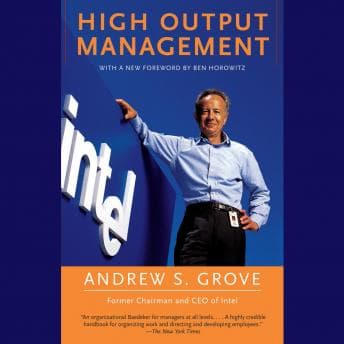
Andrew Grove ran Intel when Intel was the tech company, and High Output Management reads like it. This isn't some hand-wavy leadership philosophy book. Grove literally models a manager's output as a mathematical function of their team's output multiplied by leverage. He treats a breakfast factory (yes, a breakfast factory) as his running example for production principles, then maps those concepts onto managing knowledge workers. It's weirdly effective. The breakfast factory metaphor - soft-boiling an egg as the limiting step in a production process - is the kind of thing that sticks in your brain and changes how you think about bottlenecks in your own work.
What hit hardest for me: his section on one-on-ones. Grove argues these are the subordinate's meeting, not the manager's, and he gets granular about frequency, structure, and what signals to watch for. He talks about "task-relevant maturity" as a spectrum that determines how much you should micromanage versus delegate. No other management book I've listened to has given me something this concrete and immediately applicable. I've literally sent the relevant chapter timestamps to three different tech leads on my team.
The production principles, performance reviews, decision-making frameworks, meetings-as-a-medium-of-work - it's all here, and it's all treated with an engineer's precision. Grove doesn't waste your time with anecdotes about his childhood or motivational platitudes. He's building a system, and he shows his work.
Could This Have Been a Blog Post? Surprisingly, No.
At 8 hours, this is short for a business audiobook, which is already a point in its favor. But here's the thing - I actually wouldn't recommend speeding this one up to my usual 1.75x business-book pace. I kept it at 1.5x and even dropped to 1.25x during the chapters on performance reviews and compensation, because Grove packs concepts densely. There's no filler. No "let me tell you about Company X who did this one thing" padding. Every chapter is load-bearing.
That said, the book IS from 1983 and it shows in spots. Some of the manufacturing examples feel dated, and Grove's world is pre-internet, pre-remote-work, pre-Slack. You have to do some mental translation. The chapter on meetings, for instance, assumes everyone is physically in a room together. But the underlying logic - distinguishing between "process-oriented" and "mission-oriented" meetings - is still the clearest framework I've encountered.
The audiobook includes a downloadable PDF of selected content, which is actually useful here. Some of Grove's diagrams and matrices don't translate perfectly to audio. I found myself pulling up the PDF on the train a couple of times to see his org charts and production flow diagrams. Not a dealbreaker, but worth knowing.
Marc Cashman Gets Out of the Way (In a Good Way)
Marc Cashman narrates this in a clean, no-nonsense style that matches Grove's writing perfectly. He's not Ray Porter (nobody is), but he's doing exactly what this material needs - clear enunciation, steady pacing, professional tone. No dramatic inflections, no attempts to "perform" the text. For a book that's essentially a technical manual for management, that's the right call.
The one knock: pacing runs a little slow for audiobook consumption. This is why I'd nudge you toward at least 1.25x speed. At 1x it can feel like a lecture, and not in the good "fascinating professor" way - more in the "reading a textbook aloud" way. Bump the speed and it tightens up nicely.
Who Should Queue This Up
Perfect for: Anyone in tech who manages people or is about to. Engineers transitioning to management. Anyone tired of management books that are 80% stories and 20% substance. If you've read "The Manager's Path" by Camille Fournier, this is the book she was building on. I'd also put The Motivation Myth in that same "20% substance" bucket - worth knowing it exists, but Grove gives you more usable frameworks in a single chapter than that book manages across its entire runtime.
Skip for: If you want something entertaining or narrative-driven, this isn't it. This is a textbook you listen to because the ROI on your commute time is genuinely high. Also skip if you're looking for modern takes on remote work, DEI, or cross-functional product teams - Grove's world is hierarchical manufacturing-era Intel, and he doesn't pretend otherwise.
The Commit Message
The ROI on this audiobook is absurdly high if you manage people in tech. I finished this in about 5 commutes and immediately started applying Grove's frameworks to my own one-on-ones and team planning. It's the rare business book where I walked away with a mental model I actually use daily, not just a vague sense of inspiration. Twenty bucks and 8 hours for a permanent upgrade to how you think about organizational output? That's a trade I'd make every time. Just bump the speed to 1.25x minimum and grab the PDF for the diagrams.