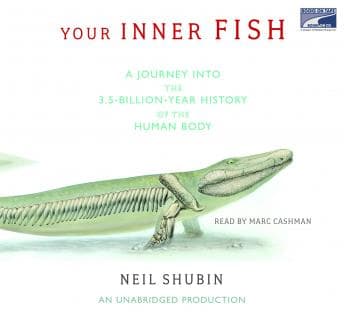

Look, I've listened to a lot of science audiobooks on my commute. Most of them are fine. Some are forgettable. And then there's Your Inner Fish, which genuinely made me miss my stop at Mountain View because I was too busy thinking about how my hands are basically fish fins.
Neil Shubin is the paleontologist who discovered Tiktaalik—that famous "fishapod" fossil that made headlines back in 2006. But here's what I didn't expect: the guy is also a genuinely entertaining writer. This isn't dry academic lecture material. It's more like having a really smart friend explain evolution to you over beers, except the friend has spent decades digging up fossils in the Arctic and has some wild stories.
Why This Book Rewired My Brain
The central premise is deceptively simple: your body is basically a 3.5-billion-year-old software project with legacy code everywhere. Shubin traces human anatomy back through deep time, showing how our organs, bones, and even our hiccups are inherited from ancient fish, worms, and single-celled organisms.
And honestly? The science holds up. I'm a software engineer, so I'm used to thinking about systems that evolved over time with weird dependencies and technical debt. But hearing Shubin explain that our inner ear bones used to be fish jaw bones, or that the nerves in our neck take a ridiculous detour because of how fish gills were wired—it's like finally understanding why there's a bizarre function call in a codebase that makes no sense until you look at the git history from 2003.
The book is organized by body part, basically. Hands, heads, bodies, genes. Each chapter builds on the last, and Shubin keeps circling back to his own fossil-hunting experiences. There's this great section where he's describing the moment they found Tiktaalik, and you can hear the excitement in Cashman's narration. It's infectious.
Marc Cashman Nails the Vibe
Here's the thing about science audiobooks: the narrator can make or break them. Marc Cashman is pretty much perfect for this material. He's got this warm, friendly delivery that matches Shubin's enthusiasm without ever feeling like he's overselling it. Genuinely feels like the author is reading it to you, which is exactly what you want for this kind of content.
Cashman picks up on Shubin's dry humor at all the right moments. There's a bit where Shubin is describing the glamorous reality of paleontology fieldwork—freezing in the Arctic, eating terrible food, finding nothing for weeks—and Cashman's delivery just lands. Not over-the-top, just... right.
One caveat: some listeners have mentioned audio quality issues. I listened on my AirPods Pro during my Caltrain commute, and I didn't notice anything major. Maybe some minor inconsistencies? But nothing that pulled me out of the experience. Your mileage may vary if you're an audio purist.
Perfect Commute Material
At just under 7 hours, this is basically a perfect week of commutes for me. The pacing is solid—Shubin doesn't drag, and the chapters are short enough that you can pause between them without losing the thread.
I finished this in about 4 commutes at 1.5x speed, which felt natural for the content. You could probably push to 1.75x if you're familiar with evolutionary biology, but I'd recommend keeping it slower. There's a lot of "wait, let me think about that" moments where you want the extra processing time.
The ROI on this audiobook is honestly excellent. It's the kind of book that changes how you see your own body. Think Like a Freak did something similar for how I approach problem-solving—same brain-rewiring effect, different domain. I caught myself looking at my wrist the other day and thinking about the homologous bone structures in fish fins. That's either a sign of a great book or an early symptom of something concerning. (Probably the former.)
Who This Is (and Isn't) For
Perfect for: train, gym, long walks. Anyone who's ever wondered why human bodies are so weirdly designed. Engineers who appreciate understanding legacy systems. People who want to sound smart at dinner parties. Skip if you want fast-paced storytelling, or you're looking for something to zone out to. This requires some attention, but it rewards it.
The Commit Message
I'm genuinely surprised this book isn't more famous in tech circles. It's basically "why is the codebase like this" but for human anatomy, and Shubin explains it with the patience of a senior engineer doing a code review. Marc Cashman delivers it like he actually cares about the material. What more do you want?







![Steve Jobs [unabridged audiobook] audiobook cover](/_next/image?url=https%3A%2F%2Fcovers.audiobooks.com%2Fimages%2Fcovers%2Ffull%2F9788499923406.jpg&w=1920&q=75)