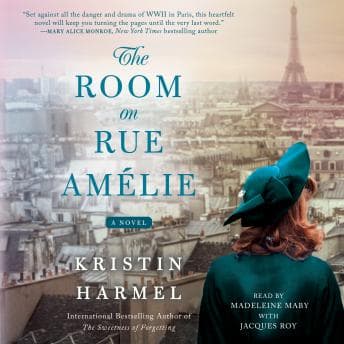

Most folks compare this one to Kristin Hannah's The Nightingale, and I get it — occupied Paris, brave women, the Resistance. But here's the thing: Room on Rue Amélie isn't trying to be that book. It's quieter, more domestic, and honestly, that's both its strength and its limitation.
I finished this one last Tuesday during a late night at the home office, going through threat assessments for a client that didn't need half the attention I was giving them. Linda had gone to bed. Ranger was sprawled at my feet. And there I was, listening to a story about an American woman hiding downed Allied airmen in her Paris apartment while I shuffled papers about corporate perimeter security. The contrast wasn't lost on me.
The Resistance Felt Personal — Until It Didn't
Ruby's arc starts strong. American girl, bad marriage, husband gets killed, discovers he was secretly in the Resistance. She decides to pick up where he left off. That premise had me locked in. The mechanics of how she hides Allied pilots — the logistics of safe houses, forged documents, the daily terror of a knock on the door — Harmel clearly did her homework on the escape networks that operated in occupied France. The detail about how pilots would be moved through a chain of apartments, never staying more than a few days, rings true to what I've read about actual Comet Line operations.
Harmel explores similar territory in Forest of Vanishing Stars: A Novel — another story about ordinary people turned protectors, though that one takes the survival-in-the-wilderness angle and the emotional stakes land even harder.But then there's the romance with Thomas, the RAF pilot. Look, I understand this is historical fiction with a love story baked in, and I knew what I was signing up for. But the pacing slows considerably once the relationship takes center stage. At ten hours, it feels like the book could've been tighter by at least ninety minutes. The middle stretch — roughly hours four through six — needed a machete taken to it. Ruby and Thomas circling each other while Paris burns around them started testing my patience.
Where Harmel absolutely nails it is Charlotte. The twelve-year-old Jewish girl whose family gets rounded up by the Gestapo. The way Ruby takes her in and they form this fragile, makeshift family — that's the emotional core that actually works. Charlotte's voice in the story carries a weight that the romance never quite matches. A kid trying to understand why her world ended overnight. That hit different for me. I've seen kids in Fallujah and Helmand trying to make sense of the same incomprehensible violence, and while the contexts are worlds apart, that particular brand of confused resilience is universal.
Maby's Voice Carries It — Mostly
Madeleine Maby handles Ruby's narration with real skill. There's a vulnerability in her read that feels earned, not performed. When Ruby discovers Marcel's Resistance work, Maby shifts her tone just enough — you hear the shock harden into resolve. That's good audio storytelling.
But — and this is where I part ways with some of the glowing reviews — the accent work is inconsistent. Maby's French accents wander. Sometimes they're subtle and convincing, sometimes they pull you out of the scene because they feel like someone doing a French accent rather than being French. Jacques Roy handles the male POV sections, which helps, but there's an odd blending problem. When Maby narrates scenes with male dialogue, the voice doesn't always shift enough to distinguish who's talking. I caught myself rewinding a few times during group conversations to figure out who said what. Not a dealbreaker, but at 1.25x speed it gets tricky.
Clean production otherwise. No weird audio artifacts, no background noise. Straightforward narration without music or sound effects, which is fine — this story doesn't need the bells and whistles.
Who Should Deploy With This One
If you're a WWII historical fiction reader who loved The Nightingale or Lilac Girls, this is absolutely in your wheelhouse. It's gentler than those books — less brutal, more focused on the emotional architecture of ordinary people doing extraordinary things under occupation.
If you're coming to this expecting a thriller with Resistance operations driving the plot, you'll be disappointed. The espionage elements are backdrop, not foreground. This is a character story wearing a war story's uniform.
Folks who are sticklers about narration consistency — especially with accents and male/female voice differentiation — might want to sample before committing a credit.
Mission Debrief
Worth your time? Here's the debrief: it's a solid WWII historical fiction audiobook that earns its emotional moments through Charlotte's story more than through its romance. Maby's narration is strong enough to carry you through the slower stretches, even if the accent work occasionally stumbles. I didn't cry — Linda would be shocked — but Charlotte's thread had me staring at my sleeping dog at midnight thinking about the randomness of who gets saved and who doesn't. That's not nothing.
Ranger slept through the whole thing, but he always sleeps through the quiet ones.