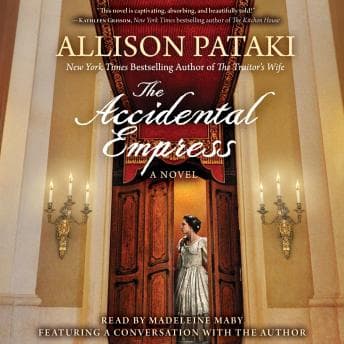

What does it actually cost a girl to become a queen? Not the crown, not the ceremony — the real cost. The version where you're fifteen, you showed up to watch your sister get engaged, and somehow you accidentally broke her heart and inherited an empire.
I started The Accidental Empress on a Sunday afternoon when I was supposed to be doing laundry. Three hours later, Frida was asleep on my lap, the laundry was still in the dryer, and I had completely forgotten that I live in a 900-square-foot apartment in Austin instead of a Habsburg palace. That's the kind of book this is.
She Didn't Ask for the Throne, She Just Asked to Be Loved
Here's what got me: Sisi isn't ambitious. That's the thing Pataki nails that most royal stories fumble. She's not scheming for power, she's not playing chess with duchesses — she's a teenager who fell in love with the wrong man at the wrong moment and then had to spend the rest of her life paying for it. The Archduchess Sophie, Franz Joseph's mother, is basically a velvet-gloved villain who makes every scene she's in feel like a cold draft through an open window. The tension between Sophie and Sisi — this older woman systematically dismantling a young wife's confidence and autonomy — had me grinding my teeth through my headphones.
The court politics are dense but Pataki paces them carefully enough that I never felt lost. There are a lot of names, a lot of titles, a lot of shifting alliances. But the story always comes back to Sisi's interior life, which is where the real action is. Her longing for Franz Joseph's attention while he drowns in state affairs. Her grief when she realizes that being loved by an emperor doesn't mean being seen by your husband. My heart. MY HEART.
Abuela would have loved this one. She lived for stories about women who were beautiful and trapped and too smart for the rooms they were put in. She would've had opinions about Sophie that I can't repeat on a family-friendly review site.
Madeleine Maby and the Sound of an Empire
Okay, can we talk about this narrator for a second? Because Madeleine Maby does something genuinely specific here that I want to name: she handles the Austrian-German and Hungarian phrases with an ease that doesn't call attention to itself. They just... land. They feel embedded in the world rather than performed at the listener. That's harder than it sounds — I've sat through audiobooks where foreign phrases feel like the narrator is suddenly doing a bit, and it pulls you right out.
Her Sisi is soft and searching, with this quality of someone always listening for something that hasn't been said yet. And her male voices — Franz Joseph especially — have enough authority without going cartoonishly stiff. The emotional beats in the quieter scenes, the ones where Sisi is alone and trying to hold herself together, are where Maby really earns it. No melodrama. Just presence.
At 18 hours, this is a commitment. But at 1.0x (obviously, always, I am not an animal), Maby's careful pacing makes the length feel like a gift rather than a sentence. You're not rushing through an empire. You're living in it.
18 Hours Is a Long Time to Be Sad, But Here We Are
I didn't ugly-cry at this one — it's more of a sustained ache than a sudden sob. The kind of sadness that settles in your chest around hour six and just... stays. Because you can see exactly where Sisi's choices are leading her and you can't stop her and she wouldn't thank you for trying.
If you want plot twists and dramatic reversals, this might not scratch that itch. The tension here is quieter — it's about watching a luminous person slowly understand the dimensions of her cage. That's not everyone's thing. But if you're the kind of listener who cares more about what a character is feeling than what they're doing, this is 18 hours of your people.
The vibes are immaculate. This is a gray afternoon book. A second cup of tea book. A 'I'm going to cancel my plans and stay inside with this' book.
Pick it up if you've ever felt like you were performing a version of yourself that someone else wrote for you. Sisi will understand. Though if you want something that swings in the opposite direction — a story where the emotional stakes are just as high but the setting couldn't be more different — my review of Love Letter might be worth a look, even if it left me a little cold.